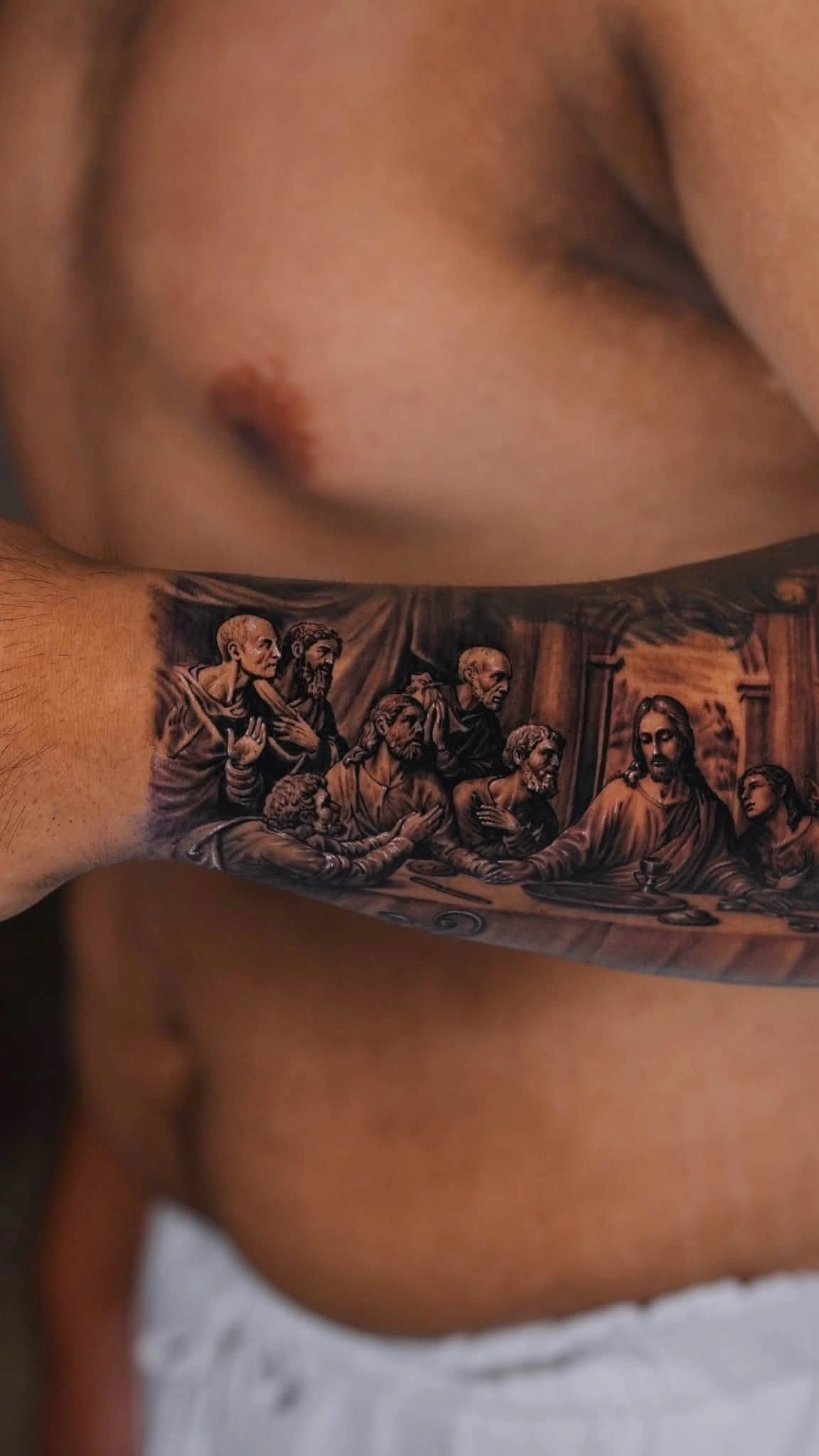
Black & Grey Realism Tattoo: The Complete Guide (2026) - Chapter 11 — What to Expect During a Black & Grey Realism Tattoo Session



Black & Grey Realism Tattoo: The Complete Guide (2026)
Chapter 11 — What to Expect During a Black & Grey Realism Tattoo Session
From Preparation to the Final Tattoo
Getting a Black & Grey Realism tattoo is very different from simply walking into a studio, choosing a design, and getting tattooed.
Realism is a process.
The artist needs time to prepare the artwork, position the design correctly, build the composition on the body, establish the major shadows, develop the details, and make sure the tattoo will continue to look balanced after healing.
For a large realism tattoo, the experience can involve several hours in the chair and, depending on the size and complexity of the project, multiple sessions.
If you have already chosen your artist and finalized your design, the next question is simple:
What actually happens when tattoo day arrives?
Quick Answer
A Black & Grey Realism tattoo session usually begins with final design and placement checks before the tattooing starts.
The artist then transfers the design to the skin and gradually builds the tattoo from larger shapes and darker values toward smaller details and highlights.
Depending on the size and complexity of the tattoo, a session can last several hours, while large sleeves, back pieces, and highly detailed compositions may require multiple appointments.
The most important thing to understand is that realism should not be rushed.
A good session is not about finishing as quickly as possible.
It is about giving the artist enough time to control composition, contrast, shading, texture and detail.
1. Before the Tattoo Session
The tattoo session actually begins before you arrive at the studio.
Once your design has been discussed and finalized, your artist will usually have a clear understanding of:
-
the subject of the tattoo;
-
the final size;
-
the placement;
-
the overall composition;
-
the main light source;
-
the contrast structure;
-
important details;
-
and how the tattoo should interact with your body.
This preparation is especially important for Black & Grey Realism because the tattoo cannot simply be treated as a flat picture.
A realism composition needs to work with the shape of your body.
A portrait on an arm, for example, needs to follow the natural direction of the forearm rather than simply being placed like a rectangular photograph.
The same principle applies to sleeves, shoulders, thighs, calves and larger body areas.
2. What Should You Do the Day Before?
You do not need a complicated preparation routine.
The goal is simply to arrive at the studio in a good physical condition.
Get enough sleep
Long tattoo sessions can be physically and mentally tiring.
Getting a good night's sleep can make it easier to remain comfortable and focused during a long appointment.
Eat properly
Do not arrive on an empty stomach.
Have a proper meal before your appointment and consider bringing a small snack for longer sessions.
Stay hydrated
Good hydration is generally helpful for your overall comfort during a long tattoo appointment.
However, you do not need to excessively drink water immediately before the session.
Avoid alcohol
Avoid drinking alcohol before your tattoo appointment.
Apart from affecting how you feel during the session, alcohol can increase bleeding and make the experience more difficult for both you and the artist.
Wear appropriate clothing
Choose clothing that gives the artist easy access to the tattoo area.
For example:
-
loose shorts for thigh tattoos;
-
comfortable sleeveless clothing for shoulder or upper-arm tattoos;
-
loose trousers that can be adjusted for leg tattoos.
Your priority should be comfort and accessibility, not fashion.
3. What Happens When You Arrive?
When you arrive at the studio, the artist may first review the design with you.
This is the final opportunity to confirm important details such as:
-
placement;
-
size;
-
orientation;
-
composition;
-
and any last-minute adjustments.
For a large Black & Grey Realism project, this stage can be especially important.
Sometimes the design looks perfect on a screen but needs a small adjustment once it is positioned on the actual body.
A professional artist should be willing to evaluate the design in relation to your anatomy rather than blindly following a digital mockup.
4. The Stencil and Placement Stage
Once everything is confirmed, the artist prepares the skin and applies the stencil or placement guide.
This is one of the stages where you should take your time.
Stand naturally.
Look at the tattoo from different angles.
Move your arm or leg if the tattoo is being placed on a moving area.
Ask yourself:
Does the composition follow my body naturally?
For larger tattoos, the placement can influence how the entire project looks.
A portrait that is slightly too high, too low or incorrectly oriented can change the visual balance of an entire sleeve.
That is why placement should never be treated as a minor technical step.
5. The Tattoo Does Not Start With Every Detail
One of the biggest misconceptions about realism tattooing is that the artist immediately begins tattooing tiny details.
Usually, that is not how a strong realism piece is built.
The artist needs to establish the major visual structure first.
This can include:
Major dark areas
The artist establishes the deepest shadows and important black values.
Mid-tones
Grey shading begins to connect the dark and light areas.
Light areas
Negative space and lighter skin areas help create the illusion of light.
Major forms
The artist establishes the structure of faces, muscles, animals, objects or architectural elements.
Only after the main structure is working does the artist spend more time refining smaller details.
This is similar to painting.
You build the overall image before obsessing over the smallest details.
6. How Long Does a Black & Grey Realism Tattoo Take?
There is no universal answer.
The duration depends on several factors:
-
tattoo size;
-
placement;
-
subject;
-
level of realism;
-
amount of detail;
-
skin condition;
-
composition;
-
artist's working method;
-
and the client's ability to remain still.
A small realism tattoo may be completed in one appointment.
A larger project can take several hours per session and may require multiple sessions.
For example, a detailed portrait is very different from a full Black & Grey Realism sleeve containing multiple subjects, textures and background elements.
This is why asking:
“How many hours will my tattoo take?”
is less useful than asking:
“How many sessions do you recommend for this project, and why?”
A professional estimate should be based on the actual design rather than a generic number.
7. Why Large Realism Tattoos Often Need Multiple Sessions
Multiple sessions are not necessarily a sign that the artist is working slowly.
They can actually be part of a better tattooing strategy.
Large realism projects contain a huge amount of visual information.
Trying to complete everything in one extremely long sitting can make the experience exhausting for both the client and artist.
Breaking a large project into sessions allows the artist to:
-
build the composition gradually;
-
work carefully on important areas;
-
allow tattooed skin to heal;
-
evaluate how the previous section settles;
-
and maintain a consistent quality throughout the project.
For a large sleeve or back piece, the tattoo may be treated as a complete visual composition rather than a collection of unrelated images.
8. Does Black & Grey Realism Hurt More?
Not necessarily.
Pain depends heavily on:
-
body placement;
-
session length;
-
individual pain tolerance;
-
skin sensitivity;
-
and how long the artist works on one area.
Some areas of the body are generally more sensitive than others.
Long realism sessions can also become uncomfortable simply because the same area is being worked on for an extended period.
The best approach is not to compare your pain tolerance with someone else's.
Instead, communicate with your artist.
If you need a short break, say so.
A short break is usually much better than forcing yourself to continue while becoming increasingly uncomfortable or unable to remain still.
9. Why Staying Still Matters So Much in Realism
This is particularly important for highly detailed work.
Black & Grey Realism depends on controlled shading and precise transitions.
If the client moves unexpectedly while the artist is working on a delicate area, it can make precise execution more difficult.
You do not need to become completely rigid.
Natural breathing and small movements are normal.
The important thing is to communicate before changing your position.
If you need to stretch, use the bathroom, adjust your body or take a break, simply let the artist know.
Good communication makes the session easier for everyone.
10. What Should You Bring to a Long Tattoo Session?
For a longer appointment, a few simple things can make the experience much more comfortable.
Consider bringing:
-
water;
-
a small snack;
-
headphones;
-
entertainment such as a phone or tablet;
-
comfortable clothing;
-
and anything else your artist specifically recommends.
However, avoid bringing too many distractions.
Remember that your artist needs concentration too.
A calm environment can help both the client and artist maintain focus during detailed work.
11. What If the Artist Changes Something During the Session?
This can happen, especially with custom realism.
Once the design is placed on the body, the artist may notice something that needs adjustment.
For example:
-
a face may need to be slightly repositioned;
-
an element may need more space;
-
a background may need to follow the body's curve;
-
or contrast may need to be adjusted for better readability.
This is not necessarily a problem.
In fact, it can be a sign that the artist is thinking about the tattoo as a piece of artwork on skin rather than simply reproducing an image.
The important thing is communication.
If you are unsure about a change, ask.
A good artist should be able to explain why the adjustment improves the final tattoo.
12. What Happens When the Session Ends?
When the tattooing is finished for the day, your artist will clean the area and provide aftercare instructions.
The tattoo may look very dark and highly contrasted immediately after the session.
That is normal.
A fresh tattoo is not the final appearance.
As the skin heals, the surface changes and the tattoo gradually settles into its more permanent appearance.
This is particularly important with Black & Grey Realism because subtle grey tones and highlights can look different after healing.
As discussed in Chapter 8, the real test of a realism tattoo is not how impressive it looks immediately after leaving the studio.
It is how well the design continues to read after the skin has healed and over the years.
13. Do Not Judge the Tattoo Too Quickly
One of the most common mistakes after getting a realism tattoo is looking at it immediately and thinking:
“It looks too dark.”
Or:
“The grey looks different from the reference.”
Fresh tattoos can appear significantly different from healed tattoos.
The skin may be:
-
red;
-
swollen;
-
shiny;
-
irritated;
-
or covered by a healing layer.
The visual contrast can therefore appear stronger than the final healed result.
Give the skin time.
Your artist should tell you how to care for the tattoo during the healing process and when it makes sense to evaluate the finished result.
14. What If the Tattoo Requires Another Session?
For a large realism project, your artist may stop before the entire design is finished.
This is normal.
The next appointment may focus on:
-
completing unfinished sections;
-
adding background;
-
increasing contrast;
-
refining textures;
-
strengthening important focal points;
-
or connecting separate elements into one composition.
At this stage, the artist is not simply “adding more detail.”
They are continuing to build the visual hierarchy of the tattoo.
The goal is to make the finished piece read as one coherent artwork.
15. The Artist's Job and the Client's Job
A successful realism tattoo is a collaboration.
The artist is responsible for:
-
technical execution;
-
composition;
-
shading;
-
contrast;
-
proportions;
-
tattooing technique;
-
and adapting the design to the body.
The client is responsible for:
-
communicating the idea clearly;
-
providing useful references;
-
being honest about expectations;
-
arriving prepared;
-
staying reasonably still;
-
following aftercare instructions;
-
and giving the skin enough time to heal.
When both sides understand their role, the process becomes much smoother.
16. What Makes a Good Realism Session?
A successful tattoo session is not necessarily the one where the most work gets completed.
It is the one where the artist can maintain control over the quality of the tattoo.
For Black & Grey Realism, that means paying attention to:
Composition → Contrast → Light → Form → Texture → Detail
in that order.
Details are important.
But detail without structure does not create realism.
A tattoo can contain thousands of tiny details and still look flat if the contrast, lighting and composition are wrong.
The strongest realism tattoos are usually built from the larger visual decisions down to the smallest details.
Frequently Asked Questions
How long does a Black & Grey Realism tattoo session take?
It depends on the size, placement, complexity and artist's working method. Smaller tattoos may take one appointment, while large realism projects often require several hours per session and multiple appointments.
Can a Black & Grey Realism tattoo be completed in one day?
Small and medium projects sometimes can be completed in one session. Large sleeves, back pieces and highly detailed compositions are more likely to require multiple sessions.
Should I eat before a realism tattoo?
Yes. Arriving well-fed can make a long tattoo appointment more comfortable. A small snack can also be useful during an extended session.
Is Black & Grey Realism more painful than other tattoo styles?
Not necessarily. Pain depends more on the placement, session length and individual tolerance than on realism itself.
Can I use my phone during the tattoo?
Usually, yes, but it depends on the placement and your artist. Avoid movements that could interfere with the tattooing process.
Why does my fresh realism tattoo look darker than expected?
Fresh tattoos can appear darker and more contrasted because the skin has just been tattooed. The appearance generally changes as the skin heals and the tattoo settles.
How many sessions will my realism sleeve need?
There is no fixed number. A sleeve's session count depends on its size, complexity, number of subjects, amount of background and the artist's approach.
When should I judge the final result?
Wait until the tattoo has properly healed before evaluating the final appearance. Your artist can advise you on when the tattoo should be considered fully settled.
Final Thoughts
A Black & Grey Realism tattoo session is not simply several hours of sitting in a tattoo chair.
It is the final stage of a much longer creative process.
The research, artist selection and design planning from the previous chapters all lead to this moment.
Once the needle touches the skin, the artist begins translating a carefully developed visual concept into something permanent.
That process takes time.
It requires patience from the client, technical control from the artist, and communication from both sides.
If you understand what happens during the session, you can approach your tattoo appointment with more realistic expectations — and enjoy the process instead of worrying about every small change along the way.
At Silver Ant Tattoo in Hanoi, our approach to realism begins with the idea and continues through consultation, custom design, tattooing and long-term consideration of how the artwork will live on the body.
A great realism tattoo is not rushed.
It is built.