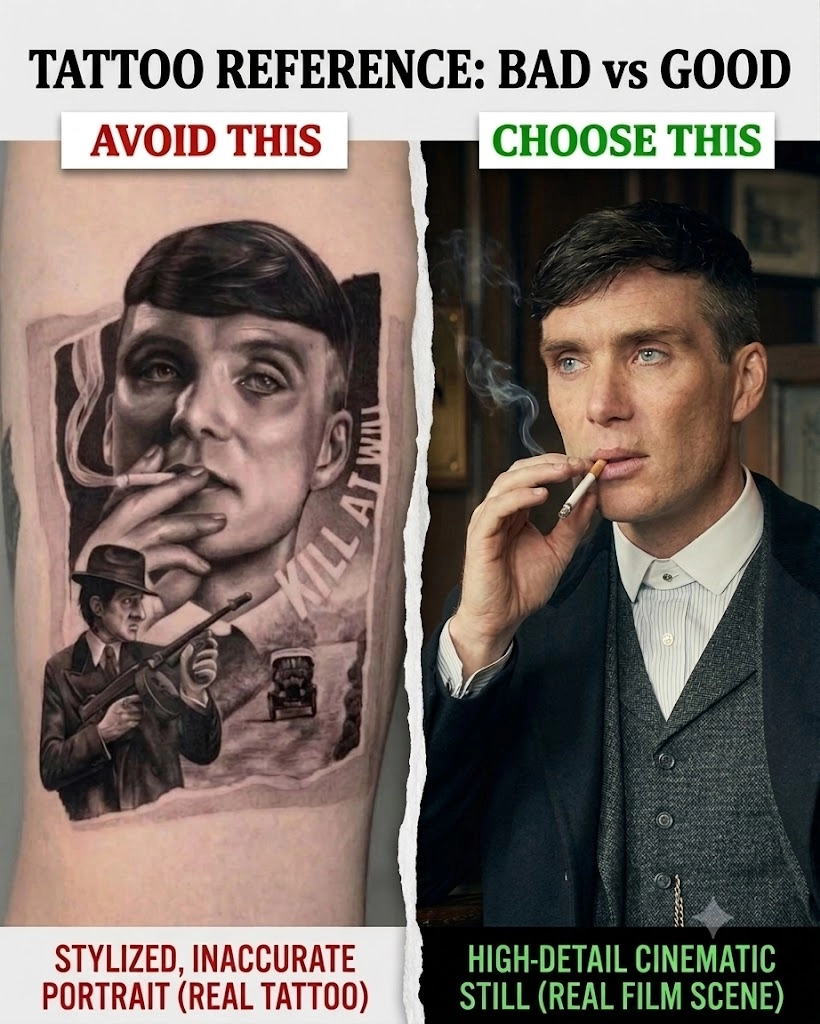
Black & Grey Realism Tattoo: The Complete Guide (2026) - Chapter 16 — How to Choose the Right Reference Photo for a Black & Grey Realism Tattoo



Black & Grey Realism Tattoo: The Complete Guide (2026)
Chapter 16 — How to Choose the Right Reference Photo for a Black & Grey Realism Tattoo
How the Right Reference Image Can Make a Realism Tattoo Better
A great Black & Grey Realism tattoo often starts with a good reference image.
That does not mean you need to find a photograph that can simply be copied onto your skin.
In fact, the best tattoo reference is often just the starting point.
A professional realism artist may change the composition, lighting, proportions, background, orientation or even combine several references to create a design that works specifically for your body.
But the quality of the original reference still matters.
A clear photograph gives the artist more useful information.
A poorly lit, heavily filtered or extremely low-resolution image can make realistic tattooing much more difficult.
So if you are planning a Black & Grey Realism tattoo, how do you choose the right reference?
Quick Answer
A good realism tattoo reference photo should have:
-
clear details;
-
good lighting;
-
visible facial or subject features;
-
enough resolution;
-
a useful angle;
-
natural proportions;
-
and enough information for the artist to understand the subject.
Avoid relying on:
-
extremely blurry images;
-
screenshots from compressed social media posts;
-
heavy beauty filters;
-
images with important areas hidden in deep shadow;
-
or photographs where the subject is too small.
Most importantly, you do not need to find the perfect tattoo design yourself.
Your artist's job is to transform your idea and references into a tattoo that works on your body.
1. Start With the Subject, Not the Tattoo
One of the easiest mistakes is searching for another tattoo that looks exactly like what you want.
For example, if you want a realistic portrait of a person, you might search:
"realistic portrait tattoo"
and send the artist another tattoo as your main reference.
That can be useful for showing the style you like.
But it is not necessarily the best reference for the actual subject.
Instead, separate your references into two categories:
Subject reference
The person, animal, object, landscape or image you actually want tattooed.
Style reference
Examples showing how you like the tattoo to look.
This distinction gives the artist much more useful information.
2. For Portrait Tattoos, Choose a Clear Face
Portrait realism is particularly sensitive to the quality of the reference.
A good portrait reference should ideally show:
-
the eyes clearly;
-
the nose structure;
-
the mouth;
-
facial proportions;
-
hair;
-
important shadows;
-
and the overall shape of the face.
The more information the artist can see, the more accurately they can interpret the subject.
A photograph where the face is heavily obscured by hair, sunglasses or dramatic shadows may still be usable, but it gives the artist fewer visual clues.
3. High Resolution Is Better
Resolution matters because realism depends on small visual information.
When you zoom into a high-quality photograph, you may be able to see:
-
skin texture;
-
individual strands of hair;
-
wrinkles;
-
eyelashes;
-
fabric texture;
-
small shadows;
-
and subtle changes in light.
A low-resolution image may turn all of those details into pixels.
The artist cannot reproduce information that is not actually visible.
This does not mean you need a professional camera photograph.
A good phone photograph can be an excellent tattoo reference if it is clear and properly exposed.
4. Avoid Excessive Filters
Social media filters can make photographs look attractive on a screen.
But they can make tattoo references less useful.
Heavy filters may:
-
smooth skin;
-
remove natural shadows;
-
change facial proportions;
-
increase contrast;
-
alter colours;
-
or remove important texture.
For realism, the artist generally benefits from seeing the subject as naturally as possible.
If you have both an original photograph and an edited version, send both.
The edited image can show the mood you like.
The original can provide more accurate information.
5. Lighting Is Extremely Important
Lighting tells the artist where the shadows and highlights actually are.
For a Black & Grey Realism tattoo, this is critical.
Imagine a portrait photographed with strong light coming from one side.
The artist can see:
-
which side of the face is brighter;
-
where the cheek falls into shadow;
-
how the nose creates a shadow;
-
how the jaw separates from the neck;
-
and how the light shapes the face.
If the entire face is evenly lit, some of that information may be missing.
If the face is almost completely dark, important details may also disappear.
The best reference is not necessarily the brightest photograph.
It is the photograph that provides useful information.
6. Don't Automatically Choose the Most Dramatic Photo
A dramatic photograph can look amazing.
But a tattoo artist has to work with skin, not photographic pixels.
Extremely dramatic lighting can sometimes create large areas where important details disappear into black.
That may work beautifully as a photograph.
It does not always translate directly into a tattoo.
A professional artist may therefore adjust the lighting or reconstruct parts of the image.
This is one reason you should not expect a reference photo to be copied exactly.
7. Choose the Right Angle
The angle of the subject affects the entire tattoo composition.
A portrait can be:
-
front-facing;
-
three-quarter view;
-
profile;
-
looking up;
-
looking down;
-
or turned away.
Different angles require different approaches.
A three-quarter portrait, for example, can create more depth than a completely frontal image.
A profile may work especially well with a vertical composition.
There is no universally correct angle.
The important thing is whether the angle suits the body placement and the tattoo size.
8. Think About the Tattoo Placement Before Choosing the Reference
Your reference and placement should work together.
For example:
Forearm
A vertical portrait or elongated subject may work naturally.
Upper arm
A portrait can be designed around the muscle's shape.
Thigh
A larger composition can include more background and supporting elements.
Chest
A wider composition may work better.
Back
A large scene can be developed with several subjects and layers.
The same photograph may need to be cropped differently depending on where you want the tattoo.
9. Don't Crop the Reference Too Early
If you are sending a photograph to your artist, it can be useful to provide the original image as well as your preferred crop.
The original gives the artist more information about:
-
body position;
-
surrounding objects;
-
lighting;
-
proportions;
-
and the original composition.
Your preferred crop tells them what part you are most interested in.
This gives the artist more options during the design process.
10. Multiple Reference Photos Can Be Better Than One
You do not always need one photograph to contain everything.
For a more complex tattoo, you might provide:
Reference 1: main subject
Reference 2: preferred lighting
Reference 3: background or architecture
Reference 4: texture or secondary element
The artist can then build a new composition from these references.
This is particularly useful for larger realism projects.
For example, a Vietnam-inspired Black & Grey Realism tattoo might combine:
-
a portrait;
-
a Vietnamese landscape;
-
an architectural element;
-
clouds;
-
and a specific atmosphere.
Trying to find one photograph containing all of these elements may be unnecessary.
11. Tell the Artist What You Like About Each Reference
Do not simply send ten photographs without explanation.
Tell the artist why you chose them.
For example:
"I like the face from this photo, but I prefer the lighting from the second image."
Or:
"I want the expression from the first reference and the composition of the second."
This makes the consultation much more efficient.
It also prevents the artist from guessing which parts of each image matter to you.
12. Reference Photos vs. Tattoo Inspiration
These are different things.
Reference photo
Shows the actual subject you want.
Tattoo inspiration
Shows a tattoo style, composition or technique you like.
Mood reference
Shows the atmosphere you want.
Placement reference
Shows where you want the tattoo to sit.
You can send all four.
Just make it clear which is which.
This is especially useful when working with an artist who has their own approach to composition.
13. Don't Expect the Artist to Copy Another Tattoo Exactly
Sending another artist's tattoo as inspiration is completely normal.
But asking for an exact copy is a different matter.
A professional tattoo artist should be able to create an original interpretation based on your idea.
Instead of saying:
"I want exactly this tattoo."
Try:
"I like the composition, contrast and realism in this example."
Then explain what you actually want to tattoo.
This gives the artist room to create a design specifically for you.
14. Avoid Images That Are Too Small
Sometimes clients send a photograph where the actual subject occupies only a small part of the frame.
For example, you may have a beautiful travel photograph where a person is standing in the distance.
It may look great as a photograph.
But if you want a detailed portrait tattoo, the artist may not have enough information to reproduce the face.
If the subject is important, try to find a closer photograph.
15. What If You Only Have an Old or Low-Quality Photo?
Don't immediately give up.
Old photographs can sometimes still be useful.
Your artist may be able to work with:
-
several photographs;
-
family photographs;
-
different angles;
-
or additional images of the same person.
For portrait tattoos, even photographs from different moments can provide useful information about facial structure.
Tell the artist why the photograph is important to you.
The emotional significance of an image can be more important than its technical perfection.
16. What If the Reference Has Someone Else in the Photo?
This is common.
You may have a photograph where the subject you want is standing next to another person.
Do not worry.
The artist can usually use the relevant part of the image as a reference and develop the composition around it.
You can also provide additional photographs of the same person if available.
17. For Animal Tattoos, Show the Details That Matter
Animal realism requires more than simply recognising the species.
The artist may need to understand:
-
fur direction;
-
eyes;
-
nose;
-
ears;
-
facial structure;
-
body proportions;
-
and the way light interacts with the fur.
If you want a portrait of your pet, try to provide several photographs.
One may show the face clearly.
Another may show the body.
Another may capture the expression you love.
Together, they can be much more useful than relying on one imperfect photograph.
18. For Landscape Tattoos, Think About Depth
Landscape realism is not just about copying a photograph.
The artist needs to translate:
foreground → middle ground → background
into the tattoo.
When choosing a landscape reference, look for photographs with a clear sense of depth.
Mountains, buildings, trees, clouds and other elements can then be arranged into a composition that remains readable on skin.
This is especially important when the tattoo is relatively small.
Not every element from a landscape photograph needs to appear in the final tattoo.
19. For Architecture, Perspective Matters
Buildings can look simple in a photograph.
They are not necessarily simple to tattoo.
Realistic architecture depends on:
-
perspective;
-
straight lines;
-
proportions;
-
windows;
-
shadows;
-
and depth.
If you want a temple, pagoda, European building or Vietnamese street scene, a high-quality reference with clear perspective is extremely helpful.
The artist may still modify the architecture to fit the body.
20. Don't Overload the Artist With 30 Similar Photos
More references do not automatically mean better references.
If you send 30 photographs that all show slightly different versions of the same idea, the artist may have difficulty understanding which one you actually want.
A smaller collection of carefully selected references is usually more useful.
As a starting point:
1–3 strong main references + a few supporting references
is often enough to begin a conversation.
21. Tell Your Artist What Must Stay
Sometimes the most important information is not visual.
Tell the artist what cannot be changed.
For example:
-
"The facial expression is important."
-
"I want the eyes to look exactly like this."
-
"The temple must remain recognisable."
-
"The dog should have this specific ear shape."
-
"I want the landscape to feel like northern Vietnam."
This helps the artist understand what defines the image for you.
22. Also Tell Your Artist What Can Change
This is equally important.
You might say:
-
"The background can be changed."
-
"You can adjust the lighting."
-
"You can simplify the clouds."
-
"The composition can be adapted to my arm."
-
"I'm open to changing the size."
Giving the artist some freedom can often lead to a better tattoo.
A photograph is two-dimensional.
Your tattoo is not.
23. Your Reference Does Not Need to Look Like a Tattoo
This is an important point.
The best reference for your tattoo may simply be a beautiful photograph.
You do not need to search exclusively for images labelled:
"tattoo reference."
In fact, searching only for existing tattoos can sometimes make your options narrower.
Look for:
-
photographs;
-
paintings;
-
architecture;
-
sculptures;
-
nature;
-
historical images;
-
fashion photography;
-
travel photography;
-
and your own personal photographs.
The artist's job is to translate the visual idea into tattoo form.
24. AI-Generated Images as Tattoo References
AI-generated images can sometimes be useful for communicating an idea.
For example, they may help you visualise:
-
a composition;
-
an atmosphere;
-
a background;
-
or a combination of elements.
But they should not automatically be treated as accurate anatomical references.
AI-generated faces, hands, animals, architecture and small details can contain inaccuracies.
If you use an AI-generated image, tell your artist.
It can be used as a concept reference, while real photographs can provide accurate information for the important details.
25. What Makes a Bad Tattoo Reference?
There is no single type of "bad" reference.
But some images are harder to work with.
Extremely low resolution
Important details disappear.
Heavy filters
Natural structure is changed.
Extreme shadows
Large areas become unreadable.
Tiny subject
The artist cannot see enough detail.
Multiple conflicting references
The artist cannot determine what you actually want.
Another person's finished tattoo
It may not fit your body or your idea.
AI-generated anatomy
Important details may be visually inaccurate.
26. A Simple Reference Checklist
Before sending your references, ask:
Is the subject clear?
Can the artist easily see what you want tattooed?
Is the image sharp enough?
Can you see the important details?
Is the lighting useful?
Are the shadows and highlights understandable?
Is the angle appropriate?
Does it suit the composition you have in mind?
Do I know what I like about this image?
Can you explain why you chose it?
Does it fit my intended placement?
Can the subject realistically work in that body area?
If the answer to most of these questions is yes, you already have a strong starting point.
27. How to Send a Reference to Your Tattoo Artist
When contacting a studio, a short and organised message is usually much more useful than a long paragraph.
For example:
Style: Black & Grey Realism
Placement: Left forearm
Size: Approximately 15–18 cm
Main reference: Photo 1
Secondary reference: Photo 2 for lighting
Important detail: Keep the facial expression and eyes from Photo 1
Flexible: Background and composition can be adapted
Preferred date: September 2026
This gives the artist a clear starting point.
28. Let the Artist Turn the Reference Into a Tattoo
The final design should not necessarily look identical to the original photograph.
The artist may need to:
-
crop the image;
-
change the lighting;
-
simplify details;
-
enlarge the subject;
-
remove unnecessary elements;
-
add negative space;
-
change the background;
-
rotate the composition;
-
or adapt everything to the body's anatomy.
These changes are not a failure to follow the reference.
They are part of turning a photograph into a tattoo.
29. The Best Reference Is One That Gives the Artist Options
A good reference does not tell the artist:
"Copy every pixel exactly."
It gives them enough information to understand:
"This is what I want the tattoo to feel like."
That distinction matters.
The strongest realism tattoos are often the result of collaboration between the client's idea and the artist's technical experience.
You provide the story.
The artist builds the visual solution.
Reference Photo Guide at a Glance
| Reference Type | Useful For | What to Look For |
|---|---|---|
| Portrait | Faces and people | Clear eyes, face, expression and lighting |
| Animal | Pet and wildlife realism | Eyes, fur, anatomy and expression |
| Landscape | Nature and scenery | Depth, foreground and background |
| Architecture | Buildings and streets | Perspective, structure and shadows |
| Object | Watches, cars, objects | Sharp details and realistic lighting |
| Tattoo example | Style inspiration | Composition, shading and overall aesthetic |
| AI image | Concept development | Mood and composition, not anatomical accuracy |
Frequently Asked Questions
What is the best reference photo for a realism tattoo?
A clear, high-resolution photograph with useful lighting and visible details is usually the strongest starting point. The ideal reference depends on the subject and tattoo placement.
Can I use a photograph from Instagram?
Yes, if the image is clear enough and you have permission to use it where necessary. For tattoo design, try to obtain the highest-quality original available rather than relying on a compressed screenshot.
Can I send multiple reference photos?
Yes. Multiple references can be useful, especially for complex compositions. Tell your artist what you like about each image.
Should I send another tattoo as a reference?
You can use another tattoo to communicate style or composition, but it is better to give the artist your own subject references and explain which aspects of the tattoo example you like.
Do I need to find the exact image I want tattooed?
No. Your artist can help develop the composition. A reference is a starting point, not necessarily the final tattoo design.
Can I use an AI-generated image as a tattoo reference?
Yes, as a concept reference. However, real photographs may be more useful for accurate anatomy, facial features, animals and other detailed subjects.
What if my reference photo is old or low quality?
Send it anyway if it is personally important. Your artist may be able to combine it with other photographs or use additional references to reconstruct important details.
How many reference photos should I send?
There is no fixed number. A few strong references are generally more useful than a large collection of similar or conflicting images.
Can my tattoo artist change the reference?
Yes. Adapting the composition, lighting, size and background is often necessary to make a photograph work properly as a tattoo.
Final Thoughts
Choosing a reference photo is not about finding a picture that is already perfect for tattooing.
It is about giving your artist enough information to understand what you want.
Find a clear image.
Show the important details.
Explain what you like.
Explain what can change.
And let the artist adapt the idea to your body.
A photograph is flat.
Your body is curved, moving and three-dimensional.
The job of a professional Black & Grey Realism artist is to bridge that gap.
The better the communication at the beginning, the more possibilities the artist has to create a tattoo that feels personal rather than simply copied from a photograph.
At Silver Ant Tattoo in Hanoi, you can send your references, preferred placement and approximate size before booking. Our artists can then assess the images and determine how they can be developed into a Black & Grey Realism tattoo that works specifically for your body.
Don't look for the perfect tattoo reference.
Look for the right starting point.