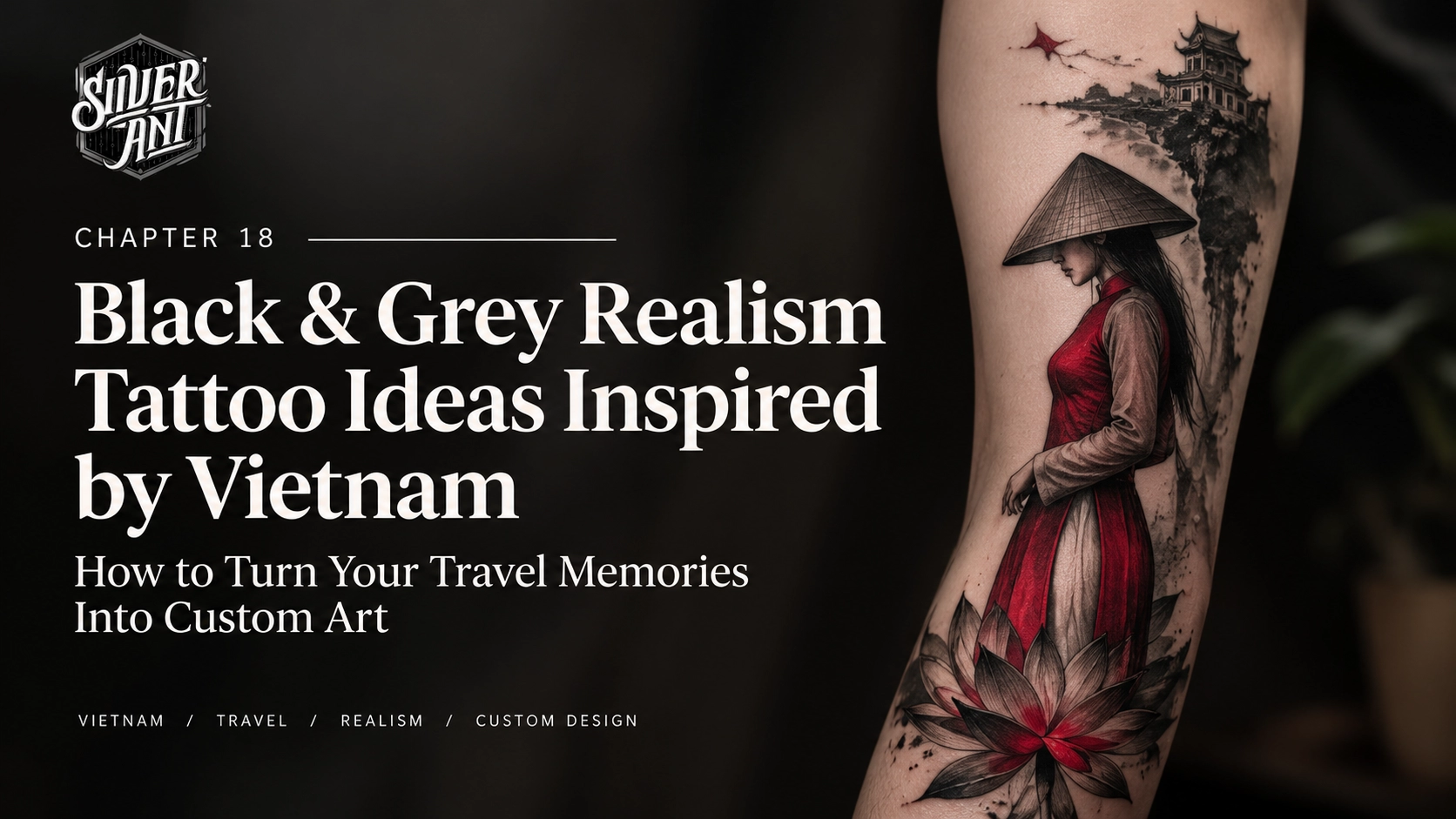
Black & Grey Realism Tattoo: The Complete Guide (2026) - Chapter 18 — Black & Grey Realism Tattoo Ideas Inspired by Vietnam: How to Turn Your Travel Memories Into Custom Art



Black & Grey Realism Tattoo: The Complete Guide (2026)
Chapter 18 — Black & Grey Realism Tattoo Ideas Inspired by Vietnam: How to Turn Your Travel Memories Into Custom Art
Vietnam is full of images that can become great tattoo subjects.
But a good Vietnam-inspired tattoo does not have to look like a souvenir.
You do not need to put a Vietnamese flag, the word "Vietnam" or a collection of traditional symbols into one composition just to make the tattoo recognizable.
With Black & Grey Realism, the more interesting approach is often to take one place, one object, one person or one memory and turn it into a carefully composed piece of artwork.
For travellers, this can be a way to keep a connection with Vietnam long after the trip is over.
For people who already have a connection with the country, it can become something even more personal.
This chapter looks at how to turn Vietnamese landscapes, architecture, people and cultural imagery into a custom Black & Grey Realism tattoo.
Quick Answer
The best Vietnam-inspired Black & Grey Realism tattoos usually begin with a personal reference rather than a generic symbol.
Some ideas include:
-
Hanoi's Old Quarter;
-
Vietnamese temples and pagodas;
-
Ha Long Bay;
-
northern mountain landscapes;
-
rice terraces;
-
traditional boats;
-
Vietnamese portraits;
-
áo dài;
-
conical hats;
-
lotus flowers;
-
cranes;
-
traditional architecture;
-
street scenes;
-
local markets;
-
or a personal travel photograph.
The important part is not simply choosing a Vietnamese subject.
It is deciding how that subject should become a tattoo.
A photograph might work as the starting point, but the final composition should be adapted to the body, the tattoo's size and the way Black & Grey shading works on skin.
1. Why Vietnam Is a Strong Source of Tattoo Inspiration
Vietnam has a very distinctive visual language.
There are contrasts everywhere:
Old architecture beside modern buildings.
Dense city streets beside open landscapes.
Traditional clothing beside contemporary fashion.
Mountain landscapes beside coastal scenery.
Ancient temples beside busy urban life.
For a realism tattoo, these contrasts provide plenty of visual material.
A tattoo can focus on one subject or combine several elements into a single composition.
For example:
A Hanoi street + traditional architecture + a portrait
or:
A mountain landscape + rice terraces + clouds
or:
A lotus + temple architecture + ornamental details
The possibilities are much broader than simply choosing a "Vietnam symbol."
2. Start With the Memory, Not the Symbol
Before choosing the tattoo subject, ask yourself:
What do I actually want to remember?
Perhaps it was your first morning walking through Hanoi.
Maybe it was a particular mountain you visited.
Maybe it was the person you travelled with.
Maybe it was a photograph you took during a motorbike trip.
Maybe you simply loved the atmosphere of an old Vietnamese street.
That memory should be the starting point.
The tattoo does not have to explain itself to everyone who sees it.
It only needs to mean something to you.
3. Hanoi Old Quarter as a Black & Grey Realism Tattoo
Hanoi's Old Quarter can provide excellent material for realism.
Rather than tattooing an entire street literally, an artist can isolate the elements that make the location recognizable.
For example:
-
narrow buildings;
-
old balconies;
-
shopfronts;
-
hanging signs;
-
street trees;
-
scooters;
-
overhead cables;
-
traditional architecture;
-
people walking through the street.
A large tattoo can use perspective to create depth.
The foreground can contain a strong architectural element while smaller details disappear into the background.
This is especially useful for Black & Grey because contrast can create depth without relying on colour.
4. Vietnamese Architecture
Temples, pagodas and traditional buildings can work particularly well in Black & Grey.
Architecture gives the artist something different from a portrait or animal.
Instead of relying mainly on anatomy, the tattoo depends on:
-
perspective;
-
geometry;
-
texture;
-
light;
-
shadow;
-
and atmospheric depth.
A pagoda can become the central subject.
Trees and clouds can frame it.
A darker foreground can create contrast.
The background can gradually disappear into lighter grey tones.
This creates a composition that feels more like a photograph or cinematic scene than a collection of separate symbols.
5. Vietnamese Landscapes
Vietnam's landscapes are particularly suitable for Black & Grey Realism.
Possible subjects include:
Northern mountains
Layered mountain ranges can create natural depth.
Rice terraces
The repeated curves and layers of rice fields can become a strong graphic element.
Ha Long Bay
Rock formations, water and mist provide natural tonal contrast.
Coastal landscapes
Cliffs, boats and waves can create a more dramatic composition.
Rural Vietnam
Paths, houses, trees and agricultural landscapes can create a quieter tattoo.
The choice should depend on the memory behind the tattoo.
6. Ha Long Bay
Ha Long Bay is one of the most recognizable landscapes in Vietnam.
But simply tattooing several limestone islands may produce a generic result.
A more personal approach is to start with your own photograph.
Perhaps you remember:
-
the view from the boat;
-
early morning fog;
-
sunset;
-
a particular island;
-
reflections on the water;
-
or the feeling of being surrounded by the landscape.
The artist can then simplify the photograph into a composition designed for skin.
This can make the tattoo more personal than a generic internet image of Ha Long Bay.
7. Mountain Tattoos Inspired by Northern Vietnam
Northern Vietnam offers another strong direction.
Mountain landscapes can work particularly well on:
-
forearms;
-
upper arms;
-
calves;
-
thighs;
-
ribs;
-
and backs.
A narrow vertical landscape can follow the shape of an arm or leg.
A wider landscape can work across the shoulder or upper back.
The artist can use atmospheric perspective to make distant mountains lighter and closer elements darker.
This is one of the situations where Black & Grey naturally complements the subject.
8. Rice Terraces
Rice terraces are visually interesting because of their repeated curves.
Instead of treating the terraces as a flat landscape, the artist can build the composition through layers.
For example:
Foreground: grass, plants or a person
Middle ground: terraces and paths
Background: mountains and clouds
This creates depth while keeping the tattoo readable.
A small version may need to simplify many of these elements.
A larger tattoo can preserve more detail.
That is why scale matters so much in realism.
9. Vietnamese Portrait Tattoos
A portrait can be one of the most meaningful ways to create a Vietnam-inspired tattoo.
The person could be:
-
someone you met;
-
a family member;
-
a historical figure;
-
someone wearing traditional Vietnamese clothing;
-
or simply a person from a photograph that represents your experience.
Portrait realism requires particularly careful attention to:
-
facial proportions;
-
eyes;
-
nose;
-
mouth;
-
skin texture;
-
hair;
-
lighting;
-
and expression.
Even small changes can affect whether the portrait feels like the intended person.
For this reason, reference quality becomes extremely important.
10. Áo Dài as a Realism Subject
The áo dài offers strong visual lines for a tattoo.
The long silhouette can work particularly well in vertical compositions.
The artist can focus on:
-
the shape of the clothing;
-
fabric folds;
-
hair;
-
movement;
-
traditional patterns;
-
and the surrounding environment.
Rather than making the áo dài itself the entire concept, it can become part of a larger scene.
For example:
Portrait + áo dài + Vietnamese architecture
or:
Woman in áo dài + lotus + traditional temple
The result can feel more like a complete artwork.
11. The Vietnamese Conical Hat
The nón lá is one of the most recognizable Vietnamese visual elements.
But because it is so recognizable, it is easy to make the tattoo feel overly literal.
One solution is to use it as a secondary element.
For example, a realistic portrait can include a conical hat without making the hat the central subject.
Another possibility is to photograph someone actually wearing one during your trip.
That gives the tattoo a personal reference rather than a generic image.
12. Lotus Flowers
The lotus is another strong subject for Black & Grey.
Its structure gives the artist plenty of opportunities to work with:
-
petals;
-
overlapping forms;
-
shadows;
-
highlights;
-
water;
-
leaves;
-
and reflections.
A lotus can also be incorporated into a larger composition.
For example:
Lotus + portrait
Lotus + temple
Lotus + Vietnamese landscape
Lotus + traditional ornamental elements
The flower does not have to stand alone.
13. Vietnamese Crane Imagery
Cranes can work beautifully in a Black & Grey composition because of their long necks, wings and elegant proportions.
They can be used as:
-
a central subject;
-
a secondary subject;
-
part of a landscape;
-
or a transitional element connecting different parts of a larger tattoo.
A crane flying through clouds, for example, can create movement and help connect a vertical composition.
14. Traditional Boats
Vietnamese boats can be particularly effective in landscape tattoos.
A small boat on water can give a sense of scale to a larger scene.
Imagine:
Mountain → water → boat → foreground
The boat becomes relatively small, but it gives the landscape a human presence.
This is an example of why realism tattoos are not always about making every element large.
Sometimes a small detail can make the entire composition work.
15. Vietnamese Street Scenes
A street scene can be one of the most personal travel tattoos.
Instead of focusing on one object, the artist can capture the atmosphere of a place.
For example:
-
an old street;
-
a café;
-
bicycles;
-
scooters;
-
street vendors;
-
balconies;
-
signs;
-
trees;
-
and people.
However, a street scene contains a lot of information.
Trying to reproduce every detail at a small tattoo size can create visual noise.
This is where the artist's ability to simplify becomes important.
16. Don't Put Every Vietnamese Symbol Into One Tattoo
This is one of the easiest mistakes to make.
You might think:
"I want the tattoo to look Vietnamese, so let's add a lotus, crane, conical hat, temple, dragon and rice terrace."
Individually, these elements may all be beautiful.
Together, they can become visually confusing.
A strong composition usually has a hierarchy.
One element should lead.
Other elements should support it.
For example:
Main subject: Vietnamese woman
Secondary: lotus
Background: temple architecture
This is much easier to read than giving every element equal importance.
17. Black & Grey Is Especially Good for Atmospheric Vietnam Scenes
Colour is not necessary to make a Vietnam-inspired tattoo feel rich.
Black & Grey can create atmosphere through:
-
contrast;
-
soft shadows;
-
fog;
-
negative space;
-
texture;
-
and tonal transitions.
This can be particularly effective for Vietnamese landscapes.
A mountain can fade into grey.
Clouds can disappear into skin.
Water can be represented through subtle reflections.
A temple can emerge from a darker background.
The tattoo can feel atmospheric without becoming visually heavy.
18. Use Negative Space as Part of the Design
Negative space is not simply "empty skin."
It can become part of the composition.
For example:
A bird can fly through open skin.
Mist can separate mountains.
The sky can surround a temple.
Light can appear between architectural elements.
This is especially useful in Black & Grey because the contrast between tattooed areas and untouched skin can help preserve clarity.
A tattoo does not need to cover every available centimetre.
Sometimes the untouched skin is what makes the tattoo readable.
19. Turning a Travel Photograph Into a Tattoo
Your photograph is a starting point.
It is not necessarily the final design.
The artist may need to:
-
crop the image;
-
change the perspective;
-
remove distracting elements;
-
improve contrast;
-
combine several photographs;
-
simplify the background;
-
enlarge important details;
-
or rearrange the composition.
This is normal.
A photograph is designed to be viewed as a photograph.
A tattoo needs to work on a three-dimensional body and remain readable as the skin ages.
Those are different requirements.
20. One Photograph Is Not Always Enough
Suppose you have a photograph of a person standing in Hanoi.
The composition is beautiful, but the face is partly in shadow.
You may have another photograph showing the face more clearly.
And another photograph showing the clothing.
There is no reason the artist has to use only one image.
A custom realism tattoo can be built from multiple references.
For example:
Photo 1: pose
Photo 2: face
Photo 3: clothing
Photo 4: background
The artist can then create one coherent composition.
21. Choosing the Right Body Placement
Vietnam-inspired realism can work on many parts of the body.
But the shape of the placement should influence the composition.
Forearm
Good for vertical subjects and narrower landscapes.
Upper arm
Works well for portraits and compact compositions.
Thigh
Provides a larger canvas for detailed scenes.
Calf
Works well with vertical landscapes.
Chest
Can support broader compositions.
Back
Offers one of the largest surfaces for a complete scene.
Sleeve
Allows multiple subjects to connect through a larger composition.
The tattoo should be designed for the body rather than simply placed onto it afterward.
22. Large Tattoos Give Realism More Room to Breathe
A larger tattoo generally gives the artist more physical space to separate important details.
For example, a large back piece can include:
-
a realistic figure;
-
horse or animal anatomy;
-
clothing details;
-
architecture;
-
plants;
-
clouds;
-
and environmental elements.
A much smaller tattoo cannot preserve the same amount of information.
This is not because small tattoos are bad.
It simply means the design needs to be simplified accordingly.
23. Micro Realism vs. Large Realism
This is an important distinction.
A micro realism tattoo often concentrates on making a small subject look highly detailed within limited space.
A larger realism composition can use its size differently.
Instead of filling every area with tiny details, it can focus on:
-
composition;
-
perspective;
-
anatomy;
-
depth;
-
lighting;
-
and relationships between multiple subjects.
For Vietnam-inspired artwork, both approaches can work.
A small lotus or conical hat may suit micro realism.
A Hanoi street, mountain landscape or complete cultural scene may benefit from a larger composition.
24. Think About How the Tattoo Will Heal
Fresh realism tattoos can look extremely sharp immediately after the session.
But fresh skin is not the final stage.
As the tattoo heals, the skin settles and the appearance changes.
This is why good realism design should not depend entirely on extremely tiny details.
The artist needs to think about:
What will remain readable?
What will remain separated?
Where should contrast be strongest?
Which details actually matter?
This is particularly important when creating a highly detailed Vietnam landscape.
The goal is not to put as much information as possible into the skin.
The goal is to put the right information into the skin.
25. The Most Important Details Should Be the Strongest
Imagine a portrait of a Vietnamese woman wearing an áo dài.
The important details might be:
-
eyes;
-
facial structure;
-
hair;
-
clothing silhouette.
Tiny background details may be less important.
The artist can therefore use stronger contrast around the face and softer tones in the background.
This creates visual hierarchy.
When the tattoo heals, the eye still knows where to look first.
26. Vietnam-Inspired Does Not Mean Traditional-Only
You can also create a contemporary Vietnam-inspired tattoo.
For example:
Hanoi architecture + modern typography
Traditional building + urban street
Vietnamese landscape + futuristic elements
Traditional figure + European realism
Asian subject + contemporary composition
The tattoo does not have to follow a traditional Vietnamese tattoo style.
It can interpret Vietnamese imagery through the visual language you personally prefer.
27. Combining Asian Subjects With European Realism
This is particularly interesting for Black & Grey Realism.
A Vietnamese or Asian subject can be represented using realistic European-style shading and composition.
The subject remains culturally recognizable.
The visual treatment becomes contemporary.
For example:
-
Vietnamese temple architecture rendered with realistic depth;
-
traditional clothing rendered with detailed fabric texture;
-
a Vietnamese landscape treated like a cinematic photograph;
-
a traditional figure combined with realistic environmental elements.
The result can feel both familiar and unexpected.
28. A Vietnam-Inspired Tattoo Can Tell a Story
The strongest large realism tattoos often have more than one visual layer.
Imagine a back piece:
Upper section: mountain landscape
Center: rider or figure
Lower section: village or water
Supporting elements: bamboo, clouds and traditional architecture
The eye can move through the tattoo.
Instead of seeing several unrelated objects, you see one scene.
That is the difference between collecting symbols and building a composition.
29. Example Concept: "Morning in Hanoi"
A traveller wants a tattoo representing their first morning in Hanoi.
Instead of simply tattooing "Hanoi," the concept could include:
Main subject: an old Hanoi building
Foreground: street details
Background: soft morning atmosphere
Secondary: a person walking through the scene
Lighting: low contrast morning light
The final tattoo becomes a visual memory.
Someone else may not immediately know where the scene comes from.
That is completely fine.
The meaning belongs to the person wearing it.
30. Example Concept: "Northern Vietnam"
Another traveller wants to remember a trip through northern Vietnam.
A possible composition:
Foreground: a person wearing a traditional conical hat
Middle ground: rice terraces
Background: layered mountains
Atmosphere: mist and clouds
The composition could be designed vertically for the calf or forearm.
The person provides scale.
The terraces provide texture.
The mountains create depth.
The negative space becomes mist.
Every element has a purpose.
31. Example Concept: "Vietnam Through Architecture"
For someone more interested in architecture, the tattoo could focus entirely on buildings.
For example:
Main subject: a Vietnamese temple
Secondary: trees and clouds
Background: simplified architectural forms
Lighting: strong side light
This can create a very sophisticated Black & Grey piece without using any obvious tourist imagery.
32. Example Concept: "A Person I Met in Vietnam"
Not every travel tattoo needs to represent a location.
Maybe the most important part of your trip was a person.
A portrait can be combined with subtle environmental elements from Vietnam.
For example:
Portrait
Vietnamese architecture
lotus
soft landscape
The portrait remains the emotional center.
The surrounding details establish the connection to Vietnam.
33. Example Concept: "Vietnam in One Frame"
A frame composition can be another interesting approach.
Rather than spreading the imagery across the skin, the artist can create a visual frame containing:
-
a Vietnamese landscape;
-
architecture;
-
a traditional figure;
-
or a travel scene.
This creates a clear boundary around the artwork.
It can work particularly well for clients who want the tattoo to feel like a permanent photograph or artwork.
34. Why Composition Matters More Than Adding More Detail
It is easy to think that realism means:
"More details = better tattoo."
Not necessarily.
A tattoo with thousands of tiny details can still be weak if the composition does not work.
A successful realism tattoo needs:
Hierarchy
Contrast
Proportion
Depth
Movement
Readable silhouettes
Appropriate detail
The details should support the composition.
They should not compete with it.
35. How to Prepare Your Own Vietnam-Inspired Tattoo Idea
Before contacting the artist, create a small reference folder.
You can include:
1. Main subject
The image that represents what you want.
2. Secondary references
Additional details you like.
3. Style references
Examples of Black & Grey Realism tattoos you like.
4. Placement photo
A photograph of the area where you want the tattoo.
5. Personal explanation
One or two sentences explaining why the subject matters.
That last part can be surprisingly useful.
An artist needs to understand not only what you want but sometimes why you want it.
36. What Not to Do
Avoid sending twenty unrelated images and saying:
"I want something like these."
This gives the artist too little direction.
Instead, identify what you like about each reference.
For example:
I like the lighting from image 1.
I like the composition from image 2.
I want the face from my own photograph.
I like the background atmosphere from image 3.
This makes the design process much clearer.
37. Let the Artist Solve the Tattoo Problem
You know your memory.
The artist knows tattooing.
Those are different areas of expertise.
You might know that you want:
"A mountain from my trip, a person walking through the rice terraces and some mist."
The artist can decide how those elements should actually be arranged on your body.
That collaboration is often what turns a good idea into a strong tattoo.
38. Vietnam-Inspired Tattoos Can Be Subtle
A tattoo does not have to immediately announce:
"I went to Vietnam."
It can simply contain details that are meaningful to you.
Someone might see:
-
a mountain;
-
a temple;
-
a woman;
-
a lotus;
-
a boat.
You see a specific place and a specific memory.
That subtlety can make the tattoo more timeless.
39. A Good Travel Tattoo Should Still Work Without the Story
This is a useful test.
Imagine removing the explanation.
Would the tattoo still look good?
If yes, the design probably has a strong visual foundation.
The story should add meaning.
It should not be the only thing making the tattoo interesting.
A beautiful landscape should still be a beautiful landscape.
A strong portrait should still be a strong portrait.
The Vietnam connection makes it personal.
40. Final Thoughts
Vietnam provides almost unlimited material for a Black & Grey Realism tattoo.
But the strongest concepts usually don't begin with:
"What Vietnamese symbol should I tattoo?"
They begin with:
"What do I want to remember?"
Maybe it is a place.
Maybe it is a person.
Maybe it is a landscape.
Maybe it is one morning in Hanoi.
Maybe it is a photograph that you took without realizing, at the time, that it would become important to you.
From there, the artist can turn that memory into a composition.
A good tattoo does not need to reproduce the photograph exactly.
It needs to preserve what made the photograph meaningful.
And perhaps that is the best reason to choose Black & Grey Realism for a Vietnam-inspired tattoo.
It allows a memory to become something more than an image.
It becomes part of your body.
Frequently Asked Questions
What are the best Vietnam-inspired Black & Grey Realism tattoo ideas?
Popular concepts include Vietnamese landscapes, Hanoi architecture, temples, pagodas, rice terraces, Ha Long Bay, portraits, áo dài, lotus flowers, cranes, traditional boats and personal travel photographs.
Can I use a photo I took during my trip to Vietnam?
Yes. Personal photographs can be excellent references. The artist can use them as the basis for a custom composition and make adjustments for tattoo placement, scale and readability.
Should a Vietnam tattoo include traditional Vietnamese symbols?
Not necessarily. A street, building, landscape or personal portrait can represent Vietnam without using obvious cultural symbols.
Can Vietnamese imagery be tattooed in European Black & Grey Realism?
Absolutely. Traditional or contemporary Vietnamese subjects can be interpreted using realistic shading, anatomy, perspective and composition.
Is Black & Grey good for landscape tattoos?
Yes. Black & Grey can use tonal transitions, contrast, atmospheric perspective and negative space to create depth in landscapes.
Can I combine several Vietnamese elements into one tattoo?
Yes, but they should have a clear hierarchy. One main subject supported by secondary elements usually creates a stronger composition than giving every symbol equal importance.
Is a larger tattoo better for Vietnam-inspired realism?
Not necessarily, but larger tattoos provide more room for complex compositions and fine details. Smaller tattoos generally require more simplification.
How do I make sure the tattoo still looks good after healing?
The artist should consider contrast, spacing, line weight, tonal separation and the amount of detail appropriate for the tattoo's size. The goal is not simply maximum detail when fresh, but a composition designed to remain readable after healing.
Can I get a Vietnam-inspired tattoo even if I don't live in Vietnam?
Of course. Travel memories, personal experiences and connections to a place can all be valid reasons for a tattoo.
Next Chapter
Chapter 19 — How Black & Grey Realism Tattoos Age: What Happens to Detail, Contrast and Shading Over the Years
This next chapter would be a strong continuation because it moves from choosing the Vietnam-inspired concept into one of the most important questions clients have before getting a realism tattoo: what will the tattoo actually look like years later?