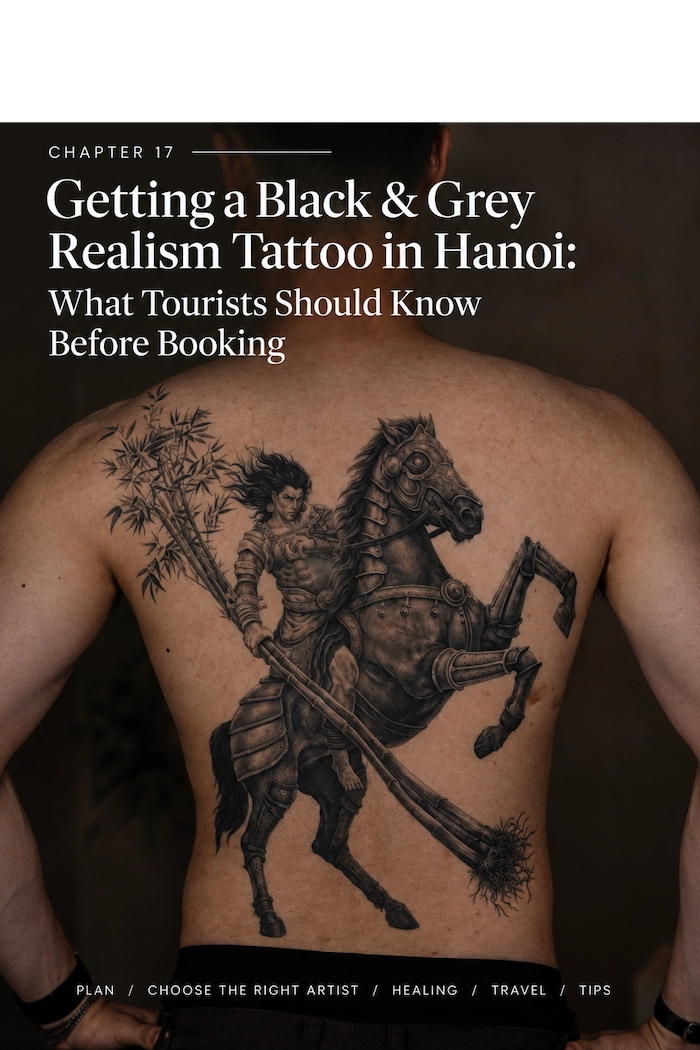
Black & Grey Realism Tattoo: The Complete Guide (2026) - Chapter 17 — Getting a Black & Grey Realism Tattoo in Hanoi: What Tourists Should Know Before Booking



Black & Grey Realism Tattoo: The Complete Guide (2026)
Chapter 17 — Getting a Black & Grey Realism Tattoo in Hanoi: What Tourists Should Know Before Booking
Planning a Realism Tattoo During Your Trip to Vietnam
Hanoi is a city where many travellers come for a few days and leave with much more than photographs.
For some visitors, that means food, coffee, architecture and memories.
For others, it means getting a tattoo that reminds them of Vietnam long after the trip is over.
Black & Grey Realism can be particularly interesting for this kind of tattoo because the style allows you to combine realistic subjects with Vietnamese landscapes, architecture, people, animals, cultural elements or personal memories.
But getting a detailed realism tattoo while travelling is slightly different from getting one at home.
You have to think about timing, healing, travel plans, communication, design preparation and the amount of time you actually have in Hanoi.
If you are planning to get a Black & Grey Realism tattoo during a trip to Vietnam, this chapter explains what you should consider before booking.
Quick Answer
If you are travelling to Hanoi and want a Black & Grey Realism tattoo, plan the tattoo before your trip rather than waiting until the last day.
The most important things to consider are:
-
your available time in Hanoi;
-
the size and complexity of the tattoo;
-
whether you need one or several sessions;
-
your reference images;
-
the artist's specialization;
-
the tattoo's placement;
-
healing during the rest of your trip;
-
your travel schedule after the appointment;
-
and how much time you can realistically spend at the studio.
For smaller projects, booking during a short Hanoi trip may be straightforward.
For large realism pieces, sleeves, back pieces or highly detailed portraits, you should allow significantly more time.
The earlier you discuss the project with the artist, the easier it is to determine whether your idea fits your travel schedule.
1. Why Get a Tattoo in Hanoi?
Hanoi is increasingly part of the travel plans of people who are interested in tattoo culture, visual art and custom tattooing.
The city has its own visual identity.
You can find inspiration everywhere:
-
Vietnamese architecture;
-
temples and pagodas;
-
old streets;
-
traditional objects;
-
landscapes;
-
local wildlife;
-
historical imagery;
-
Vietnamese people and portraits;
-
mountains;
-
rice fields;
-
traditional clothing;
-
and everyday scenes from Hanoi.
A tattoo inspired by your trip does not have to be an obvious souvenir tattoo.
Instead of simply tattooing a Vietnamese flag or a tourist symbol, you can work with an artist to create something more personal.
For example, a landscape can become part of a larger realism composition.
A temple can become a background element.
A portrait can be combined with Vietnamese architecture.
A personal travel photograph can become the main subject.
This is where custom tattoo design becomes more interesting than simply choosing something from a flash sheet.
2. Should You Book Before Arriving in Hanoi?
For a detailed Black & Grey Realism tattoo, booking in advance is usually the most practical approach.
This is especially important if:
-
you have a specific artist in mind;
-
you are visiting Hanoi for only a few days;
-
you want a large tattoo;
-
you need a long session;
-
you want a particular appointment date;
-
or you need the artist to prepare a custom design.
A walk-in can work for some smaller tattoos.
But a detailed realism project is different.
The artist may need to review your references, discuss the concept, consider the placement and estimate the working time before the appointment.
If you are travelling internationally, doing this before you arrive also reduces unnecessary uncertainty.
3. How Early Should You Contact the Studio?
There is no universal number of days that every tattoo project requires.
It depends on the artist, design and schedule.
However, contacting the studio before your trip gives everyone more time to communicate.
A useful first message can include:
Your tattoo idea
Briefly explain what you want.
Your references
Send the main photographs or visual references.
Placement
For example:
-
left forearm;
-
upper arm;
-
thigh;
-
chest;
-
back;
-
calf.
Approximate size
Give dimensions if possible.
For example:
15 × 20 cm
or:
approximately half sleeve.
Your travel dates
Tell the studio when you will be in Hanoi.
Preferred appointment date
If you already know your schedule, include your preferred day.
This information gives the studio a much clearer picture of the project.
4. Don't Book Your Tattoo at the Last Hour of Your Trip
This is one of the most important things for tourists to understand.
A fresh tattoo needs time to begin healing.
That does not mean you cannot travel after getting tattooed.
It means you should think about what you will be doing after the appointment.
For example, imagine you get a large realism tattoo on the final morning of your Vietnam trip and then immediately begin:
-
a long flight;
-
airport transfers;
-
sightseeing;
-
swimming;
-
beach activities;
-
heavy exercise;
-
or several days of outdoor travel.
That may make the early healing period less convenient.
If possible, leave some time between the tattoo appointment and major travel activities.
Your tattoo artist can also explain the studio's specific aftercare instructions.
5. How Many Days Should You Stay in Hanoi After a Tattoo?
There is no single required number of days.
It depends on:
-
tattoo size;
-
placement;
-
session length;
-
your travel plans;
-
and your normal healing process.
A small tattoo and a six-hour Black & Grey Realism piece are very different situations.
If you are travelling specifically to get tattooed, it can be useful to place the appointment somewhere in the middle or later part of your Hanoi stay rather than immediately before a major activity.
The important thing is not simply the number of days.
It is what you plan to do during those days.
6. Can You Go Sightseeing After Getting a Tattoo?
You can usually continue normal daily activities, but your freshly tattooed skin needs appropriate care.
This is where travelling can become slightly inconvenient.
Hanoi can involve:
-
walking for several hours;
-
hot weather;
-
sweating;
-
crowded streets;
-
motorbike travel;
-
outdoor activities;
-
and significant sun exposure.
A fresh tattoo and several hours under strong sunlight are not an ideal combination.
If you know you will spend the entire day walking around Hanoi after your appointment, tell your artist.
They can give you aftercare guidance based on the tattoo and the products used by the studio.
7. What About Swimming in Vietnam?
If swimming is a major part of your travel plans, consider the timing carefully.
After getting a fresh tattoo, artists generally advise avoiding activities that can expose the healing tattoo to prolonged soaking or potentially contaminated water.
That includes situations such as:
-
swimming pools;
-
beaches;
-
hot tubs;
-
and similar activities.
If you are planning to visit Ha Long Bay, spend time at the beach or book a hotel with a swimming pool, it may be better to schedule those activities before the tattoo rather than immediately afterward.
Your artist should provide specific aftercare instructions for your tattoo.
8. What About Sun Exposure?
Sun exposure is another important consideration for tourists.
Vietnam can be very sunny, and travellers often spend much more time outdoors than they normally would.
A fresh tattoo should be protected according to your artist's aftercare instructions.
After the tattoo has fully healed, protecting it from excessive UV exposure also helps preserve the appearance of the tattoo over time.
This matters particularly for Black & Grey Realism because the quality of tonal transitions and fine details contributes significantly to the final appearance.
9. Can You Get a Large Black & Grey Realism Tattoo in One Session?
Sometimes.
But not always.
A large realism tattoo can involve many hours of work.
Whether it can be completed in one session depends on:
-
size;
-
complexity;
-
placement;
-
skin condition;
-
subject;
-
amount of detail;
-
artist working style;
-
and how long you can comfortably sit.
A full sleeve, large back piece or highly detailed portrait may require multiple sessions.
If you are visiting Hanoi for only three days, this is important information to establish before booking.
Do not assume that a large tattoo can automatically be completed in one appointment.
10. What If You Only Have 2–3 Days in Hanoi?
You can still contact a tattoo studio.
The key is to communicate your schedule clearly.
Tell the artist:
"I'm in Hanoi from Friday to Sunday and would like a Black & Grey Realism tattoo."
Then provide:
-
your reference;
-
approximate size;
-
placement;
-
preferred date;
-
and how flexible you are.
The artist can then assess whether your project is realistic for that timeframe.
For a small or medium project, this may be relatively straightforward.
For a large project, the studio may recommend a different session structure.
11. What If You Want a Vietnam-Inspired Tattoo?
This is one of the most interesting possibilities for tourists.
Instead of simply copying a Vietnamese symbol, think about what part of Vietnam actually means something to you.
For example:
Landscape
A mountain range, rice terrace, coastline or countryside scene.
Architecture
A temple, pagoda, old Hanoi building or another place you visited.
Portrait
Someone you met, a historical figure or a personal photograph.
Traditional imagery
Lotus, crane, Vietnamese conical hat or other cultural elements.
Travel memory
A street, building, landscape or personal moment from your trip.
These elements can be interpreted through Black & Grey Realism rather than being treated as isolated symbols.
12. You Don't Have to Get a "Vietnam Tattoo"
A common mistake is thinking that a travel tattoo has to look obviously connected to the destination.
It doesn't.
Your tattoo could simply be inspired by something you experienced in Vietnam.
For example:
A traveller might photograph a particular street in Hanoi.
The final tattoo might focus on the architecture, light and atmosphere rather than including a literal Vietnam symbol.
Another person might photograph a mountain during a trip.
The tattoo could become a realistic landscape composition.
The connection can be personal rather than obvious.
13. Can You Use Your Own Travel Photos?
Absolutely.
Your own photographs can be excellent tattoo references.
They have one major advantage:
They represent your actual experience.
Perhaps you have a photograph of:
-
your partner in Hanoi;
-
your first Vietnamese meal;
-
a mountain you visited;
-
a street you loved;
-
a temple;
-
a local building;
-
or a moment that only happened during your trip.
The photograph does not need to be technically perfect.
As discussed in Chapter 16, the artist can use several references to reconstruct or improve the final composition.
14. What If My Travel Photo Isn't Good Enough?
Send it anyway.
Do not automatically reject a meaningful photograph because it has:
-
poor lighting;
-
another person in the frame;
-
an unusual crop;
-
low resolution;
-
or an imperfect background.
Your artist may be able to combine it with other photographs.
For example:
Your personal photo → emotional reference
A second photo → facial details
A third photo → lighting
A fourth photo → background
The final tattoo can then be developed from all of them.
The goal is not to reproduce one photograph pixel by pixel.
15. How to Choose a Black & Grey Realism Artist in Hanoi
Choosing an artist should go beyond looking at the studio's overall Instagram feed.
Look at the artist who will actually tattoo you.
Pay attention to:
Portrait quality
If you want a portrait, look for consistent portrait work.
Tonal transitions
Black & Grey Realism depends heavily on controlled transitions between dark, mid-tone and light areas.
Detail
Look at how the artist handles small details.
Composition
A good realism tattoo should work as a tattoo, not simply resemble a photograph.
Healed work
Fresh tattoos can look very different from healed tattoos.
Relevant experience
If you want animals, portraits, architecture or landscapes, look for examples of that specific subject.
The most useful portfolio is one that shows what the artist repeatedly produces.
16. Should You Choose the Studio or the Artist First?
For a highly detailed realism tattoo, the artist matters enormously.
A studio may have many artists with completely different strengths.
One artist might specialise in:
-
portraits;
-
another in animals;
-
another in black & grey;
-
another in colour realism;
-
another in fine line.
So don't simply ask:
"Is this a good tattoo studio?"
Ask:
"Which artist is the right fit for this particular tattoo?"
This is also why sending your reference before booking can be useful.
17. Communication Matters When You Are Travelling
Many international clients worry about explaining a complicated tattoo idea in English.
You do not need to write a long essay.
A clear message is usually better.
For example:
Hi, I'm visiting Hanoi in October and I'm interested in a Black & Grey Realism tattoo.
I'd like a portrait based on the attached photo.
Placement: left upper arm
Size: approximately 18–20 cm
Style: Black & Grey Realism
Preferred date: October 12
I'm flexible with the composition if you think another layout would work better.
This gives the artist enough information to start the conversation.
18. Don't Be Afraid to Ask About the Healing Process
Before booking, ask what you should expect after the appointment.
This is particularly important if you are travelling.
You can ask:
-
How should I clean the tattoo?
-
How long should I avoid swimming?
-
What should I do if I have a long flight?
-
Can I exercise?
-
How should I protect the tattoo from the sun?
-
What should I bring with me?
-
What aftercare products does the studio recommend?
A professional studio should be able to explain its aftercare process clearly.
19. What Should You Bring to Your Appointment?
You do not need to bring a suitcase full of tattoo equipment.
But a few practical things can make a long session easier.
Consider:
-
your reference images;
-
your travel schedule;
-
comfortable clothing;
-
water;
-
something to keep yourself entertained during a long session;
-
and any information the studio has requested before your appointment.
For example, if you are getting a large thigh tattoo, clothing that allows easy access to the area is more practical than tight trousers.
Think about the tattoo placement before choosing what to wear.
20. What Should You Eat Before a Long Tattoo Session?
Do not arrive at a long tattoo appointment exhausted and hungry.
Have a normal meal beforehand and stay hydrated.
For a long Black & Grey Realism session, this is particularly relevant because you may be sitting for several hours.
You should also tell your artist if you feel unwell or uncomfortable during the session.
A tattoo appointment does not need to be a test of how long you can tolerate discomfort.
21. What About Jet Lag?
International travellers may arrive in Hanoi after a long flight.
If you are heavily jet-lagged, dehydrated or exhausted, consider whether a long tattoo session is a good idea on your first day.
This is especially relevant for large realism projects.
A six-hour tattoo session requires concentration and patience from both the artist and client.
If you can choose your appointment date, allowing yourself time to settle into the trip may make the experience more comfortable.
22. How Much Time Should You Allow for the Appointment?
Do not plan your tattoo appointment like a restaurant reservation.
If the artist estimates five hours, your day should not depend on leaving the studio exactly five hours later.
There can be time involved in:
-
consultation;
-
stencil placement;
-
positioning;
-
design adjustments;
-
breaks;
-
preparation;
-
and the actual tattooing.
For international travellers, leave some flexibility around the appointment.
This is particularly important if you have a flight, train or tour booked immediately afterward.
23. Can I Get a Tattoo and Fly the Same Day?
People sometimes have to do this because of their travel schedule.
However, if you have a choice, it is generally more convenient not to schedule a long tattoo immediately before a major journey.
A fresh tattoo can be uncomfortable, and a long flight means spending many hours in a confined environment.
You may also have limited control over:
-
clothing;
-
movement;
-
hygiene;
-
hydration;
-
and access to your usual aftercare routine.
If same-day travel is unavoidable, discuss it with your artist beforehand and follow their specific aftercare instructions.
24. How Much Does a Black & Grey Realism Tattoo Cost in Hanoi?
There is no single price for every realism tattoo.
As explained in Chapter 15, the final cost depends on:
-
size;
-
detail;
-
placement;
-
artist;
-
estimated working time;
-
and whether the project requires multiple sessions.
At Silver Ant Tattoo, the current standard reference rate is around 2,500,000 VND per hour, while specific project structures can vary.
The most useful way to request an estimate is to send:
-
your reference;
-
placement;
-
approximate size;
-
desired style;
-
and your travel dates.
This allows the studio to estimate the project based on the actual tattoo rather than giving you a generic price.
25. Is Hanoi More Affordable Than Getting the Same Tattoo at Home?
Tattoo prices vary enormously between countries, cities, artists and studios.
It is therefore difficult to make a meaningful comparison based only on hourly rates.
If you are travelling to Hanoi, don't choose a tattoo simply because it is cheaper than what you would pay at home.
Instead, compare:
-
the artist's portfolio;
-
relevant experience;
-
healed results;
-
studio standards;
-
communication;
-
design process;
-
estimated working time;
-
and total project cost.
A tattoo is permanent.
The cheapest option is not necessarily the most useful comparison.
26. What About Hygiene and Safety?
This should be one of the first things you consider when choosing a tattoo studio anywhere in the world.
Look for clear professional hygiene practices.
You should be comfortable with the studio's:
-
cleanliness;
-
sterilization procedures;
-
disposable equipment;
-
preparation of the tattoo area;
-
handling of needles and other single-use items;
-
and general working environment.
If something about the hygiene process is unclear, ask.
Being a tourist does not mean you should lower your standards.
27. Should I Get a Tattoo in Hanoi's Old Quarter?
There are tattoo studios throughout Hanoi, including around central tourist areas.
Being close to a tourist attraction does not automatically tell you anything about the quality of a tattoo studio.
Likewise, an attractive Instagram page or a large number of reviews is not enough by itself.
Look at the actual artist's work.
For realism especially, check whether the portfolio shows:
-
consistent quality;
-
healed tattoos;
-
relevant subjects;
-
realistic shading;
-
strong composition;
-
and work that matches the style you are requesting.
The tattoo should be the focus of your research, not simply the location.
28. What If I Don't Speak Vietnamese?
This is usually not a reason to avoid getting tattooed in Hanoi.
Many studios that work with international clients have English-speaking staff or artists.
The more important issue is whether you can clearly communicate:
-
what you want;
-
where you want it;
-
how large it should be;
-
what references matter;
-
and what you are flexible about.
Pictures are also extremely useful.
A well-organised reference board can communicate things that words cannot.
29. Should I Use a Local Vietnamese Tattoo Artist?
If your tattoo is inspired by Vietnam, working with an artist based in Hanoi can offer an interesting perspective.
A local artist may already be familiar with:
-
Vietnamese architecture;
-
local landscapes;
-
traditional imagery;
-
cultural references;
-
and how these elements are commonly represented.
That does not mean every Vietnamese artist will automatically be the right choice.
The artist's actual portfolio should still be the deciding reference for whether their style matches your project.
30. What Makes a Good Travel Tattoo?
A good travel tattoo does not necessarily have to contain the name of the country.
It can simply preserve something meaningful.
Think about:
A place
Where were you?
A person
Who were you with?
A moment
What happened?
An image
What did you photograph?
An atmosphere
What did the place feel like?
These questions can lead to a much more personal tattoo concept.
31. Example: Turning a Hanoi Memory Into a Realism Tattoo
Imagine you spend several days walking through Hanoi's Old Quarter.
You take a photograph of an old building at sunset.
You like:
-
the architecture;
-
the light;
-
the shadows;
-
the narrow street;
-
and the feeling of the city.
Instead of simply copying the photograph, the artist could develop a composition around the architectural details and atmosphere.
The final tattoo might use:
Main subject: the building
Supporting element: street perspective
Lighting: adapted sunset shadows
Background: simplified architectural details
Style: Black & Grey Realism
Placement: forearm or upper arm
The tattoo becomes a memory of Hanoi rather than a literal tourist souvenir.
32. Example: A Personal Portrait From Your Trip
Another traveller may want a portrait of their partner taken during a Vietnam trip.
The original photograph may not be perfect.
Perhaps the background is crowded.
Maybe the lighting is uneven.
Maybe the person is not facing the camera directly.
The artist can use the photograph as the emotional reference and other images to clarify facial details.
The final tattoo can then be composed specifically for the body.
This is where a custom realism tattoo becomes different from simply printing a photograph onto skin.
33. What If I Want a Vietnam Landscape Tattoo?
Landscape tattoos can work particularly well as travel memories.
You might choose:
-
northern Vietnam mountains;
-
rice terraces;
-
Ha Long Bay;
-
countryside scenery;
-
coastal landscapes;
-
or a place you personally visited.
For Black & Grey Realism, the artist can use tonal contrast to separate:
foreground
from
middle ground
and
background.
The composition may then be adapted to the shape of your arm, thigh, calf, chest or back.
34. What If I Want a Vietnamese Cultural Element?
Cultural imagery should be approached thoughtfully.
A lotus, crane, temple, conical hat or other Vietnamese element can be used as part of a larger composition.
You do not necessarily need to combine every symbol you associate with Vietnam.
In many cases, one carefully chosen element is stronger than five unrelated ones.
This is another reason to discuss the concept with the artist before finalising the design.
35. Don't Try to Design Everything Yourself
You should absolutely communicate your idea.
But you do not need to solve every design problem before contacting the artist.
Tell them:
What you want.
Why you want it.
What references you like.
What must remain.
What you are willing to change.
Then allow the artist to contribute their expertise.
A professional tattoo artist is not simply someone who operates a tattoo machine.
They also need to understand composition, anatomy, contrast, skin and how an image will behave over time.
36. A Simple Booking Checklist for Tourists
Before confirming your appointment, make sure you know:
Artist
Who will actually tattoo you?
Style
Does their portfolio match your desired Black & Grey Realism style?
Design
Has the artist seen your references?
Placement
Have you discussed the exact body area?
Size
Have you discussed approximate dimensions?
Time
How long is the estimated session?
Price
Do you understand the pricing structure?
Sessions
Will the tattoo require more than one appointment?
Aftercare
Do you know how to care for it afterward?
Travel
Does your itinerary allow enough flexibility?
Swimming
Have you planned around any beach or pool activities?
Sun
Can you protect the fresh tattoo from excessive sun exposure?
If you can answer these questions before your appointment, you are much less likely to encounter surprises.
37. What to Send When Contacting a Hanoi Tattoo Studio
You can keep your first message simple.
For example:
Style: Black & Grey Realism
Subject: Portrait + Vietnamese landscape
Placement: Right upper arm
Size: Approximately 20 cm
References: Attached
Time in Hanoi: October 8–12
Preferred appointment: October 10
Flexibility: Open to adjustments to the composition
This is enough for the studio to understand the basic project.
You can discuss the finer details afterward.
38. Final Checklist Before You Book
Ask yourself:
Do I have enough time in Hanoi?
If not, consider whether the project should be smaller or scheduled differently.
Have I chosen the right artist?
Look at the actual artist's work, not just the studio's general portfolio.
Are my references useful?
Chapter 16 covers this in detail.
Do I understand the price?
Chapter 15 explains the main factors that affect realism tattoo pricing.
Have I considered healing?
Especially if you plan to swim, sunbathe or travel immediately afterward.
Am I giving the artist enough creative freedom?
A custom tattoo usually needs adaptation.
Do I understand the appointment schedule?
Allow some flexibility rather than planning another important activity immediately afterward.
Frequently Asked Questions
Can tourists get Black & Grey Realism tattoos in Hanoi?
Yes. Hanoi has tattoo studios that work with international clients, including custom realism projects. The most important consideration is choosing an artist whose portfolio matches the style and subject you want.
Should I book my tattoo before travelling to Hanoi?
For detailed realism work, contacting the studio before your trip is generally more practical, especially if you have limited time or want a particular artist.
Can I get a tattoo if I'm only staying in Hanoi for a few days?
Potentially. The feasibility depends on the size, complexity, artist availability and your travel schedule. Tell the studio your exact dates before booking.
Can I swim after getting a tattoo?
A fresh tattoo should not be treated like fully healed skin. Follow your artist's aftercare instructions regarding swimming, soaking and other activities during healing.
Can I get tattooed before a flight?
It is possible in some circumstances, but a long tattoo session immediately before major travel can be inconvenient. If you have flexibility, discuss your travel schedule with the artist and avoid creating an unnecessarily tight itinerary.
Can I use my own travel photographs?
Yes. Personal photographs can be excellent references, especially when the tattoo is intended to preserve a specific memory.
Can I get a Vietnam-inspired Black & Grey Realism tattoo without using obvious Vietnamese symbols?
Absolutely. A street, landscape, building, portrait or personal photograph can communicate your connection with Vietnam without becoming a traditional souvenir tattoo.
How much does Black & Grey Realism cost in Hanoi?
The price depends on the artist, size, complexity, placement and working time. At Silver Ant Tattoo, the current standard reference rate is around 2,500,000 VND per hour, although individual projects can have different session structures.
How far in advance should I contact a tattoo studio?
There is no universal booking period. The earlier you contact the studio, the more opportunity there is to discuss your references, artist availability, design and travel schedule.
What should I send when asking for a quote?
Send your main reference images, tattoo style, placement, approximate size and preferred appointment date. If you are travelling, also include the dates you will be in Hanoi.
Final Thoughts
Getting a tattoo while travelling is different from getting one at home.
You are not simply booking an appointment.
You are fitting a permanent piece of artwork into a temporary travel schedule.
For a Black & Grey Realism tattoo, that means thinking about more than the design itself.
Think about:
Who will tattoo you.
How the design will be adapted to your body.
How long the session will take.
How much it will cost.
How your tattoo will heal.
And what you plan to do after the appointment.
If your tattoo is inspired by Vietnam, you also have the opportunity to create something much more personal than a standard souvenir.
Bring your own photographs.
Bring the places and memories that matter to you.
Then let the artist turn those references into a composition that works as a tattoo.
At Silver Ant Tattoo in Hanoi, international clients can send their references, placement, approximate size and travel dates before booking. The studio can then discuss the concept, artist and estimated working time before you arrive.
You don't need to arrive in Hanoi with the entire tattoo already designed.
You just need a good idea, useful references and enough time to let the artist turn that idea into something that belongs on your skin.
**Your trip to Vietnam lasts days.
A good tattoo can stay with you for decades.**
Next Chapter
Chapter 18 — Black & Grey Realism Tattoo Ideas Inspired by Vietnam: How to Turn Your Travel Memories Into Custom Art