Fresh vs. Healed Tattoos: How to Tell If a Tattoo Artist Is Truly Good



Fresh vs. Healed Tattoos: How to Tell If a Tattoo Artist Is Truly Good
A fresh tattoo can look incredible. But what happens six months, one year, or five years later?
If you're planning to get a tattoo in Hanoi, you've probably spent time scrolling through Instagram, Google Maps, or tattoo studio websites. You'll find dramatic black-and-grey portraits, razor-sharp fine lines, intricate micro-realism, and beautifully saturated colors.
But there's something many portfolios don't show you: what those tattoos look like after healing.
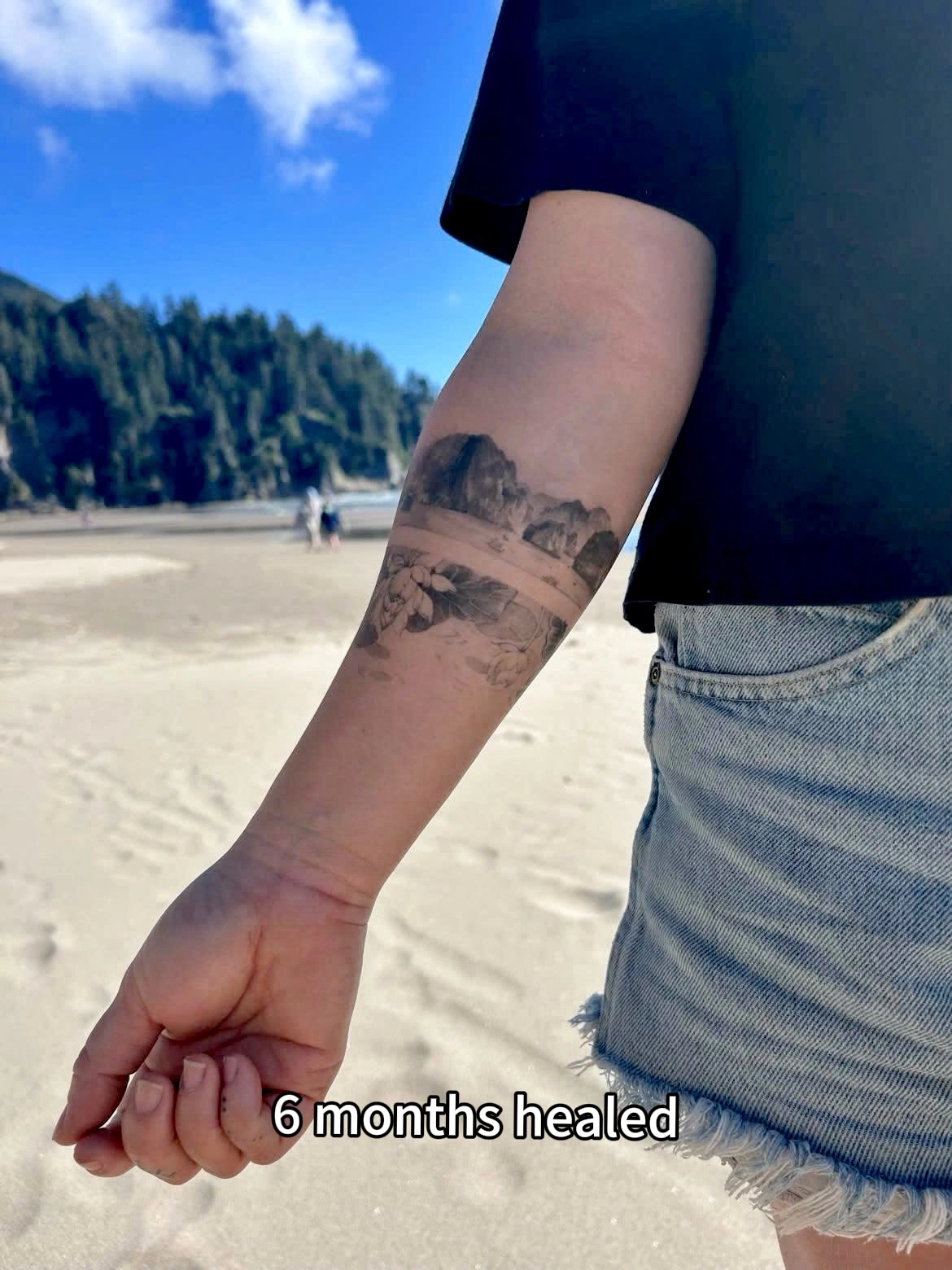
A fresh tattoo and a healed tattoo can look noticeably different. Redness fades, swelling disappears, and the skin settles. Some details remain crisp, while others may soften or lose definition. The quality of the original work becomes easier to judge once the skin has recovered.
This is why, when choosing a tattoo artist, you shouldn't look exclusively at fresh photographs.
You should look at the healed work.
1. Why Fresh Tattoos Often Look Better in Photographs
Immediately after a tattoo session, the contrast can appear exceptionally strong. Dark areas look deep, fine details seem sharp, and the entire composition may have a striking visual impact.
Professional lighting, careful positioning, contrast adjustments, and photo editing can enhance that impression even further.
None of this automatically means the tattoo is bad. Fresh tattoos are a legitimate part of an artist's portfolio. However, they show only one stage of the process.
As the tattoo heals, the skin undergoes a natural recovery process. The appearance of the ink changes, and the final result depends on several factors, including technique, placement, skin characteristics, ink, design, and aftercare.
A photograph taken immediately after the session cannot tell you everything you need to know about the finished tattoo.
The real test is whether the tattoo retains its visual strength after healing.
2. Five Things to Look for in a Healed Tattoo
Linework That Remains Clear
Fine-line tattoos demand control and precision. Lines need to be appropriate for the design, the placement, and the amount of detail being attempted.
When examining healed work, look for lines that remain readable and consistent with the original composition. Pay attention to areas where several lines sit close together. If the design becomes difficult to read as the lines soften, the original spacing may not have allowed enough room for the tattoo to age well.
A good artist understands that precision isn't simply about making the thinnest possible line. It's about choosing the right line for the job.
Black and Grey Shading With Lasting Contrast
Black-and-grey realism depends on the relationship between highlights, midtones, shadows, and dark areas.
A portrait might look dramatic when freshly tattooed, but if the tonal structure isn't carefully planned, important features can become less distinct over time.
Look at healed portraits, animals, and other realistic subjects. Can you still distinguish the facial features? Do the shadows support the form? Does the image retain depth without becoming an indistinct mass of grey?
The strongest work uses contrast intentionally, rather than relying on darkness alone.
Micro-Realism That Preserves Essential Details
Micro-realism is particularly demanding because it attempts to communicate a complex image within a limited space.
Tiny eyes, intricate clothing patterns, delicate textures, and miniature architectural elements may look impressive in a fresh close-up. But small details need enough room and appropriate spacing to remain distinguishable as the tattoo ages.
This doesn't mean every small tattoo will lose its detail. It means the artist must understand the limitations of scale and design accordingly.
A skilled artist knows when to simplify, when to enlarge an element, and when a concept needs more space to achieve the desired result.
Good micro-realism isn't about fitting in the maximum number of details. It's about preserving the details that matter most.
Color That Still Works as a Composition
For color tattoos, look at how the colors relate to one another after healing. Consider the separation between adjacent elements, the balance of light and dark, and whether the composition remains easy to read.
Color retention varies with many factors, including pigments, skin, placement, sun exposure, and aftercare. A healed photograph offers useful evidence, although it cannot predict exactly how another person's tattoo will age.
A Design That Still Makes Sense on the Body
A tattoo isn't a flat digital illustration. It sits on skin, follows the body's contours, and changes appearance as the wearer moves.
Healed photographs can help you assess whether the composition still reads well at a normal viewing distance, whether the focal point remains clear, and whether the design works as a whole rather than only in a magnified close-up.
The best tattoo artists think beyond the moment the needle leaves the skin. They consider how the finished work will exist on the body.
3. How to Check a Tattoo Artist's Portfolio Before Booking
If you're visiting Hanoi and have limited time to choose a studio, a little research can make a meaningful difference.
Here are five practical steps.
First, ask for healed photographs. Don't be afraid to request examples of tattoos that have fully healed. Ideally, look for work several months old or longer, while remembering that different styles and placements can age differently.
Second, compare the same tattoo at different stages. If the artist has both fresh and healed photographs of one project, you can better understand how the work changes.
Third, inspect more than the best three photographs. Look for consistency across multiple projects. A portfolio should demonstrate an artist's ability to produce strong work repeatedly, not just occasionally.
Fourth, research the individual artist. A studio may have several artists working in different styles. Make sure the portfolio you're viewing belongs to the person who will actually tattoo you.
Finally, ask how the design will age. A thoughtful artist should be able to explain why a particular size, level of detail, line weight, or contrast structure suits your idea.
These questions aren't about finding fault with an artist. They're about understanding the work before making a permanent decision.
4. Why We Believe Healed Quality Matters at Silver Ant Tattoo
At Silver Ant Tattoo in Hanoi, we believe the quality of a tattoo shouldn't be judged only by how impressive it looks immediately after a session.
Fresh photographs are useful for showing detail, technique, and the finished design. But healed results offer another important perspective: how well the work has settled into the skin.
Our approach places importance on thoughtful composition, technical execution, and choosing an appropriate design for each client's ideas and placement.
We also encourage clients to think realistically about detail. A large black-and-grey realism piece may provide more room for facial features, textures, and tonal transitions than the same concept compressed into a very small tattoo. Fine-line and micro-realism projects require their own considerations, especially when closely spaced elements are involved.
There is no single size or style that works for everyone. The right solution depends on the design and the result the client wants to achieve.
Our artists continue to develop their skills, explore their chosen disciplines, and participate in tattoo competitions. We value that commitment to improvement because creating a strong tattoo requires more than reproducing a reference image.
It requires understanding how to translate an idea into a design that works on real skin.
5. Does a Healed Tattoo Always Look Exactly Like a Fresh One?
No — and it shouldn't be expected to.
A tattoo is created within living skin, so some changes in appearance are normal as it heals and ages. The goal isn't to freeze the tattoo in its freshly completed state. The goal is to create a design that remains clear, balanced, and visually effective as time passes.
Healing results also depend on factors outside the artist's direct control. Individual skin characteristics, body location, sun exposure, friction, and aftercare can all affect the final appearance.
Even excellent work can change over time, and no responsible artist can guarantee that every tiny detail will remain perfectly unchanged forever.
What matters is whether the design was planned with those realities in mind and executed with appropriate technique.
For certain tattoos, touch-ups may be useful after healing. These should be discussed with the artist based on the actual condition of the tattoo, rather than assumed to be necessary for every project.
6. Don't Choose Your Tattoo Based on a Single Photograph
When comparing tattoo studios in Hanoi, it's easy to focus on prices, online reviews, convenient locations, and attractive social media feeds.
Those things can help you discover potential artists, but they shouldn't be the only factors in your decision.
Look for technical consistency. Ask about healed work. Examine the artist's experience in your preferred style. Consider whether the design is appropriate for the size and placement you have in mind.
And remember that the most impressive fresh photograph isn't necessarily evidence of the best long-term result.
A tattoo is something you carry long after your trip ends. It deserves more consideration than a quick decision based on a single image.
Looking for a Tattoo Artist in Hanoi?
At Silver Ant Tattoo, we welcome clients who care about the artistry behind their tattoos — whether they're considering fine-line work, black-and-grey realism, micro-realism, or a larger custom composition.
Explore our artists, review their portfolios, and tell us what you'd like to create. We'll help you discuss the design, size, placement, and level of detail appropriate for your project.
Silver Ant Tattoo — Hanoi, Vietnam.
Don't just ask how your tattoo will look today. Ask how the design is meant to hold up over time.
Visit silveranttattoo.com to explore our work and plan your next tattoo.