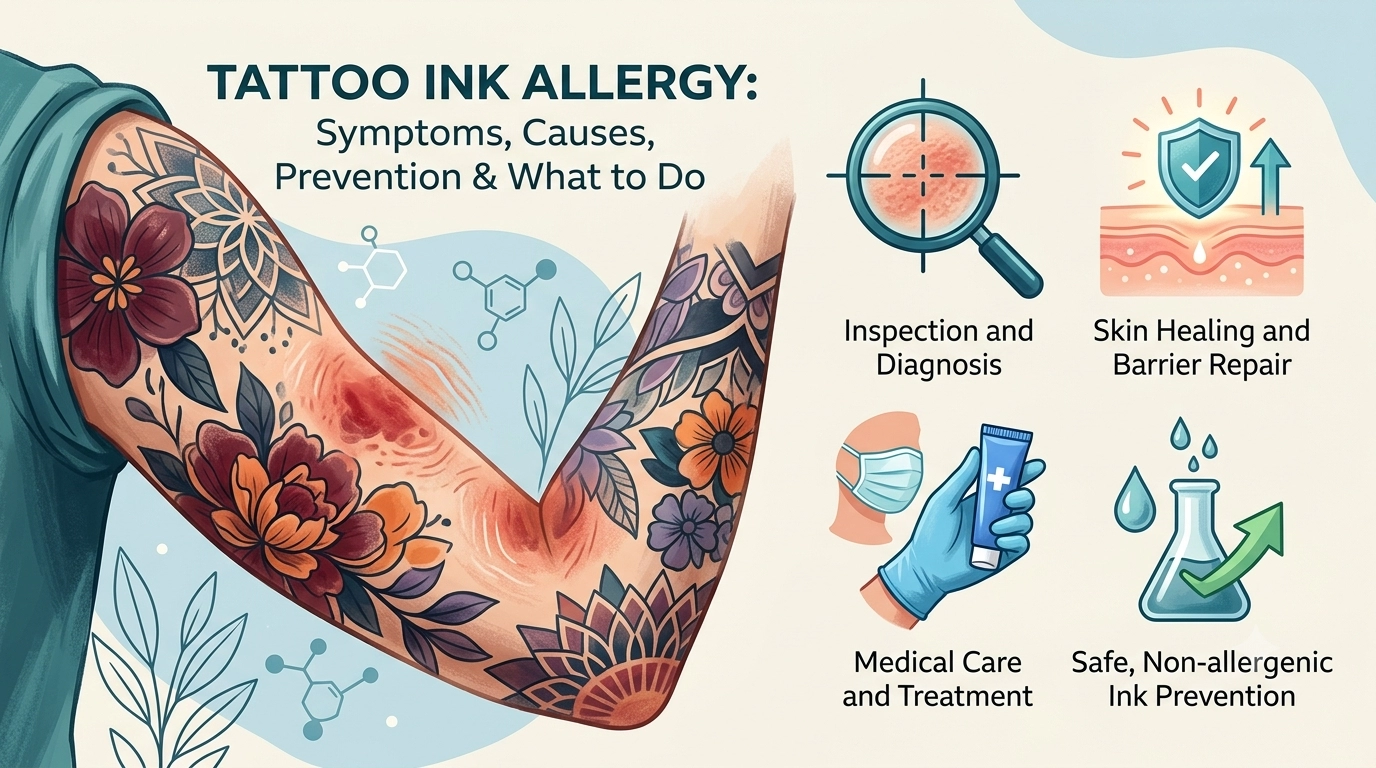
Tattoo Ink Allergy: Symptoms, Causes, Prevention & What to Do



Tattoo Ink Allergy: Symptoms, Causes, Prevention & What to Do
Tattoo Ink Allergy: What You Need to Know Before and After Getting Tattooed
Getting a tattoo means introducing tattoo ink into the skin, so it is natural to wonder how your body may react to the pigments used in the process.
One concern that occasionally comes up is tattoo ink allergy.
Redness, itching, swelling, or changes in the skin around a tattoo can certainly be concerning. However, not every skin reaction after getting tattooed is an allergic reaction. Normal healing, skin irritation, infection, reactions to aftercare products, and genuine pigment allergies can sometimes produce similar symptoms.
Understanding the difference is important.
In this guide, we explain what a tattoo ink allergy is, what the symptoms can look like, which tattoo ink colors are more commonly associated with reactions, why an allergy can sometimes appear years after getting tattooed, and what you should do if your tattoo develops an unusual reaction.
What Is a Tattoo Ink Allergy?
A tattoo ink allergy is an immune reaction to one or more substances associated with tattoo pigment or the other ingredients contained in tattoo ink.
Tattoo ink is not simply a colored liquid. Depending on the product, it can contain pigments together with carriers and other ingredients used to create and maintain the ink formulation.
When the immune system reacts to one of these substances, inflammation can develop in the tattooed skin.
One of the unusual aspects of tattoo-related allergic reactions is that they do not always happen immediately. Some reactions can develop days or weeks after tattooing, while others may appear months or even years later.
This is one reason why identifying the exact cause of a tattoo reaction can sometimes be difficult.
What Are the Symptoms of a Tattoo Ink Allergy?
A tattoo ink allergy can produce several different skin symptoms.
Possible signs include:
-
Persistent itching
-
Redness around part of the tattoo
-
Swelling
-
Raised or thickened areas of skin
-
Small bumps or a rash
-
Scaly or flaky skin
-
Blistering
-
Changes affecting a particular ink color
-
Persistent inflammation after the tattoo should have healed
One interesting feature of some tattoo reactions is that they may affect one particular color rather than the entire tattoo.
For example, a tattoo containing black, grey, red, and yellow pigment may heal normally except for the red areas, which later become itchy or raised.
However, symptoms alone cannot always tell you whether you are experiencing an allergy. A dermatologist may be needed to determine the actual cause.
Is Red Tattoo Ink More Likely to Cause an Allergy?
Red tattoo ink has historically been associated with a relatively high number of reported tattoo-related allergic reactions.
That does not mean that red ink is inherently unsafe or that everyone who gets a red tattoo will experience an allergic reaction.
Modern tattoo pigments are different from many pigments historically used in tattooing, and formulations vary between manufacturers.
Reactions have also been reported with other colors, including yellow, green, blue, and black pigments.
Research into tattoo pigment reactions suggests that the pigment itself may not always be the only factor involved. Other substances within an ink formulation may also contribute to a reaction.
For this reason, it is more accurate to talk about the possibility of reactions to specific tattoo pigments or ink ingredients rather than assuming that one particular color is always responsible.
Can a Tattoo Allergy Appear Years Later?
Yes.
A tattoo that has been completely healed for years can, in some cases, later develop an inflammatory or allergic reaction.
This can be surprising, especially if you have had several tattoos before without experiencing any problems.
One possible explanation is that tattoo pigments can undergo chemical changes over time. Exposure to sunlight and ultraviolet radiation may contribute to pigment degradation, while the immune system can respond to altered pigment particles or other substances within the tattoo.
Delayed reactions to tattoo pigments have been documented and remain an area of medical research.
This means that having several tattoos without previous problems does not guarantee that a future tattoo will never cause a reaction.
Tattoo Allergy vs. Normal Tattoo Healing
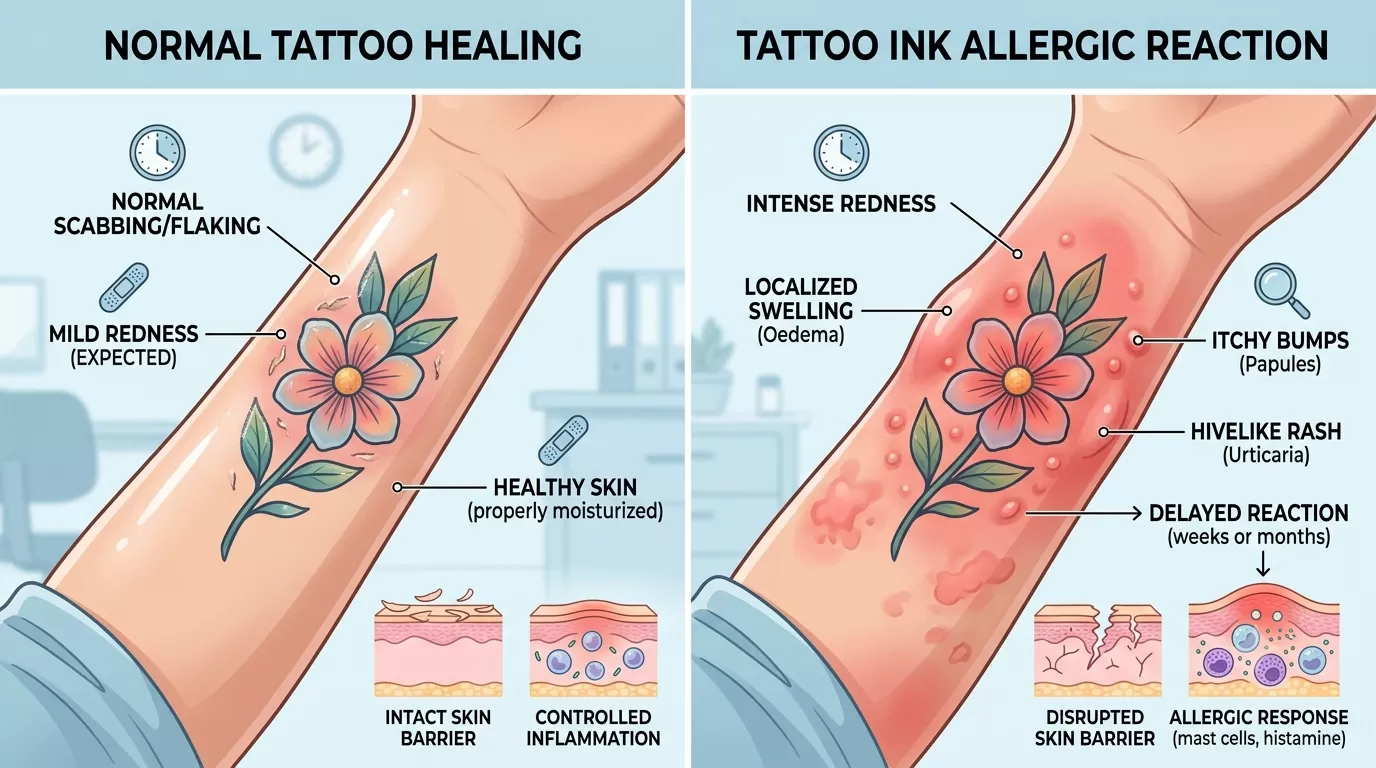
This is one of the most important distinctions to understand.
A fresh tattoo is essentially an area of skin that has undergone controlled trauma. The body needs time to repair the skin, and temporary redness, tenderness, swelling, dryness, peeling, and itching can all occur during normal healing.
A healing tattoo may therefore look or feel unusual for several days or weeks.
Typical healing symptoms can include:
-
Mild redness
-
Tenderness
-
Mild swelling
-
Dryness
-
Peeling
-
Itching
-
Small amounts of clear or slightly tinted fluid during the early stage
These symptoms do not automatically indicate an allergy.
The more important question is how the skin changes over time.
If the tattoo gradually becomes less irritated as it heals, that is generally different from a reaction that continues, becomes increasingly inflamed, or develops unusual bumps, thickening, blistering, or persistent itching.
When in doubt, professional medical evaluation is the safest way to determine what is happening.
Tattoo Ink Allergy vs. Tattoo Infection
Allergic reactions and infections can sometimes look similar, but they are not the same problem.
A possible infection may involve symptoms such as:
-
Increasing redness
-
Worsening pain
-
Significant swelling
-
Pus or abnormal discharge
-
Increasing warmth around the tattoo
-
Redness spreading beyond the tattoo
-
Fever or chills
If these symptoms develop, it is important not to assume that the problem is simply an allergy or normal tattoo healing.
A suspected infection should be assessed by a medical professional as soon as possible.
This is particularly important because treating an infection is very different from managing an allergic or inflammatory reaction.
Can Aftercare Products Cause a Reaction?
Yes.
Not every reaction that happens after getting tattooed is caused by the tattoo ink itself.
A person may potentially react to ingredients in products that come into contact with the skin during or after tattooing, including:
-
Aftercare creams
-
Lotions
-
Fragrances
-
Cleansers
-
Adhesive products
-
Certain topical ingredients
This is why it can be difficult to identify the cause simply by looking at the tattoo.
If the reaction appears after introducing a new skincare or aftercare product, that product should also be considered as a possible cause.
Can You Test Tattoo Ink for Allergies Before Getting Tattooed?
This is a common question from people who are concerned about tattoo ink allergies.
Unfortunately, there is no simple test that can guarantee that you will never develop a reaction to a tattoo pigment.
Some people consider a small patch or spot test before tattooing. However, testing pigment on the surface of the skin does not necessarily reproduce what happens when pigment is introduced into the deeper layers of the skin during tattooing.
Medical literature has also highlighted limitations in using conventional allergy testing to predict tattoo pigment reactions.
Therefore, a negative test should not be interpreted as a 100% guarantee that a tattoo will not cause a reaction.
If you have a history of significant allergies or previous reactions to tattoos, discussing the situation with a dermatologist before getting tattooed is a sensible precaution.
Who Is More Likely to Experience a Tattoo Ink Reaction?
There is no simple profile that can predict exactly who will develop a tattoo ink allergy.
A person may have several tattoos without any complications and still develop a reaction to a new tattoo or a particular pigment.
Previous reactions to tattoo ink, cosmetics, hair dyes, or other substances may be useful information to share with both your tattoo artist and healthcare provider.
However, having no previous history of allergies does not completely eliminate the possibility of a reaction.
How Can You Reduce the Risk of Tattoo Complications?
No tattoo can come with a guarantee of zero risk.
However, choosing a professional tattoo studio and following appropriate hygiene and aftercare practices can help reduce preventable complications.
Before getting tattooed, consider:
1. Choose a professional tattoo studio
Look for a studio that takes hygiene, equipment handling, and client safety seriously.
2. Ask about the tattoo ink
A professional artist should be able to provide information about the products being used and their manufacturers.
3. Tell your artist about previous reactions
If you have experienced an unusual reaction to tattoos, cosmetics, pigments, adhesives, or skincare products before, tell your artist before your appointment.
4. Follow professional aftercare instructions
Do not introduce unnecessary products to a fresh tattoo. Follow the aftercare instructions provided by your artist and avoid experimenting with multiple creams or skincare products at the same time.
5. Pay attention to changes during healing
A tattoo should generally move toward recovery rather than progressively becoming more painful, swollen, or inflamed.
If something seems unusual, ask for professional advice rather than trying to diagnose the problem yourself.
What Should You Do If You Think You Are Allergic to Tattoo Ink?
If you suspect an allergic reaction, avoid scratching the affected area and avoid applying multiple new products in an attempt to make it better.
For persistent or significant symptoms, consult a dermatologist or other qualified healthcare professional.
A doctor may evaluate the appearance and history of the reaction and determine whether further testing or treatment is appropriate.
If you experience symptoms such as difficulty breathing, widespread hives, severe swelling, dizziness, or other signs of a serious allergic reaction, seek emergency medical attention immediately.
Can a Tattoo Allergy Be Treated?
Treatment depends on the type and severity of the reaction.
A dermatologist may recommend appropriate treatment based on the specific symptoms and suspected cause. In some cases, topical medication may be considered for inflammatory reactions. More persistent or complex reactions may require additional medical investigation.
Tattoo removal is not automatically the first solution for every suspected allergic reaction.
Laser tattoo removal can also have its own risks and does not necessarily eliminate every pigment-related complication.
For this reason, anyone experiencing a significant reaction should seek medical advice before considering tattoo removal or other major interventions.
Does Tattoo Ink Allergy Mean You Can Never Get Tattooed Again?
Not necessarily.
If you experience a reaction to one tattoo, it does not automatically mean that you are allergic to every tattoo pigment.
The specific cause of the reaction matters.
Some people may react to a particular pigment or ingredient while having no problems with others. However, if you have experienced a confirmed or significant allergic reaction, it is important to discuss future tattoo plans with a medical professional before getting tattooed again.
Your previous reaction should also be communicated to your tattoo artist.
Final Thoughts: Tattoo Ink Allergy and Responsible Tattooing
Tattoo ink allergies are real, but they should not be confused with the normal healing process or with every instance of redness and itching after tattooing.
The key is to pay attention to the pattern and progression of the reaction.
A fresh tattoo can naturally be red, tender, dry, peeling, and itchy while it heals. A reaction that persists, becomes increasingly inflamed, affects a specific pigment, or develops long after the tattoo has healed deserves further attention.
For clients considering a tattoo, the best approach is not to become unnecessarily worried about every possible complication. Instead, choose a professional studio, make sure appropriate hygiene practices are followed, use reputable tattoo products, follow proper aftercare instructions, and communicate any relevant history of skin reactions before your appointment.
And if your tattoo develops a persistent or unusual reaction, a dermatologist is the right person to determine what is actually happening.
Frequently Asked Questions About Tattoo Ink Allergies
Can you suddenly become allergic to tattoo ink?
Yes. A reaction can occur even if you have had previous tattoos without any problems.
What color tattoo ink causes the most allergies?
Red pigment has historically been associated with many reported tattoo-related allergic reactions, but reactions can occur with other colors as well.
How long does a tattoo ink allergy take to appear?
It can appear relatively soon after tattooing or develop much later. Some reactions have been reported months or years after the tattoo was completed.
Is an itchy tattoo always an allergic reaction?
No. Itching is also a normal part of tattoo healing. Persistent or worsening itching, especially when accompanied by swelling, bumps, thickening, or other changes, should be evaluated.
Can tattoo ink allergy be prevented?
There is no way to guarantee complete prevention. Choosing a professional studio, using appropriate products, following aftercare instructions, and discussing previous allergies or reactions can help reduce avoidable risks.
Should I remove my tattoo if I think I am allergic to the ink?
Not necessarily. See a dermatologist first. The appropriate treatment depends on the actual cause and severity of the reaction.
Medical Disclaimer
This article is provided for general educational purposes and does not constitute medical advice, diagnosis, or treatment. If you develop a persistent, severe, or unusual reaction after getting a tattoo, consult a qualified healthcare professional or dermatologist.