Black & Grey Realism Tattoo: The Complete Guide (2026) - Chapter 6 — Mastering Texture - How Artists Tattoo Stone, Metal, Smoke, Water, and Fabric in Black & Grey Realism



Black & Grey Realism Tattoos
Chapter 6
Mastering Texture
How Artists Tattoo Stone, Metal, Smoke, Water, and Fabric in Black & Grey Realism
Quick Answer
One of the greatest strengths of Black & Grey Realism is its ability to recreate a wide variety of materials using nothing more than black ink, grey wash, and the natural tone of the skin.
Whether depicting polished steel, weathered stone, flowing smoke, or soft fabric, realism depends not on copying every surface detail, but on understanding how different materials interact with light.
Texture is not drawn.
It is suggested through value, edge control, and contrast.
Why Texture Isn't About Detail
When people admire a realistic tattoo, they often say:
"It looks so detailed."
While detail certainly plays a role, it isn't what convinces the brain.
Imagine looking at a marble statue from across a room.
You can't see every tiny crack or scratch.
Yet you immediately recognize it as marble.
The same principle applies to tattooing.
Your brain identifies materials by observing:
-
how they reflect light;
-
how soft or sharp their edges appear;
-
how shadows transition;
-
how highlights behave.
Professional realism artists study these characteristics long before adding fine textures.
Artist Insight
"Texture isn't something we tattoo at the end. It's something we build from the very first shadow."
— Silver Ant Tattoo
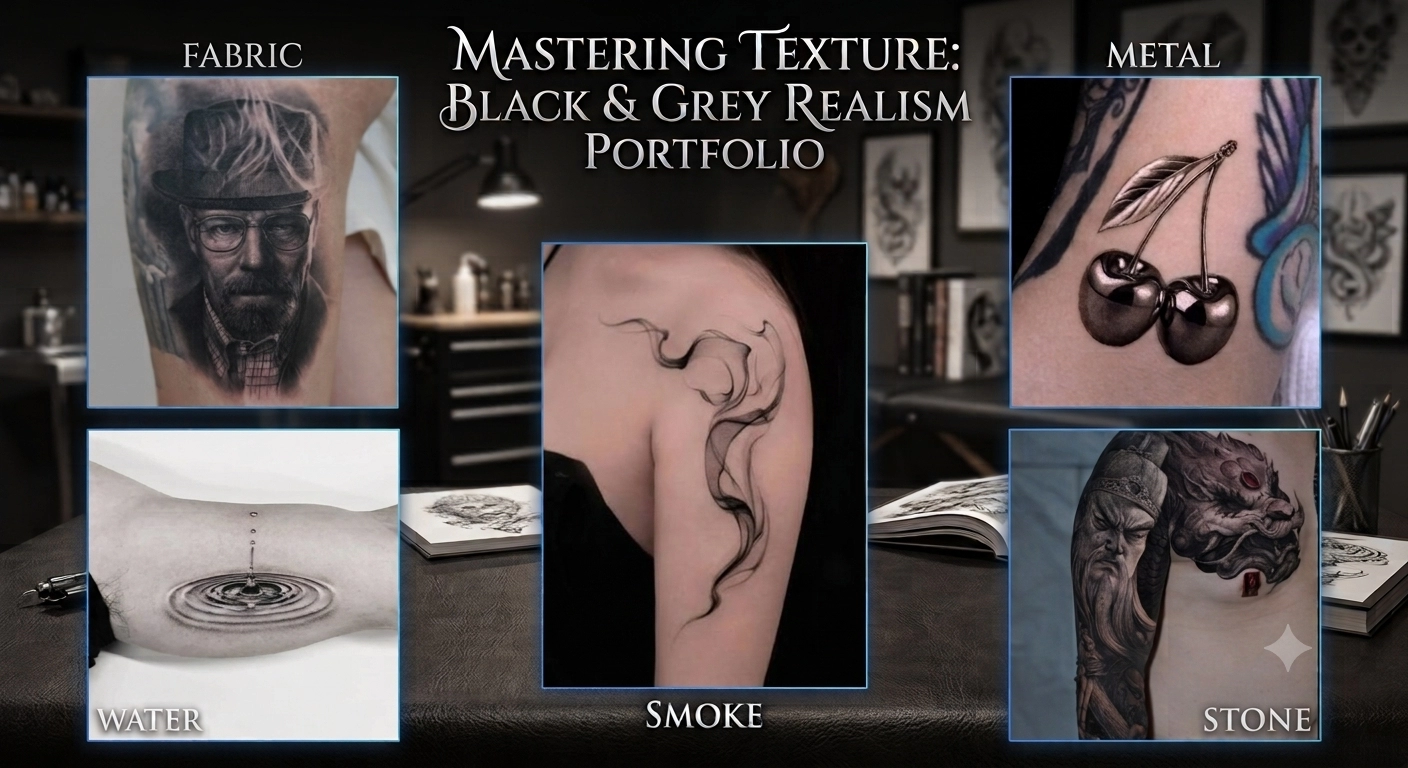
Stone: Strength Through Simplicity
Stone is one of the most common subjects in Black & Grey Realism.
Think of:
-
Greek sculptures;
-
Roman busts;
-
Gothic architecture;
-
carved statues;
-
religious figures.
Interestingly, stone usually contains less visible texture than people imagine.
Its realism comes from:
-
broad shadow shapes;
-
subtle surface imperfections;
-
chipped edges;
-
believable lighting.
Adding too many cracks often makes stone appear artificial.
Professional artists usually suggest weathering rather than illustrating every imperfection.
Metal: Contrast Creates Shine
Metal behaves very differently from stone.
Instead of absorbing light, polished metal reflects it.
This creates:
-
bright highlights;
-
deep shadows;
-
abrupt transitions;
-
mirrored reflections.
In Black & Grey tattoos, shiny metal is achieved by placing the darkest blacks immediately beside untouched skin or very light grey values.
The sharper the transition, the shinier the object appears.
This principle is commonly used in tattoos featuring:
-
swords;
-
armour;
-
watches;
-
mechanical parts;
-
helmets;
-
firearms (historical or decorative subjects).
The shine isn't created by white ink alone.
It is created by contrast.
Did You Know?
Many realism artists deliberately exaggerate the contrast in metallic objects.
Real skin naturally softens tattoos over time, so stronger initial value separation helps preserve the illusion of polished metal after healing.
Smoke: Painting the Invisible
Smoke presents a unique challenge.
Unlike stone or metal, it has no defined edges.
Its form is constantly changing.
Professional artists avoid outlining smoke.
Instead, they rely on:
-
soft gradients;
-
negative space;
-
overlapping values;
-
gradual transitions.
The viewer's brain completes the missing information.
Ironically, smoke often appears more realistic when less of it is actually tattooed.
Scientific Note
Human vision naturally groups incomplete shapes into recognizable forms, a principle known in Gestalt psychology as closure. Realism artists often use this phenomenon by allowing negative space to suggest rather than fully define smoke, mist, or clouds.
Further Reading
-
National Eye Institute
-
National Library of Medicine (PubMed)
Water: Movement Before Reflection
Many artists initially focus on reflections when tattooing water.
Experienced realism artists begin somewhere else:
Movement.
Still water behaves differently from rushing water.
Ocean waves differ from waterfalls.
Rain differs from mist.
Every type of water creates its own rhythm of highlights and shadows.
Rather than drawing every ripple, artists establish the overall flow first.
Only then do they introduce smaller reflections and surface textures.
The result feels dynamic rather than decorative.
Fabric: Softness Through Gradation
Fabric appears realistic because of its folds.
Each fold changes the direction of the surface.
That change influences the way light behaves.
Soft fabrics produce:
-
gradual transitions;
-
rounded shadows;
-
gentle highlights.
Leather behaves differently.
Denim behaves differently.
Silk behaves differently again.
Professional artists simplify these differences into readable value patterns that continue looking natural after healing.
Too many wrinkles quickly make clothing appear cluttered.
Strong realism comes from selecting only the folds that matter.
Artist Note
One of the easiest ways to improve realism is to simplify texture.
Instead of tattooing every surface detail, ask:
What is the viewer supposed to feel?
Cold steel.
Weathered stone.
Soft fabric.
Moving water.
The emotional impression is often more important than perfect technical description.
Combining Multiple Materials
Some of the most impressive realism tattoos feature several materials within a single composition.
Imagine a warrior portrait containing:
-
polished armour;
-
weathered stone;
-
flowing fabric;
-
drifting smoke;
-
human skin.
Each surface responds differently to the same light source.
Maintaining those differences while keeping the entire composition visually balanced is one of the defining challenges of advanced realism.
This is why experienced artists think about the composition as a whole rather than rendering each object independently.
Texture Should Never Overpower Composition
It is tempting to fill every surface with intricate detail.
However, realism is not a competition to see who can tattoo the most texture.
A successful composition guides the viewer's eye naturally.
Highly textured areas should support the focal point—not compete with it.
Professional artists intentionally alternate:
-
complex textures;
-
smooth transitions;
-
open negative space;
-
bold shadow masses.
This variation creates visual rhythm and allows the tattoo to breathe.
Common Misconception
"More texture automatically means more realism."
Not at all.
Excessive texture often makes a tattoo feel busy and reduces readability over time.
The strongest realism tattoos simplify wherever possible, allowing the most important textures to stand out instead of blending into visual noise.
Key Takeaways
-
Texture is created through light and value, not detail alone.
-
Different materials reflect light in different ways.
-
Stone relies on broad forms; metal relies on sharp contrast.
-
Smoke and water are defined by soft transitions and movement.
-
Simplifying texture often creates stronger realism than adding more detail.
Continue Exploring
Now that we've explored materials and textures, the next chapter focuses on one of the biggest artistic decisions in Black & Grey Realism:
How composition transforms individual images into a cohesive tattoo.
You may also enjoy:
-
The Ultimate Guide to Realism Tattoos
-
The Science of Light and Shadow
-
Designing a Realism Tattoo
-
Tattoo Placement Guide
References & Further Reading
Vision & Perception
-
National Eye Institute
-
National Library of Medicine (PubMed)
Art & Materials
-
The Metropolitan Museum of Art
-
Getty Museum
Next Chapter
Chapter 7 — Composition & Flow: Designing Black & Grey Tattoos That Move with the Body