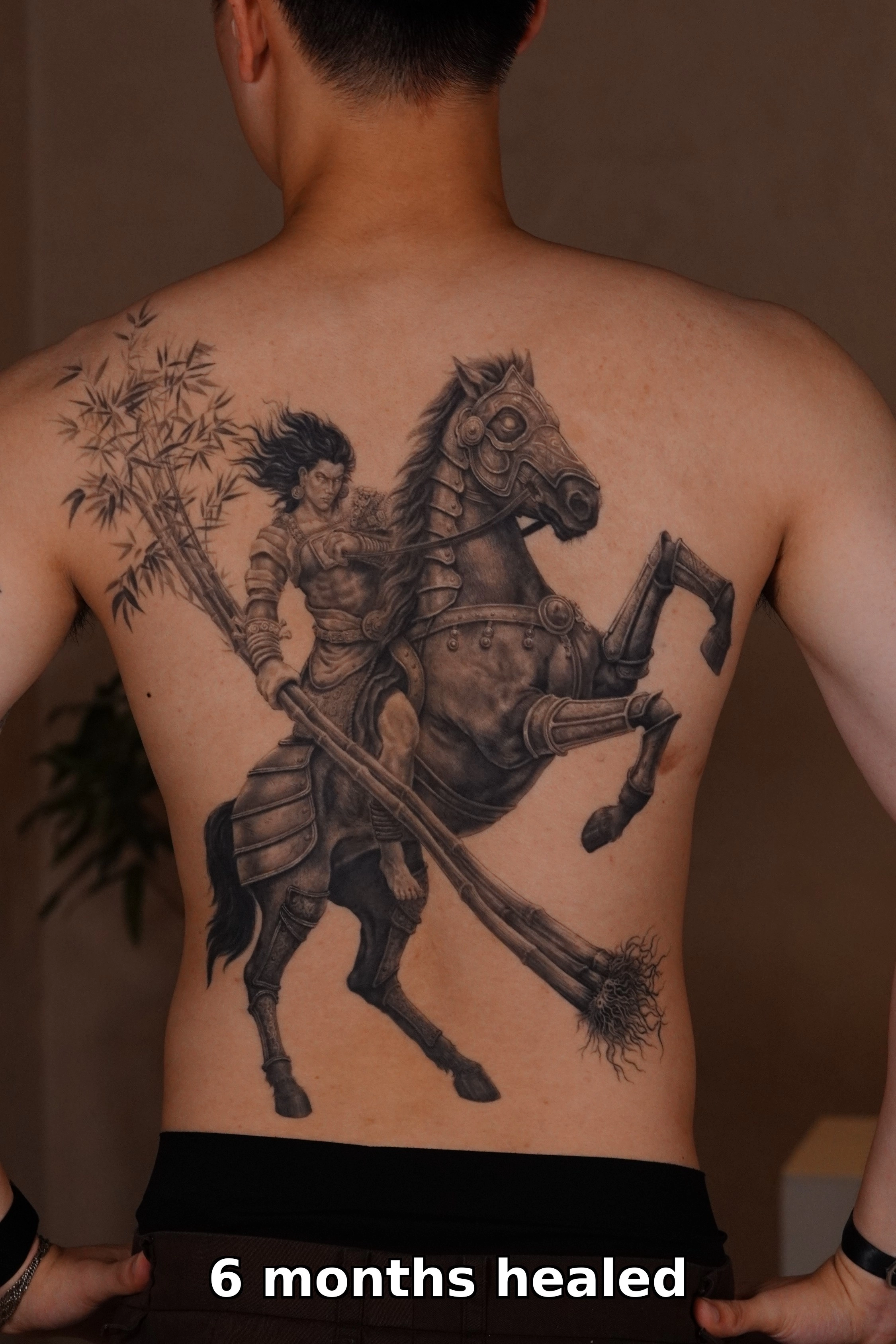
Black & Grey Realism Tattoo: The Complete Guide (2026) - Chapter 8 — Do Black & Grey Realism Tattoos Age Well? - Longevity, Healing & Long-Term Care



Black & Grey Realism Tattoos
Chapter 8
Do Black & Grey Realism Tattoos Age Well?
Longevity, Healing & Long-Term Care
Quick Answer
Yes, a well-designed and professionally tattooed Black & Grey Realism tattoo can age very well.
However, realism tattoos naturally change as the skin heals and ages. Fine details soften, very light tones may become less noticeable, and the overall contrast gradually settles.
The key to longevity isn't preventing every change.
It's designing the tattoo with those changes in mind from the beginning.
A Fresh Tattoo Is Not the Final Tattoo
One of the biggest mistakes when evaluating a realism tattoo is judging it only when it is freshly completed.
Fresh tattoos can appear:
-
extremely dark;
-
highly contrasted;
-
unusually sharp;
-
more detailed than the healed result.
This is normal.
During healing, the skin undergoes a natural recovery process. The tattoo gradually settles into the skin, and the visual appearance becomes softer and more integrated.
A professional artist should anticipate this transformation before tattooing begins.
The goal isn't to create a tattoo that looks perfect for one week.
The goal is to create one that remains visually strong for years.
What Happens During Healing?
A tattoo is a controlled injury to the skin.
The body responds by repairing the treated area.
During the early stages, you may experience:
-
redness;
-
mild swelling;
-
tenderness;
-
peeling;
-
itching;
-
temporary changes in colour and contrast.
As the skin heals, the tattoo gradually develops its more permanent appearance.
This is why professional artists often ask clients to wait before judging the final result.
A tattoo that looks slightly different after healing isn't necessarily a problem.
In many cases, it is exactly what should happen.
Artist Insight
"We don't design for the moment when the tattoo leaves the studio. We design for the moment months and years later, when the skin has completely settled."
— Silver Ant Tattoo
Suggested Figure 9
Title
The Realism Tattoo Healing Timeline
Timeline
Fresh Tattoo
↓
Early Healing
↓
Peeling
↓
Settled Skin
↓
Long-Term Aging
Image Filename
black-grey-tattoo-healing-timeline.webp
ALT
Timeline showing the typical visual changes of a Black & Grey realism tattoo during healing and long-term aging.
Why Some Details Fade Faster Than Others
Not every part of a tattoo ages at the same rate.
Very light grey tones and extremely fine details are generally more vulnerable to becoming subtle over time.
Dark, well-established values tend to remain visually stronger.
This is why experienced artists carefully control the relationship between:
-
deep blacks;
-
mid-tones;
-
light grey;
-
untouched skin.
A tattoo with only subtle grey values may look beautiful when fresh but lose readability as those lighter tones soften.
A tattoo with thoughtfully distributed contrast has a stronger visual foundation.
Contrast Is the Foundation of Longevity
If there is one principle to remember from this entire guide, it is this:
Contrast protects readability.
Imagine a portrait consisting entirely of similar grey tones.
Initially, it may appear soft and sophisticated.
As those tones gradually settle, however, the image can become difficult to read.
Now imagine the same portrait with carefully planned:
-
deep shadows;
-
medium values;
-
soft transitions;
-
preserved highlights.
The overall structure remains much easier to recognise.
This is why professional realism artists think about the future before the tattoo even begins.
Why Negative Space Matters Over Time
Untattooed skin provides natural contrast.
This becomes particularly important as a tattoo ages.
Strategic negative space can separate:
-
one subject from another;
-
highlights from shadows;
-
foreground from background;
-
individual elements within a sleeve.
Without enough breathing room, a complex realism tattoo may gradually lose clarity as the elements visually merge.
Negative space is therefore not simply an aesthetic choice.
It is part of the tattoo's long-term design strategy.
Placement Affects Longevity
Different parts of the body experience different levels of friction, movement, and sun exposure.
Areas that frequently experience:
-
rubbing;
-
stretching;
-
washing;
-
direct sunlight;
may require additional consideration during design and aftercare.
For example, hands and fingers often experience significantly more environmental exposure and friction than the upper arm.
This doesn't mean certain placements cannot hold realism.
It simply means expectations and design choices should be adjusted accordingly.
An experienced artist can help determine whether the desired level of detail is appropriate for a particular location.
Sun Exposure Is One of the Biggest Enemies
Ultraviolet radiation can gradually degrade tattoo pigments.
Over many years, repeated sun exposure can contribute to:
-
fading;
-
reduced contrast;
-
softer details;
-
changes in overall appearance.
This is why sun protection remains important even after the tattoo has completely healed.
For long-term preservation:
-
protect healed tattoos from prolonged direct sunlight;
-
use appropriate sunscreen once the tattoo is fully healed;
-
avoid excessive tanning;
-
keep the skin moisturised.
A great tattoo deserves long-term protection.
Does Black & Grey Need Touch-Ups?
Not necessarily.
A properly healed tattoo doesn't automatically need a touch-up simply because it has changed slightly.
Some softening is completely normal.
Touch-ups may become useful when:
-
a specific area has lost significant pigment;
-
healing was uneven;
-
a small section requires restoration;
-
the collector wants to refresh certain elements.
However, repeatedly adding ink simply because the tattoo no longer looks exactly like it did on day one isn't always necessary.
A healed tattoo should look like a healed tattoo.
Did You Know?
Many professional artists prefer to evaluate healed work before deciding whether any correction is needed.
This is because the skin may continue changing visually for several weeks after the initial session.
Patience can prevent unnecessary reworking.
Aftercare Still Matters
Good design cannot compensate for poor aftercare.
Following your artist's instructions during healing helps minimise unnecessary complications and supports the best possible final result.
Although aftercare instructions vary depending on the artist and technique, the basic principles generally include:
-
keeping the tattoo clean;
-
avoiding unnecessary friction;
-
not picking or scratching peeling skin;
-
avoiding prolonged soaking during early healing;
-
protecting the area while it heals.
Always follow the specific aftercare instructions provided by your tattoo artist.
How Long Should a Realism Tattoo Last?
There is no single number that applies to every tattoo.
Longevity depends on a combination of:
-
tattoo quality;
-
ink placement;
-
design;
-
contrast;
-
body location;
-
sun exposure;
-
individual skin characteristics;
-
aftercare.
A well-executed Black & Grey tattoo can remain recognisable and visually impressive for decades, although it will naturally soften and change over time.
The goal isn't to freeze the tattoo in its original state.
It's to create artwork that ages gracefully.
The Difference Between Fading and Aging
These two concepts are often confused.
Fading generally refers to a loss of pigment or visual intensity.
Aging is broader.
It includes:
-
softened edges;
-
subtle changes in contrast;
-
skin texture changes;
-
natural variation in pigment appearance.
Some degree of aging is inevitable.
In fact, many collectors appreciate the character that develops in a tattoo over time.
A well-designed realism tattoo should become softer—not meaningless.
Common Misconception
"A tattoo that has faded slightly is a bad tattoo."
Not necessarily.
All tattoos change.
The real question is whether the underlying composition, contrast, and focal points remain readable.
A successful realism tattoo can lose some microscopic detail while preserving the visual impression that made it powerful in the first place.
Designing for the Future
This is ultimately what separates short-term realism from long-term realism.
An artist who designs only for the freshly finished tattoo may prioritise:
-
extreme detail;
-
very soft grey;
-
maximum complexity.
An artist designing for longevity considers:
-
future contrast;
-
skin movement;
-
placement;
-
negative space;
-
simplified detail;
-
overall composition.
The tattoo isn't being designed for a photograph.
It is being designed for a lifetime on skin.
Key Takeaways
-
A fresh tattoo is not the same as a healed tattoo.
-
Some softening and fading are natural parts of tattoo aging.
-
Strong contrast helps preserve readability.
-
Negative space becomes increasingly valuable as a tattoo ages.
-
Sun exposure can accelerate pigment degradation.
-
Touch-ups aren't automatically necessary.
-
Good design, professional technique, and proper aftercare all contribute to longevity.
Continue Exploring
The final chapter brings everything together and looks at the most important decision of all:
How to choose the right Black & Grey Realism artist and prepare for your tattoo project.
You may also enjoy:
-
The Ultimate Guide to Realism Tattoos
-
Tattoo Aftercare Guide
-
Tattoo Healing Guide
-
Tattoo Placement Guide
-
The 7 Best Realism Tattoo Artists at Silver Ant Tattoo
References & Further Reading
Skin & Tattoo Care
-
American Academy of Dermatology
-
National Library of Medicine (PubMed)
Tattoo Longevity
-
National Library of Medicine (PubMed)
Next Chapter
Chapter 10 — Choosing the Right Black & Grey Realism Artist: What to Look For Before Your Tattoo