Black & Grey Realism Tattoo: The Complete Guide (2026) - Chapter 12 — Black & Grey Realism Tattoo Aftercare: A Complete Healing Timeline



Black & Grey Realism Tattoo: The Complete Guide (2026)
Chapter 12 — Black & Grey Realism Tattoo Aftercare: A Complete Healing Timeline
What Happens to Your Tattoo After the Session?
Getting the tattoo is only one part of the process.
Once you leave the studio, your skin still has a lot of work to do.
A fresh tattoo is essentially an area of skin that has been repeatedly worked with needles. During the following days and weeks, the skin gradually closes, sheds damaged surface layers and settles around the ink.
For a Black & Grey Realism tattoo, this healing period is particularly important.
Realism depends on subtle grey tones, smooth gradients, fine details and carefully controlled contrast. Poor aftercare will not necessarily "destroy" a tattoo, but unnecessary irritation, excessive sun exposure, picking at the skin or ignoring signs of infection can interfere with the healing process and the final appearance.
So what should you actually expect?
Let's go through the healing process step by step.
Quick Answer
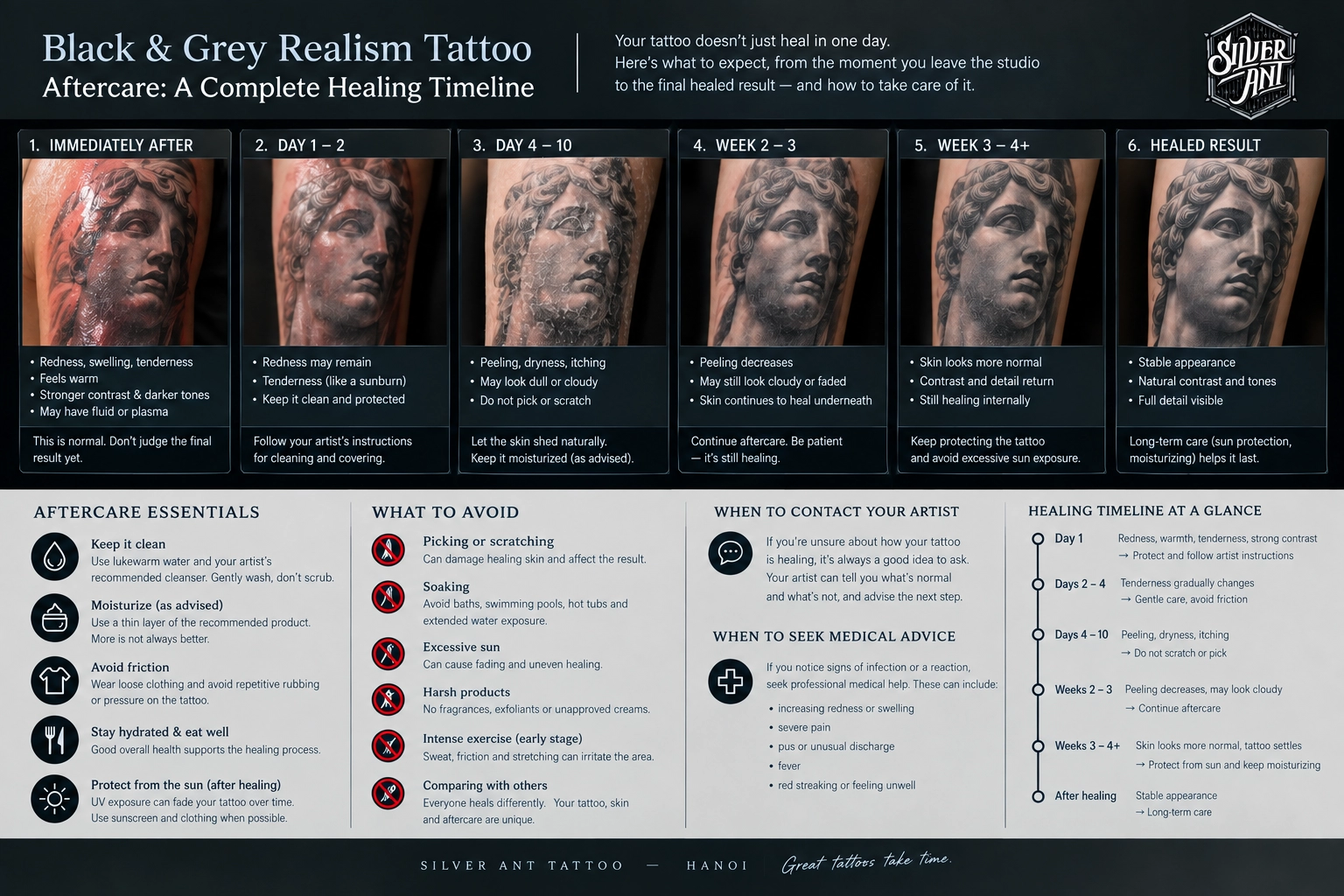
A Black & Grey Realism tattoo typically goes through several visible stages during healing.
The first few days: the tattoo may be red, swollen, tender and appear darker than expected.
Around the first week: the skin may begin peeling, flaking or feeling itchy.
During weeks two to three: most surface peeling gradually decreases, although the tattoo can temporarily look dull or slightly cloudy.
Around weeks three to four and beyond: the skin continues settling and the tattoo gradually develops a more stable healed appearance.
Healing times vary between people and depend on tattoo size, placement, individual skin, aftercare and other factors.
The most important rule is simple:
Follow your tattoo artist's aftercare instructions first.
Different artists may use different bandages, products and healing methods, so there is no single routine that is correct for every tattoo.
1. Immediately After Getting Tattooed
When your tattoo session ends, the skin will usually look very different from the healed tattoo.
You may notice:
-
redness;
-
mild swelling;
-
tenderness;
-
warmth;
-
fluid or plasma on the surface;
-
stronger contrast;
-
and darker-looking blacks and grey tones.
This is normal for freshly tattooed skin.
A detailed Black & Grey Realism tattoo can look especially intense immediately after the session because the skin is still irritated and the ink is sitting within freshly tattooed tissue.
Do not judge the final result at this stage.
The tattoo needs time to heal.
Your artist will normally clean the tattoo and apply the appropriate covering or protective film before you leave.
2. The First 24–48 Hours
The first day or two is mainly about protecting the tattoo and avoiding unnecessary irritation.
Your artist will tell you when and how to remove the covering.
Depending on the method used, you may be instructed to keep a protective film on the tattoo for a specific period or remove it earlier and begin a washing routine.
Once you are allowed to clean the tattoo, use the method recommended by your artist.
In general, the goal is to keep the area clean without aggressively rubbing the skin.
Avoid:
-
scratching;
-
picking;
-
rubbing;
-
tight clothing that constantly touches the tattoo;
-
unnecessary soaking;
-
and applying products that your artist has not recommended.
You do not need to constantly touch or inspect the tattoo.
In fact, leaving it alone is often better.
3. Why a Fresh Realism Tattoo Looks So Dark
This is one of the most common concerns after getting a Black & Grey Realism tattoo.
A client may leave the studio and think:
"The blacks are much darker than I expected."
That does not necessarily mean something is wrong.
Freshly tattooed skin can look darker and more contrasted than healed skin.
The surface may also be shiny because of healing fluid, ointment or irritation.
As healing progresses, the tattoo will gradually change in appearance.
Grey tones may appear softer.
The contrast may become more natural.
Fine details may also look different once the skin has fully settled.
This is why professional tattoo artists evaluate healed work rather than relying only on photographs taken immediately after a session.
4. Days 2–4: Redness and Tenderness
During the first several days, some redness and tenderness can remain.
The tattoo may feel similar to a sunburn.
Large pieces can naturally feel more noticeable because a larger area of skin has been tattooed.
During this stage, avoid unnecessary friction.
If the tattoo is on your arm, for example, be careful with tight sleeves or activities that repeatedly rub the area.
If it is on the leg, clothing and movement can create similar problems.
The goal is not to keep the tattoo completely untouched forever.
It is simply to avoid repeatedly irritating freshly tattooed skin.
5. Days 4–10: Peeling and Itching
For many people, this is the stage where the tattoo starts looking less attractive.
The skin may become:
-
dry;
-
flaky;
-
itchy;
-
slightly rough;
-
or covered by small peeling areas.
This can look alarming if you are not expecting it.
But peeling is a normal part of skin healing.
The most important rule during this stage is:
Do Not Pick the Tattoo.
Even if a piece of dry skin is hanging loose, do not pull it off.
Let the skin shed naturally.
Picking or scratching can unnecessarily damage healing skin and may interfere with the appearance of the tattoo.
If the tattoo becomes itchy, follow the moisturizing or aftercare routine recommended by your artist rather than scratching it.
6. The "Ugly" Healing Stage
There is a period when a tattoo can temporarily look worse before it looks better.
The tattoo may appear:
-
dull;
-
cloudy;
-
patchy;
-
faded;
-
dry;
-
or less sharp than it was immediately after the appointment.
This is particularly noticeable with Black & Grey Realism because clients are often expecting the dramatic contrast they saw immediately after the session.
Do not panic.
A tattoo does not finish healing in the same condition in which it leaves the studio.
The skin is changing.
The surface is shedding.
The underlying ink is settling.
Give it time.
7. Weeks 2–3: The Tattoo Starts Settling
By the second or third week, much of the obvious peeling may have disappeared.
However, the tattoo may still not look completely settled.
Some areas can appear slightly cloudy or less vibrant than expected.
This does not automatically mean the tattoo has lost its quality.
The skin can continue changing after the obvious peeling has stopped.
Continue following the aftercare instructions provided by your artist.
Do not suddenly return to aggressive exfoliation, prolonged sun exposure or other activities simply because the tattoo "looks healed."
8. Around Weeks 3–4 and Beyond
For many tattoos, the skin will look considerably more normal by this stage.
However, complete settling can take longer, particularly with larger or more heavily worked pieces.
The final appearance depends on:
-
the tattoo itself;
-
your skin;
-
placement;
-
healing;
-
sun exposure;
-
aftercare;
-
and how the tattoo was originally executed.
This is why there is no single day when every tattoo can be declared completely healed.
Your artist can give you a more appropriate assessment based on the tattoo and your individual situation.
9. How to Wash a Healing Tattoo
Your artist's instructions should always take priority.
When washing is recommended, the general goal is gentle cleaning rather than aggressive scrubbing.
Use clean hands and avoid unnecessary friction.
You do not need to scrub the tattoo to make it "extra clean."
The skin is already healing.
Overhandling the area can create unnecessary irritation.
After washing, follow the drying and moisturizing instructions provided by your artist.
10. Moisturizing a Healing Tattoo
Moisturizing can help prevent excessive dryness and discomfort, but more is not necessarily better.
A common mistake is applying a very thick layer of product because the tattoo feels dry.
Instead, use the product and amount recommended by your artist.
The tattoo should not constantly feel covered in a heavy layer of cream or ointment.
Your artist may recommend a specific tattoo aftercare product, depending on their preferred healing method.
Follow that recommendation rather than mixing several different products without a reason.
11. Can You Shower With a New Tattoo?
Usually, normal showering can be compatible with tattoo aftercare once your artist says the covering can be removed and the tattoo can be washed.
The important distinction is between showering and soaking.
Long periods in:
-
baths;
-
swimming pools;
-
hot tubs;
-
or other bodies of water
can expose a healing tattoo to unnecessary moisture and potential contamination.
Follow your artist's specific instructions regarding when these activities can safely resume.
12. What About Exercise?
Exercise can usually return gradually, but the tattoo's location matters.
Consider:
-
friction from clothing;
-
sweat;
-
equipment touching the tattoo;
-
stretching of the tattooed area;
-
and contact with shared surfaces.
A fresh tattoo on an area that repeatedly rubs against gym equipment may need more consideration than one in a relatively protected location.
For larger realism pieces, it may be sensible to give the skin some recovery time before returning to activities that heavily irritate the tattooed area.
When in doubt, ask your artist.
13. Sun Exposure Is One of the Biggest Long-Term Concerns
Even after your tattoo has healed, UV exposure can contribute to fading over time.
This matters particularly for Black & Grey Realism.
The style relies heavily on carefully controlled contrast.
If blacks and grey values gradually lose their clarity, the original visual hierarchy can become less defined.
Once the tattoo is fully healed, protecting it from excessive sun exposure can help preserve its appearance.
For outdoor activities, appropriate clothing and sunscreen can be useful once the skin is fully healed and your healthcare professional or tattoo artist has advised that sunscreen is appropriate.
Do not apply sunscreen to an actively healing open tattoo unless specifically advised.
14. What Should You NOT Put on a Healing Tattoo?
There is no universal list of products that every person must avoid because aftercare methods differ.
However, one principle is important:
Do not experiment unnecessarily.
Avoid randomly applying:
-
household creams;
-
fragrances;
-
harsh exfoliants;
-
strong active skincare products;
-
or products recommended by someone who does not know your tattoo or healing situation.
If you are unsure about a product, ask your tattoo artist or a qualified healthcare professional.
15. Common Aftercare Mistakes
Many tattoo healing problems are not caused by a complicated medical issue.
Sometimes they come from simple mistakes.
Picking the peeling skin
One of the most common mistakes.
Let the skin shed naturally.
Over-moisturizing
More product does not automatically mean better healing.
Scrubbing
A tattoo does not need aggressive cleaning.
Soaking too early
Swimming, baths and prolonged water exposure can be inappropriate during the early healing stage.
Excessive sun exposure
UV exposure is one of the long-term enemies of tattoo longevity.
Wearing clothing that constantly rubs the tattoo
Friction can make an already irritated area more uncomfortable.
Comparing your healing process with someone else's
Two people can have very different healing experiences.
Your tattoo size, placement, skin and aftercare all matter.
16. When Should You Contact Your Tattoo Artist?
Not every unusual-looking tattoo requires an emergency response.
But if you are concerned about how your tattoo is healing, contacting your artist is often a good first step.
They can compare what you are experiencing with the expected healing process and tell you whether something looks unusual.
Send them a clear photograph if they request one.
A professional artist would rather answer a reasonable question than have a client ignore something because they are afraid of "asking too much."
17. When Should You Seek Medical Advice?
Tattoo aftercare is not a substitute for medical care.
If you develop symptoms that concern you — particularly signs that could indicate infection or an allergic reaction — seek advice from a qualified healthcare professional.
Potential warning signs can include worsening rather than improving redness, significant swelling, increasing pain, pus or unusual discharge, fever, red streaking, or feeling generally unwell.
Do not attempt to diagnose a serious problem from tattoo photographs alone.
Your tattoo artist can provide practical guidance about normal healing, but medical professionals should handle medical concerns.
18. What If the Tattoo Looks Patchy After Healing?
Do not immediately assume that the tattoo is ruined.
Some areas can heal differently from others.
This may be more noticeable in:
-
large black areas;
-
heavily shaded sections;
-
areas that experienced more irritation;
-
or parts of the body that naturally heal differently.
Once the tattoo is fully healed, your artist can evaluate whether a touch-up is actually necessary.
A touch-up should be based on the healed tattoo — not on how it looked during the first few days.
19. Why Touch-Ups Should Wait Until Healing Is Complete
It can be tempting to fix a small area immediately.
But tattooed skin needs time to recover.
Adding more work to skin that has not fully healed can create unnecessary irritation.
A professional artist will normally want to see the tattoo after the healing process before deciding whether anything needs to be adjusted.
Sometimes what looks like a missing section during the peeling stage becomes perfectly normal once the skin settles.
Patience is part of good tattoo aftercare.
20. Healing Is Part of the Tattoo Process
It is easy to think of aftercare as something separate from tattooing.
It isn't.
The artist controls what happens during the tattoo session.
After you leave the studio, you become responsible for protecting the work while your skin heals.
That does not mean you can completely control the final result — healing is biological and varies between people.
But good aftercare gives your skin the best possible environment to recover.
And for a highly detailed Black & Grey Realism tattoo, that matters.
Black & Grey Realism Healing Timeline at a Glance
| Stage | What You May Notice | Main Priority |
|---|---|---|
| Day 1 | Redness, warmth, tenderness, strong contrast | Protect and follow artist instructions |
| Days 2–4 | Tenderness gradually changes | Gentle care, avoid friction |
| Days 4–10 | Peeling, dryness, itching | Do not scratch or pick |
| Weeks 2–3 | Peeling decreases, tattoo may look cloudy | Continue aftercare |
| Weeks 3–4+ | Skin looks more normal, tattoo settles | Continue protecting the healed tattoo |
| After healing | Stable appearance | Sun protection and long-term care |
Frequently Asked Questions
How long does a Black & Grey Realism tattoo take to heal?
Healing varies from person to person and depends on the tattoo, placement and individual skin. The obvious surface healing often happens over the first few weeks, while the tattoo can continue settling beyond that period.
Why does my Black & Grey tattoo look darker after getting it?
Freshly tattooed skin can make blacks and grey tones appear stronger and more contrasted. The tattoo's appearance changes as the skin heals.
Is peeling normal after a realism tattoo?
Yes. Peeling and flaking can be part of the normal healing process. Do not pick or pull the peeling skin.
Can I scratch my tattoo if it itches?
Try not to. Scratching can irritate healing skin. Follow the aftercare routine recommended by your tattoo artist instead.
Can I swim after getting a tattoo?
Avoid soaking a fresh tattoo until it has sufficiently healed and your artist says it is safe. Follow the specific aftercare instructions provided for your tattoo.
Can I exercise after getting a tattoo?
It depends on the tattoo's location and the type of exercise. Sweat, friction, stretching and contact with equipment can all affect comfort during healing.
Why does my tattoo look cloudy after peeling?
A temporary cloudy or dull appearance can happen while the skin continues to heal. Give the tattoo time before judging the final result.
When should I get a realism tattoo touch-up?
Usually after the tattoo has fully healed and your artist can properly assess the finished result. Do not rush into a touch-up while the skin is still healing.
What should I do if I think my tattoo is infected?
If you notice concerning symptoms such as worsening redness, significant swelling, increasing pain, pus, fever or other signs of illness, seek medical advice promptly. Your tattoo artist can advise on normal tattoo healing but cannot replace medical assessment.
Final Thoughts
A Black & Grey Realism tattoo does not finish when you leave the studio.
The first few days, the peeling stage, the gradual settling of the grey tones and the final healed appearance are all part of the same process.
The most important thing is not to overcomplicate it.
Protect the tattoo.
Keep it clean according to your artist's instructions.
Do not pick or scratch.
Avoid unnecessary friction and soaking while it heals.
Protect the finished tattoo from excessive sun exposure.
And most importantly, give it time.
A fresh tattoo shows you what was done that day.
A healed tattoo shows you how well the work has settled into the skin.
For Black & Grey Realism, that distinction matters.
At Silver Ant Tattoo in Hanoi, we believe the quality of a realism tattoo should be considered beyond the fresh photograph — from the original concept and execution to how the work heals and lives on the body over time.
The session creates the tattoo.
The healing process reveals it.