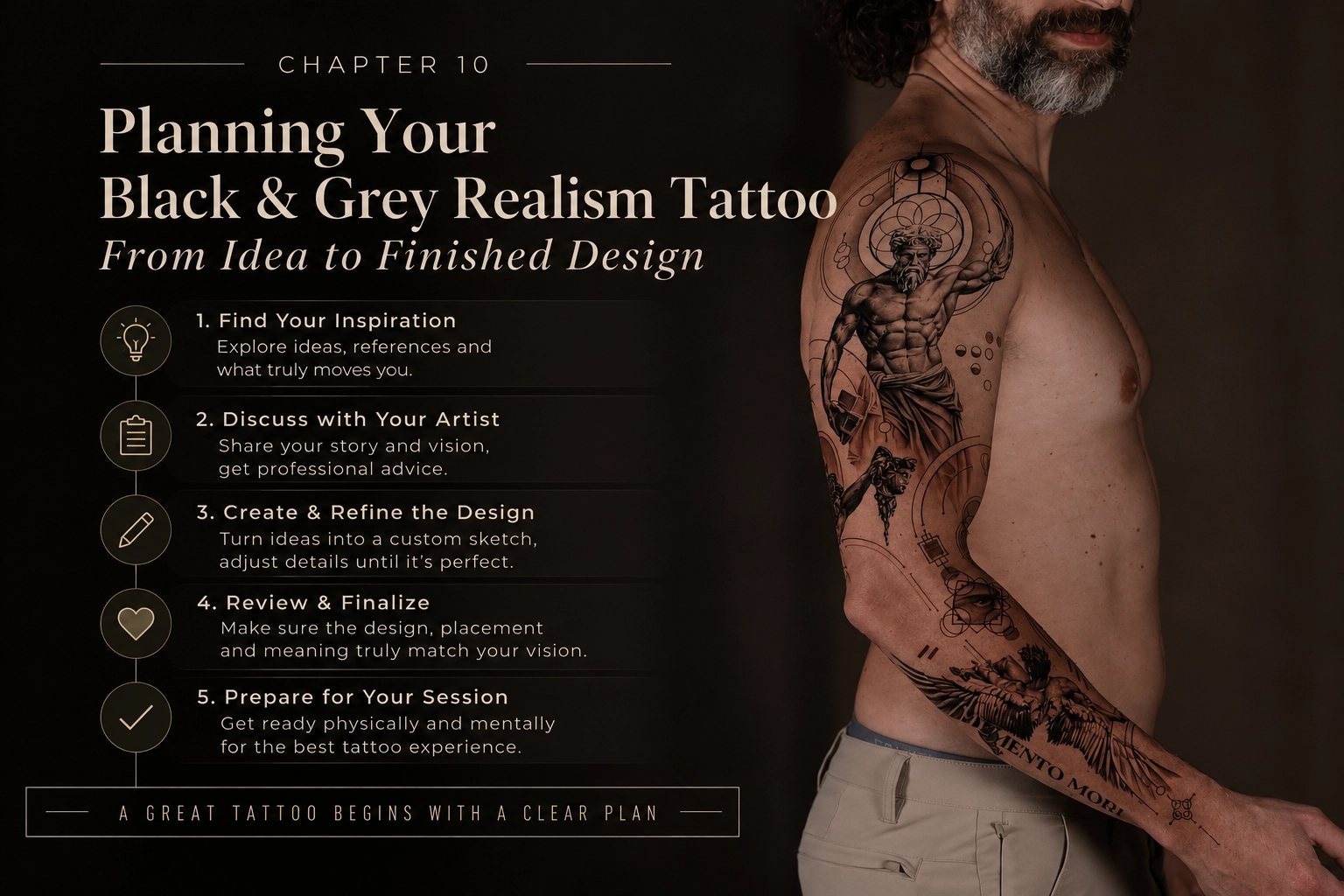
Black & Grey Realism Tattoo: The Complete Guide (2026) - Chapter 10 — Planning Your Black & Grey Realism Tattoo From Idea to Finished Design



Black & Grey Realism Tattoos
Chapter 10
Planning Your Black & Grey Realism Tattoo
From Idea to Finished Design
Quick Answer
The success of a Black & Grey Realism tattoo begins long before the tattoo machine touches the skin.
Great realism projects are built through careful planning:
-
choosing the right subject;
-
gathering strong references;
-
selecting the appropriate placement;
-
determining the correct size;
-
working with the artist during consultation;
-
and understanding what is realistically achievable on skin.
The better the planning process, the stronger the final tattoo becomes.
Every Great Tattoo Starts With an Idea
Most realism tattoos begin with a simple thought.
A memory.
A person.
An animal.
A meaningful object.
A story.
At this stage, the idea does not need to be fully developed.
Many collectors worry that they need to arrive with a complete design.
In reality, experienced realism artists often prefer starting with a concept rather than a finished drawing.
Their job is not simply to copy an image.
Their job is to transform an idea into a tattoo that works on the body.
Artist Insight
"The best consultations often begin with a story, not a design."
— Silver Ant Tattoo
Choosing the Right Subject
Not every image makes an equally strong realism tattoo.
Some subjects naturally translate well to skin because they contain:
-
clear lighting;
-
strong contrast;
-
recognizable forms;
-
emotional impact.
Popular realism subjects include:
Portraits
Family members.
Historical figures.
Musicians.
Actors.
Personal heroes.
Wildlife
Lions.
Tigers.
Wolves.
Owls.
Eagles.
Bears.
Religious & Mythological Imagery
Buddha.
Angels.
Samurai.
Greek gods.
Norse mythology.
Sculptures & Architecture
Classical statues.
Temples.
Cathedrals.
Historic monuments.
Personal Symbolism
Objects that represent memories, values, or important life experiences.
The strongest projects often combine multiple elements into a single cohesive composition.
Reference Images Matter More Than Most People Realize
A realism artist can only work with the visual information available.
Poor references often create unnecessary limitations.
When collecting references, look for images that have:
-
sharp focus;
-
clear lighting;
-
sufficient resolution;
-
visible details;
-
strong contrast.
Avoid:
-
blurry screenshots;
-
heavily filtered social media images;
-
AI-generated references with distorted anatomy;
-
low-resolution photos.
Good references make design easier.
Bad references create guesswork.
Did You Know?
Professional realism artists often combine multiple references into a single composition.
Rather than copying one image exactly, they may use:
-
one image for the face;
-
another for lighting;
-
another for pose;
-
another for background elements.
The final design becomes a custom artwork rather than a direct reproduction.
Why Size Matters
One of the most common mistakes in realism tattoo planning is choosing a size that is too small.
Realism depends on information.
Information requires space.
For example:
A portrait needs room for:
-
eyes;
-
nose;
-
mouth;
-
skin texture;
-
shadows;
-
highlights.
Trying to compress all of these elements into a very small tattoo often forces the artist to sacrifice readability.
As a general rule:
More detail requires more space.
A larger tattoo is not always better, but realism often benefits from sufficient scale.
Choosing the Right Placement
Placement affects:
-
composition;
-
visibility;
-
longevity;
-
comfort during tattooing;
-
future expansion possibilities.
Different placements create different opportunities.
Forearm
-
Excellent visibility
-
Good surface area
-
Popular for portraits and wildlife
Upper Arm
-
Versatile
-
Easy to expand into sleeves
-
Suitable for most realism subjects
Chest
-
Strong focal placement
-
Ideal for large compositions
Back
-
Maximum design freedom
-
Best for highly detailed large-scale projects
Leg
-
Excellent for vertical compositions
-
Allows significant detail
The best placement often depends on both the design and long-term tattoo plans.
Thinking Beyond One Tattoo
Many collectors initially plan a single tattoo.
Years later, they decide to add more.
This is why experienced artists often consider future possibilities during the first consultation.
Questions worth asking include:
-
Could this become a sleeve later?
-
Will additional subjects be added?
-
Should space be preserved for future expansion?
-
How will the tattoo connect with existing work?
Planning ahead can make future additions feel intentional rather than improvised.
The Consultation Process
A consultation is not merely an appointment to discuss price.
It is a creative planning session.
During consultation, a professional artist may ask:
-
What is the story behind the tattoo?
-
Which elements are most important?
-
What style do you prefer?
-
Where do you want the tattoo?
-
What size are you considering?
-
Are there examples of work you admire?
These questions help transform ideas into workable tattoo designs.
The more information you provide, the more effectively the artist can help.
Artist Note
Many clients worry when an artist suggests changing part of their original idea.
This is often a positive sign.
The artist is not rejecting the concept.
They are adapting it to work better as a tattoo.
Understanding Budget and Sessions
Large realism projects frequently require multiple sessions.
The final cost depends on factors such as:
-
size;
-
complexity;
-
placement;
-
number of sessions;
-
artist experience.
Instead of focusing solely on the total cost, think about the overall value.
A tattoo may remain on your skin for decades.
The planning process, artistic execution, and long-term readability often matter far more than short-term savings.
Trust the Design Process
One of the most important parts of realism tattooing is collaboration.
Clients bring:
-
ideas;
-
meaning;
-
personal stories.
Artists contribute:
-
design knowledge;
-
composition;
-
anatomy;
-
lighting;
-
technical execution.
The strongest projects emerge when both sides trust the process.
A successful consultation should feel less like placing an order and more like creating a custom artwork together.
Common Planning Mistakes
Choosing a Design That Is Too Small
Insufficient space often compromises realism.
Prioritizing Detail Over Composition
A tattoo should be readable before it becomes detailed.
Copying Another Tattoo Exactly
Custom designs generally create stronger long-term results.
Ignoring Placement
The body should influence the design from the beginning.
Rushing the Decision
Good tattoos benefit from thoughtful planning.
Preparing for Your Appointment
Before the tattoo session:
-
confirm the design;
-
review placement;
-
follow any instructions from your artist;
-
stay hydrated;
-
get sufficient rest;
-
communicate any concerns.
Preparation helps create a smoother experience for both artist and client.
From Concept to Artwork
A Black & Grey Realism tattoo is rarely created in a single step.
It evolves through stages:
Idea
↓
Research
↓
Reference Collection
↓
Consultation
↓
Design Development
↓
Placement Planning
↓
Tattoo Session
↓
Healing
↓
Finished Artwork
Every stage contributes to the final result.
Skipping steps often creates avoidable problems later.
Why the Planning Phase Is So Important
The difference between a good tattoo and an exceptional tattoo often becomes visible before tattooing even begins.
A well-planned project benefits from:
-
stronger composition;
-
better placement;
-
improved readability;
-
greater longevity;
-
more meaningful storytelling.
Planning doesn't limit creativity.
It creates the foundation that allows creativity to succeed.
Key Takeaways
-
Great realism tattoos begin with strong planning.
-
Good reference images improve design quality.
-
Size and placement significantly affect realism.
-
Consultations are part of the creative process.
-
Many successful projects require multiple sessions.
-
Trust between artist and client is essential.
-
Thoughtful preparation leads to stronger long-term results.
Final Thoughts
Black & Grey Realism is one of the most technically demanding and visually rewarding forms of tattooing.
Throughout this guide, we've explored:
-
the history of Black & Grey tattooing;
-
light and shadow;
-
portraits;
-
wildlife;
-
texture;
-
composition;
-
style comparisons;
-
longevity;
-
artist selection;
-
project planning.
While techniques and trends may evolve, the core principles remain the same:
Strong design.
Strong composition.
Strong understanding of light.
And a commitment to creating artwork that continues to resonate long after the tattoo has healed.
Whether you're planning your first realism tattoo or your next large-scale project, taking the time to understand these foundations will help you make informed decisions and achieve better results.
Because the best realism tattoos are not defined by how closely they resemble a photograph.
They are defined by how successfully they transform an idea into a lasting piece of art.
Further Reading
You may also enjoy:
-
The Ultimate Guide to Realism Tattoos
-
Color Realism Tattoos: The Complete Guide
-
Tattoo Placement Guide
-
Tattoo Healing Guide
-
Tattoo Aftercare Guide
-
The 7 Best Realism Tattoo Artists at Silver Ant Tattoo
Recommended Internal Links
-
Realism Tattoo Artists
-
Color Realism Tattoos
-
Tattoo Placement Guide
-
Tattoo Healing Guide
-
Tattoo Aftercare Guide
-
Tattoo Consultation Guide
-
Tattoo Pricing Guide
End of Guide