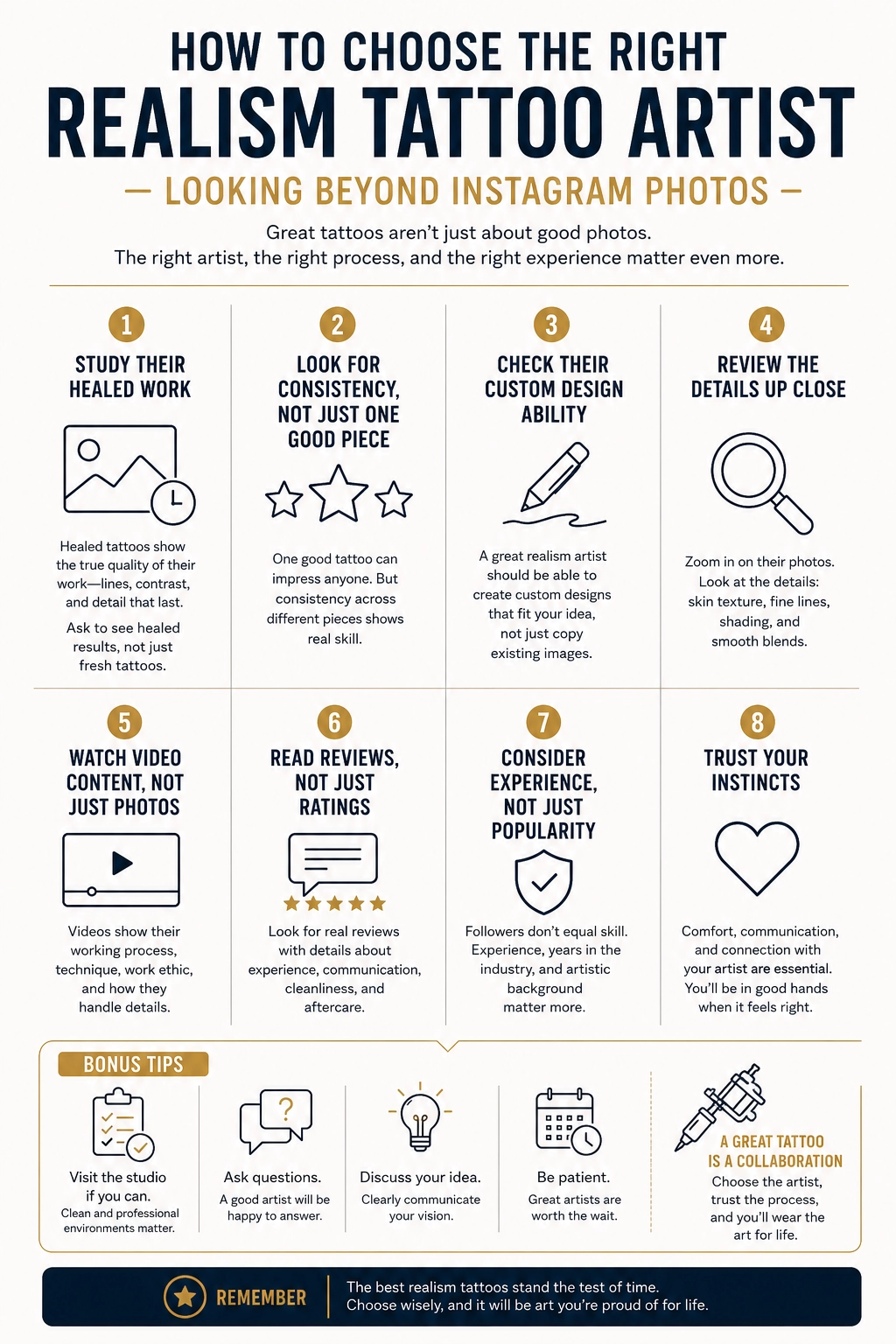
The Ultimate Guide to Realism Tattoos (2026) - Chapter 8 — How to Choose the Right Realism Tattoo Artist - Looking Beyond Instagram Photos



The Ultimate Guide to Realism Tattoos (2026)
Chapter 8
How to Choose the Right Realism Tattoo Artist
Looking Beyond Instagram Photos
Quick Answer
Choosing the right realism tattoo artist is far more important than choosing the perfect reference photo.
A skilled artist doesn't simply reproduce images—they understand composition, anatomy, skin behaviour, healing, and long-term readability. While social media portfolios can be helpful, they rarely tell the complete story.
The best artist is not necessarily the one with the most followers.
It's the one whose work continues to look exceptional years after it has healed.
Why This Decision Matters More Than the Design
Clients often spend weeks searching for the perfect reference photo.
Many spend only a few minutes choosing the artist.
That approach should be reversed.
A great artist can elevate an average reference into an outstanding tattoo.
An inexperienced artist can struggle even with a perfect photograph.
Realism is one of the most technically demanding tattoo styles because every mistake is immediately visible.
The quality of your artist will influence:
- the accuracy of the composition;
- the smoothness of the shading;
- the strength of the contrast;
- the way the tattoo heals;
- and how it looks years later.
No reference image can compensate for a lack of artistic understanding.
Artist Insight
"Clients sometimes ask if we can copy another tattoo exactly. Our answer is always the same: we'd rather create something that belongs to you. A realism tattoo should fit your anatomy, your story, and your future—not someone else's."
— Silver Ant Tattoo
Don't Judge an Artist by Fresh Tattoos Alone
Fresh tattoos almost always look their best.
The skin is tight.
The ink appears saturated.
Highlights are crisp.
Photographs are carefully lit.
While fresh work demonstrates technical execution, it does not reveal how the tattoo will mature.
A professional portfolio should ideally include:
- fresh tattoos;
- fully healed tattoos;
- projects photographed months or years later;
- large-scale compositions;
- close-up details;
- images taken in natural lighting.
Healed work demonstrates confidence.
It shows that the artist is willing to stand behind long-term results—not just the first impression.
If you'd like to understand why healing changes the appearance of a tattoo, continue with our Tattoo Healing Guide (/tattoo-guides/tattoo-healing).
Consistency Is More Important Than One Amazing Tattoo
Every artist has a favourite project.
Every portfolio has standout pieces.
The real question is:
Can they deliver that quality consistently?
Instead of looking for the single best tattoo in a portfolio, examine:
- Do multiple portraits share the same quality?
- Are shadows consistently smooth?
- Does the artist handle different skin tones well?
- Do sleeves flow naturally around the body?
- Are healed results consistently strong?
Consistency is one of the clearest signs of professional experience.
Did You Know?
Many experienced collectors judge an artist by their average work, not their best work.
One exceptional tattoo may be memorable.
A portfolio filled with consistently excellent tattoos is much harder to achieve.
A Consultation Should Feel Like a Conversation
The consultation is not simply about scheduling an appointment.
It is part of the creative process.
A professional artist should ask questions such as:
- Why do you want this tattoo?
- What story does it represent?
- Is this your first tattoo?
- How do you imagine expanding it in the future?
- Which parts of the reference image matter most to you?
These questions help transform an idea into a custom composition rather than a direct copy.
Likewise, clients should feel comfortable asking questions about:
- the design process;
- expected healing;
- placement recommendations;
- session planning;
- aftercare;
- and realistic expectations.
Our Tattoo Consultation Guide (/tattoo-guides/tattoo-consultation) explains how to prepare for your first meeting with a tattoo artist.
Technical Skill Is Only Half the Equation
Outstanding realism artists combine technical ability with artistic judgement.
They understand:
- anatomy;
- perspective;
- composition;
- lighting;
- colour theory;
- skin behaviour;
- and visual storytelling.
Just as importantly, they know when not to add more detail.
Restraint is often one of the clearest signs of experience.
The ability to simplify a composition without losing realism is a skill developed through years of observation and practice.
Scientific Note
Visual perception research consistently demonstrates that people recognise overall structure and contrast before fine detail. This reinforces why experienced artists prioritise composition and value relationships before texture.
Further Reading
- National Eye Institute — https://www.nei.nih.gov
- National Library of Medicine (PubMed) — https://pubmed.ncbi.nlm.nih.gov
Questions Every Client Should Ask
Before committing to a realism tattoo, consider asking your artist:
Do you have healed examples of similar projects?
Fresh tattoos show technique.
Healed tattoos show experience.
Will this design be customised?
A custom composition almost always produces a stronger long-term result than copying an existing tattoo.
Does this placement suit the design?
Professional artists often recommend changing placement to improve readability and longevity.
How will this tattoo age?
An experienced artist should be able to explain how contrast, size, placement, and healing influence long-term appearance.
Can this project grow into a sleeve later?
Thinking ahead allows future additions to feel intentional rather than improvised.
Red Flags to Watch For
Not every impressive social media profile reflects consistent professional work.
Potential warning signs include:
- portfolios containing only fresh tattoos;
- excessive image filters or heavy editing;
- unwillingness to discuss healing;
- reluctance to customise designs;
- unrealistic promises such as "this tattoo will never fade";
- rushing consultations or avoiding questions.
A trustworthy artist is usually transparent about both the strengths and limitations of realism tattooing.
Artist Note
At Silver Ant Tattoo, we believe choosing an artist should never feel like buying a product.
It should feel like selecting a creative partner.
The best projects happen when both the client and the artist contribute to the final design.
That collaboration often leads to tattoos that are not only technically stronger, but also far more meaningful.
Key Takeaways
✔ Choosing the artist is more important than choosing the reference photo.
✔ Healed work reveals far more than fresh portfolio images.
✔ Consistency matters more than one exceptional tattoo.
✔ A consultation should be collaborative, not transactional.
✔ Professional artists customise designs instead of copying them.
Continue Exploring
Learn more before planning your project:
- Tattoo Consultation Guide →
/tattoo-guides/tattoo-consultation - Tattoo Design Process →
/tattoo-guides/tattoo-design-process - Tattoo Placement Guide →
/tattoo-guides/tattoo-placement-guide - Tattoo Healing Guide →
/tattoo-guides/tattoo-healing - Portrait Tattoo Guide →
/tattoo-styles/portrait-tattoo
References & Further Reading
Art & Perception
- National Eye Institute — https://www.nei.nih.gov
- The Metropolitan Museum of Art — https://www.metmuseum.org
Skin & Healing
- American Academy of Dermatology — https://www.aad.org
- National Library of Medicine (PubMed) — https://pubmed.ncbi.nlm.nih.gov
Next Chapter
Chapter 9 — Healing & Longevity: Why the Best Realism Tattoos Are Judged Months Later, Not Minutes Later