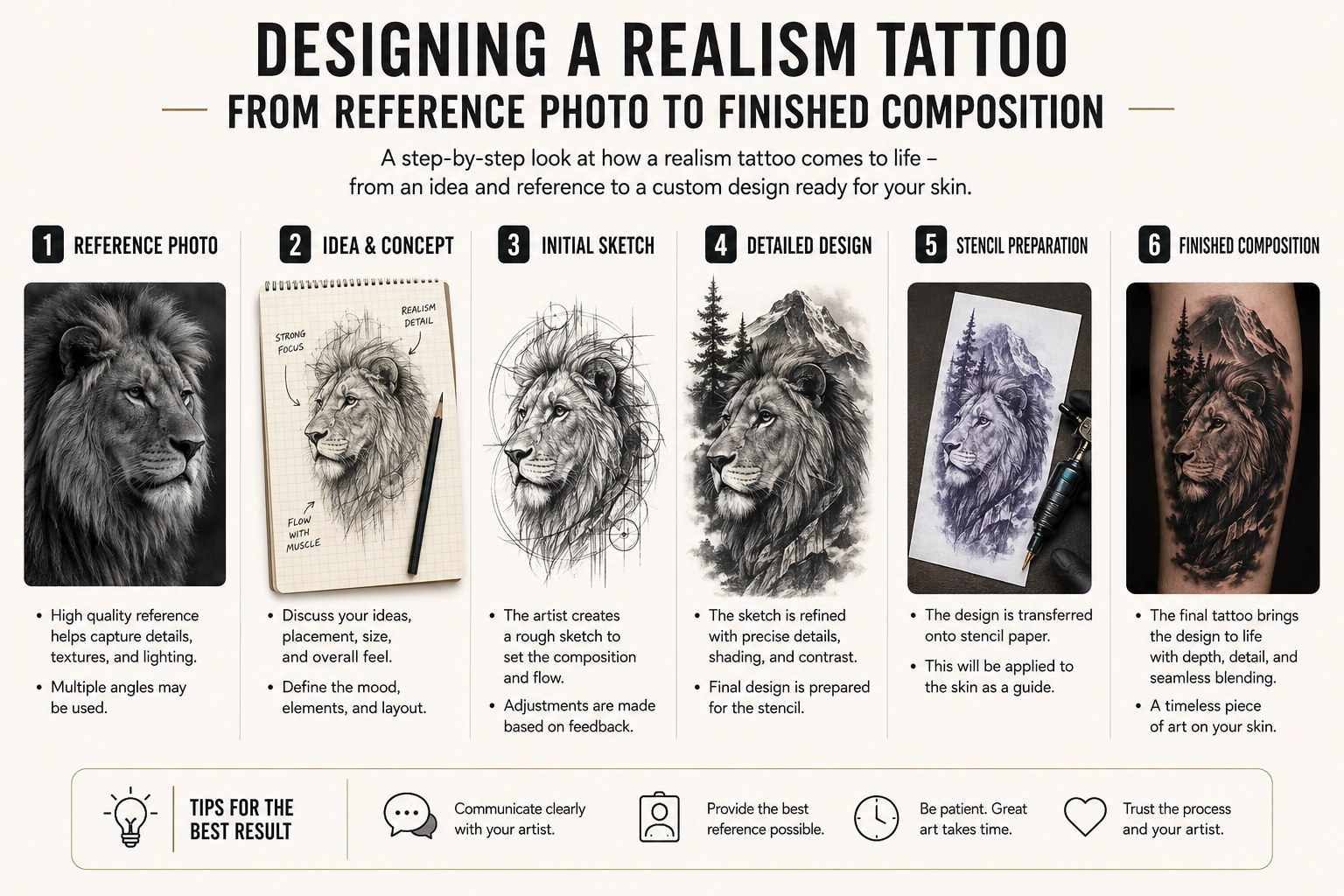
The Ultimate Guide to Realism Tattoos (2026) - Chapter 7 — Designing a Realism Tattoo From Reference Photo to Finished Composition



The Ultimate Guide to Realism Tattoos (2026)
Chapter 7
Designing a Realism Tattoo
From Reference Photo to Finished Composition
Quick Answer
A successful realism tattoo begins long before the tattoo machine is switched on. The design process transforms one or more reference images into a composition that works with the client's anatomy, preserves visual clarity, and remains readable as the tattoo naturally ages.
Professional artists don't simply copy photographs—they redesign them.
Every Great Tattoo Starts With a Better Question
Many first-time clients arrive with a single reference photo and ask,
"Can you tattoo this exactly?"
The better question is:
"How can we turn this idea into the strongest possible tattoo?"
These are two very different goals.
A photograph captures a single moment.
A tattoo becomes part of someone's body for decades.
Because of this, realism tattoo design is less about reproduction and more about translation.
The artist must translate a two-dimensional image into a composition that follows the natural shape of the body while preserving depth, balance, and long-term readability.
Artist Insight
"We don't design tattoos for a flat screen—we design them for shoulders that rotate, forearms that twist, and muscles that move. The body is part of the composition."
— Silver Ant Tattoo
Step 1: Understanding the Story
Before discussing placement, shading, or technical details, experienced artists begin with something much simpler:
Why do you want this tattoo?
The answer influences every design decision.
A memorial portrait requires a different emotional tone than a wildlife sleeve.
A family piece demands different priorities than a fantasy composition.
Understanding the story allows the artist to identify the true focal point of the tattoo—not just the subject, but the emotion behind it.
This is one reason consultations are far more than technical discussions.
They are creative conversations.
Step 2: Choosing the Right Reference Images
Contrary to popular belief, the highest-resolution photograph is not always the best reference.
Artists evaluate references based on several factors:
-
lighting quality;
-
viewing angle;
-
facial expression;
-
image distortion;
-
depth;
-
composition;
-
emotional impact.
Many projects combine multiple references into a single original composition.
For example:
-
one photograph for facial expression;
-
another for lighting;
-
another for background atmosphere.
The final design may look effortless, but it often represents hours of careful decision-making.
Did You Know?
Some of the strongest realism tattoos are created from three to ten different reference images, rather than a single photograph.
Each image contributes something unique to the final composition.
Step 3: Designing Around the Body
A tattoo should never feel like a sticker placed on the skin.
It should feel as though it belongs there.
This means the body itself becomes part of the design.
Professional artists consider:
-
muscle flow;
-
natural body curves;
-
joint movement;
-
future tattoo plans;
-
visual balance from multiple viewing angles.
A composition that works beautifully on the outer forearm may need significant redesign before it suits the chest or thigh.
Rather than forcing the artwork onto the body, experienced artists allow the body to guide the composition.
If you're still deciding where your tattoo should go, our Tattoo Placement Guide (/tattoo-guides/tattoo-placement-guide) explores how different areas influence design, readability, and longevity.
Step 4: Establishing the Focal Point
Every successful realism tattoo answers one question:
Where should the viewer look first?
Without a clear focal point, the eye wanders.
Details compete.
The composition feels confusing.
Artists establish focus through:
-
contrast;
-
scale;
-
lighting;
-
edge sharpness;
-
negative space;
-
directional flow.
Everything else supports that focal point.
Nothing competes with it.
This principle becomes especially important in large sleeves and back pieces where multiple subjects must coexist within a single composition.
Artist Note
At Silver Ant Tattoo, one of the most common revisions we make during consultations is reducing the number of competing focal points.
Clients often arrive with several meaningful ideas.
Our role is to organise those ideas into a composition that tells one clear visual story instead of several disconnected ones.
Step 5: Planning for Healing
Professional realism artists never design only for the fresh tattoo.
They design for the healed tattoo.
This affects decisions such as:
-
spacing between details;
-
shadow density;
-
line emphasis;
-
value separation;
-
texture complexity.
Elements that appear subtle on the day of the appointment often become much softer after healing.
Designing with healing in mind helps preserve clarity for years rather than months.
For a deeper understanding of this process, see our Tattoo Healing Guide (/tattoo-guides/tattoo-healing) and Tattoo Aftercare Guide (/tattoo-guides/tattoo-aftercare).
Scientific Note
Human skin begins repairing itself immediately after tattooing. As healing progresses, inflammation subsides, the epidermis renews, and the tattoo gradually settles into its final appearance. Understanding these biological processes helps artists make informed design decisions before tattooing even begins.
Further Reading
-
American Academy of Dermatology — https://www.aad.org
-
National Library of Medicine (PubMed) — https://pubmed.ncbi.nlm.nih.gov
Why Simplicity Often Creates Better Realism
Many people associate realism with complexity.
Experienced artists often associate realism with clarity.
Adding more background elements does not automatically improve a composition.
Neither does increasing the amount of detail.
In many cases, removing unnecessary visual information makes the subject feel stronger.
Professional artists constantly ask:
-
Does this texture add value?
-
Does this background support the story?
-
Does this detail strengthen the focal point?
If the answer is no, it is often removed.
The result is a cleaner, more timeless tattoo.
Common Mistake
"If I provide enough reference photos, the tattoo will automatically be better."
Reference images are only the starting point.
The quality of the final tattoo depends on how the artist interprets, edits, and redesigns those references—not on how many images are provided.
Custom Design vs Copying Someone Else's Tattoo
Using another person's tattoo as direct reference is one of the most common requests artists receive.
While it may seem harmless, it often limits creativity and leads to weaker results.
A custom realism tattoo should be designed around:
-
your anatomy;
-
your story;
-
your placement;
-
your long-term goals.
Using another tattoo as inspiration is perfectly acceptable.
Copying it exactly rarely is.
Original design almost always produces stronger, more personal artwork.
Key Takeaways
✔ Great realism tattoos begin with thoughtful design—not tattooing.
✔ Professional artists redesign photographs instead of copying them.
✔ Body anatomy should influence composition.
✔ Every realism tattoo needs a clear focal point.
✔ Healing should be considered before the first line is tattooed.
✔ Simplicity often creates stronger long-term realism than unnecessary complexity.
Continue Exploring
Continue building your knowledge with:
-
Tattoo Placement Guide →
/tattoo-guides/tattoo-placement-guide -
Tattoo Healing Guide →
/tattoo-guides/tattoo-healing -
Tattoo Aftercare Guide →
/tattoo-guides/tattoo-aftercare -
Portrait Tattoo Guide →
/tattoo-styles/portrait-tattoo -
Tattoo Consultation Guide →
/tattoo-guides/tattoo-consultation
References & Further Reading
Skin & Healing
-
American Academy of Dermatology — https://www.aad.org
-
National Library of Medicine (PubMed) — https://pubmed.ncbi.nlm.nih.gov
Art & Composition
-
The Metropolitan Museum of Art — https://www.metmuseum.org
-
Getty Museum — https://www.getty.edu
Next Chapter
Chapter 8 — How to Choose the Right Realism Tattoo Artist: Beyond Instagram Photos