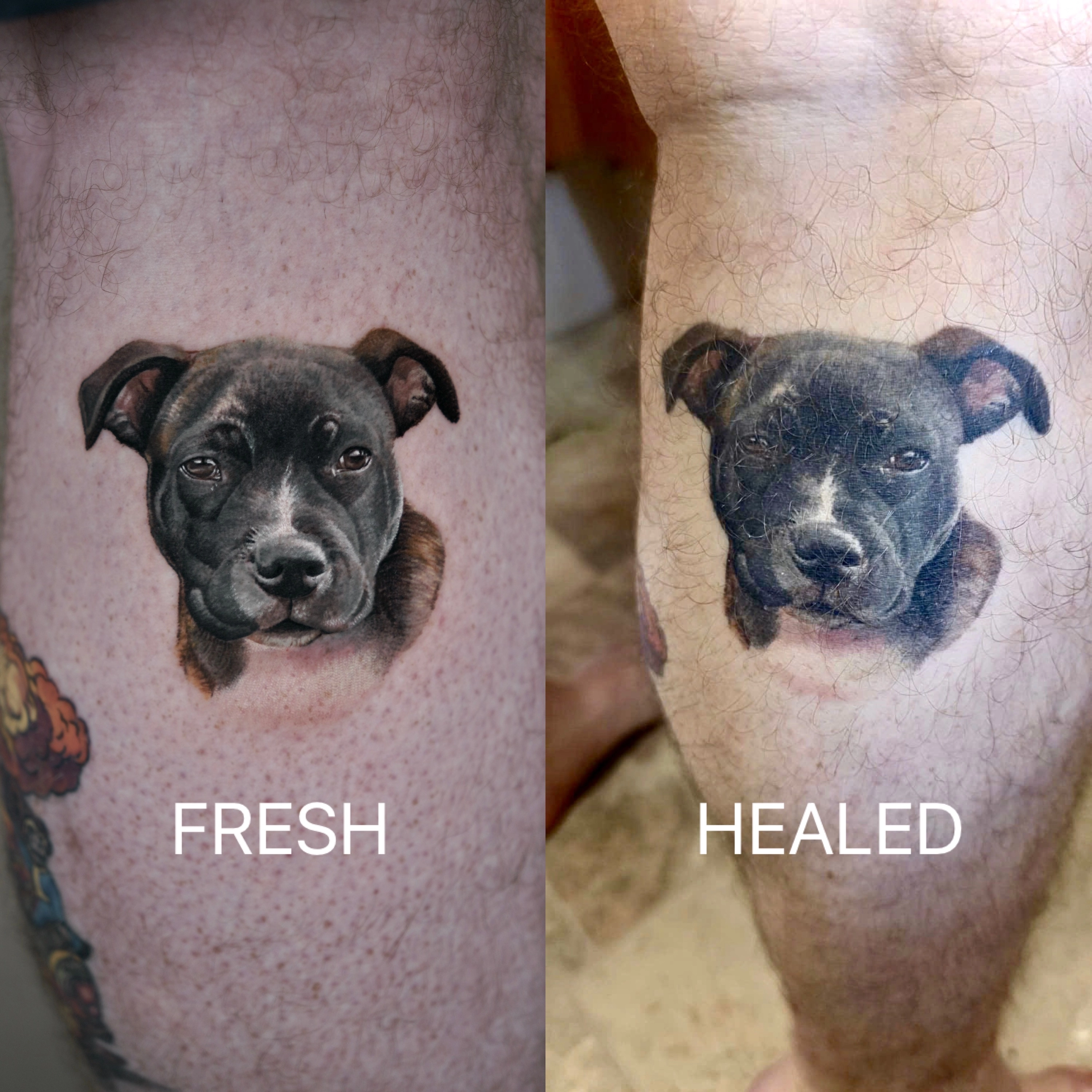
The Ultimate Guide to Realism Tattoos (2026) - Chapter 9 — Healing & Longevity - Why the Best Realism Tattoos Are Judged Months Later, Not Minutes Later



The Ultimate Guide to Realism Tattoos (2026)
Chapter 9
Healing & Longevity
Why the Best Realism Tattoos Are Judged Months Later, Not Minutes Later
Quick Answer
A realism tattoo is not finished when the session ends.
The healing process plays a crucial role in determining how the tattoo will ultimately look. During the weeks and months after tattooing, the skin repairs itself, inflammation subsides, and the artwork gradually settles into its long-term appearance.
This is why experienced realism artists evaluate success by healed results—not fresh tattoos.
The Fresh Tattoo Is Only the Beginning
Fresh tattoos receive the most attention online.
They appear darker.
Sharper.
More saturated.
Professional lighting, fresh skin, and high-resolution photography make every detail stand out.
But this is only the first stage of the tattoo's life.
Over the following weeks, the skin begins repairing itself. As healing progresses, the tattoo softens naturally and settles into a more balanced appearance.
This change is completely normal.
In fact, experienced artists expect it.
Rather than designing only for the first photograph, they design for the healed result.
Artist Insight
"We don't judge our realism tattoos on the day they're finished. We judge them months later, when the skin has fully recovered and the artwork begins its real life."
— Silver Ant Tattoo
What Happens During Healing?
Tattooing creates thousands of tiny openings in the skin.
Your body immediately begins repairing those micro-injuries.
Although every person heals differently, the process generally follows the same pattern.
Stage 1: Fresh Tattoo (Days 1–3)
The tattoo appears:
-
darker than expected;
-
slightly swollen;
-
highly saturated;
-
extremely crisp.
This appearance is temporary.
Stage 2: Peeling (Days 4–14)
The outer layer of skin begins renewing itself.
Light flaking and peeling are normal.
This is often the stage when clients worry their tattoo is "losing colour."
In reality, the tattoo is simply transitioning into the next phase of healing.
Stage 3: Settling (Weeks 3–8)
Surface healing is largely complete.
The tattoo begins looking more natural.
Contrast softens slightly.
Fine transitions become smoother.
The overall composition becomes easier to appreciate.
Stage 4: Fully Healed (Around 2–3 Months)
Although timelines vary from person to person, this is generally when realism tattoos reveal their intended appearance.
Professional artists often request healed photographs at this stage because they provide the most accurate representation of the final work.
If this is your first tattoo, our Tattoo Healing Guide (/tattoo-guides/tattoo-healing) explains each stage in greater detail, while our Tattoo Aftercare Guide (/tattoo-guides/tattoo-aftercare) covers the best practices for protecting your investment.
Scientific Note
Healing involves a complex interaction between inflammation, immune response, collagen remodelling, and epidermal renewal. Although tattoo pigment remains within the dermis, the surrounding skin continues to recover for weeks after the session.
Further Reading
-
American Academy of Dermatology — https://www.aad.org
-
National Library of Medicine (PubMed) — https://pubmed.ncbi.nlm.nih.gov
Why Healed Tattoos Matter More Than Fresh Tattoos
A fresh tattoo demonstrates technical execution.
A healed tattoo demonstrates artistic planning.
This distinction is especially important for realism.
When a tattoo heals, tiny transitions soften naturally.
If the original design relied on extremely subtle value differences, the image may gradually lose depth.
Experienced artists compensate for this long before the tattooing begins.
They strengthen contrast.
Simplify unnecessary textures.
Protect the focal point.
Allow breathing room within the composition.
These decisions often become invisible in fresh photos—but obvious years later.
When choosing a realism artist, always ask to see healed work in addition to fresh portfolio images.
Our How to Choose the Right Tattoo Artist Guide (/tattoo-guides/how-to-choose-a-tattoo-artist) explains why this is one of the most reliable indicators of long-term quality.
What Influences Long-Term Longevity?
Every realism tattoo ages.
The goal is not to stop ageing.
The goal is to help the tattoo age beautifully.
Several factors influence long-term appearance.
1. Artist Technique
Smooth saturation.
Balanced contrast.
Thoughtful composition.
Appropriate detail density.
These decisions begin before the first line is tattooed.
2. Placement
Areas exposed to frequent friction or constant stretching may soften differently over time.
Placement should always be considered during the design process.
See our Tattoo Placement Guide (/tattoo-guides/tattoo-placement-guide) to learn how different body areas affect longevity.
3. Sun Exposure
Ultraviolet light gradually affects both skin and tattoo pigments.
Consistent sun protection helps preserve contrast and colour.
4. Aftercare
Following professional aftercare instructions during the healing process gives the tattoo the best possible foundation for long-term success.
5. Lifestyle
Weight fluctuations, skin health, hydration, and general skincare habits all contribute to how a tattoo evolves over the years.
Did You Know?
Many experienced collectors judge a realism artist by photographs taken one year after healing, not immediately after the appointment.
Long-term results reveal the quality of the design far more accurately than fresh work ever can.
Can Realism Tattoos Last a Lifetime?
Yes—when they are thoughtfully designed, professionally executed, and properly cared for.
Will they look identical after twenty years?
No.
Neither will a painting exposed to sunlight every day.
Ageing is natural.
The objective is not perfection.
It is longevity with character.
Strong realism tattoos continue telling their story because their foundations—contrast, composition, anatomy, and visual hierarchy—remain intact even as the skin changes.
Common Misconception
"If my tattoo becomes slightly softer after healing, something went wrong."
Not at all.
Every tattoo softens to some degree as the skin heals.
Professional artists anticipate this process during the design stage.
The question is not whether the tattoo changes.
The question is whether it was designed to change gracefully.
Artist Note
One of the principles we value most at Silver Ant Tattoo is documenting healed work.
Fresh tattoos are exciting.
Healed tattoos are honest.
They allow both the artist and the client to evaluate how the design performs over time and provide valuable insight for future projects.
Key Takeaways
✔ A fresh tattoo is only the beginning of the journey.
✔ Healing is a normal biological process—not a flaw.
✔ Strong design becomes even more important after healing.
✔ Long-term readability depends on contrast, composition, placement, and proper care.
✔ Healed portfolio photos are one of the best indicators of an experienced realism artist.
Continue Exploring
Continue your realism journey with:
-
Tattoo Healing Guide →
/tattoo-guides/tattoo-healing -
Tattoo Aftercare Guide →
/tattoo-guides/tattoo-aftercare -
How to Choose a Tattoo Artist →
/tattoo-guides/how-to-choose-a-tattoo-artist -
Tattoo Placement Guide →
/tattoo-guides/tattoo-placement-guide -
Black & Grey Realism Tattoo →
/tattoo-styles/black-grey-realism-tattoo
References & Further Reading
Skin & Healing
-
American Academy of Dermatology — https://www.aad.org
-
National Library of Medicine (PubMed) — https://pubmed.ncbi.nlm.nih.gov
-
MedlinePlus — https://medlineplus.gov
Skin Biology
-
Cleveland Clinic — https://my.clevelandclinic.org
Next Chapter
Chapter 10 — Frequently Asked Questions About Realism Tattoos