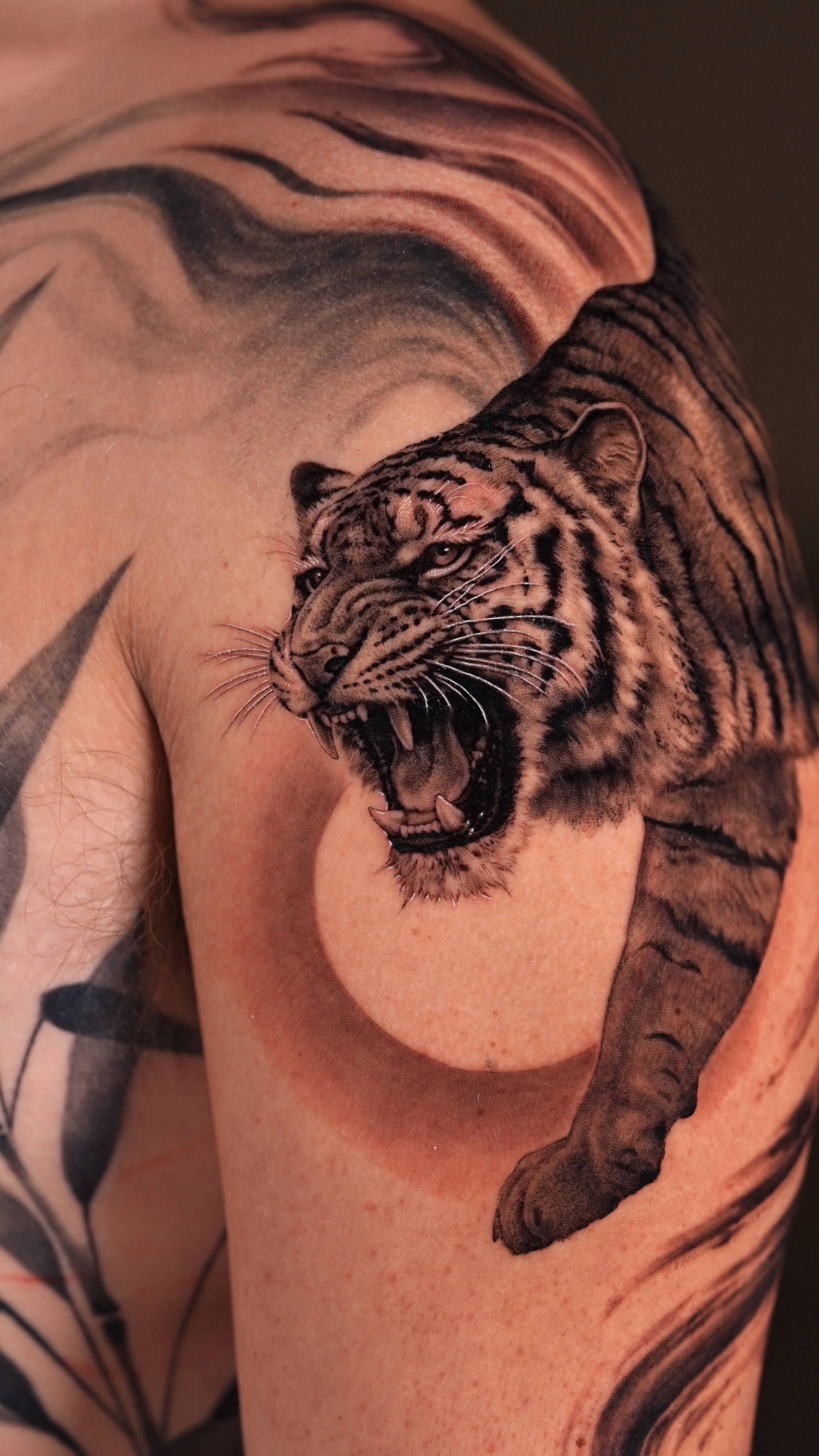
The Ultimate Guide to Realism Tattoos (2026) - Chapter 1 — What Is a Realism Tattoo? - Part 2 of 2



The Ultimate Guide to Realism Tattoos (2026)
Chapter 1 — What Is a Realism Tattoo?
Part 2 of 2
Skin Is Not Paper
One of the biggest differences between tattooing and every other visual art form is the surface itself.
A painter works on canvas.
A photographer captures light through a camera sensor.
A sculptor shapes stone.
A tattoo artist works on living human skin.
That difference changes everything.
Skin stretches when you move, contracts when muscles relax, heals after every tattoo session, and naturally changes throughout your lifetime. Sun exposure, age, hydration, collagen density, body weight, and even lifestyle all influence how a tattoo will look years after it is finished.
For realism artists, understanding skin is just as important as understanding anatomy or composition.
The goal is never to create the most detailed tattoo possible.
The goal is to create the tattoo that will remain the most convincing after healing.
This is why experienced artists constantly ask themselves questions that clients rarely consider:
-
Will this shadow still read clearly five years from now?
-
Is this transition too soft for this area of skin?
-
Does this body placement allow enough room for the details to breathe?
-
Will natural skin movement strengthen—or weaken—the composition?
Every answer influences the final design.
If you're unsure how placement affects a tattoo's longevity, our Tattoo Placement Guide (/tattoo-guides/tattoo-placement-guide) explains how different areas of the body influence detail retention, healing, and aging.
Artist Insight
"Many clients judge a realism tattoo by how it looks on the day it's finished. We judge it by how we expect it to look after the skin has fully settled. A beautiful fresh tattoo is only the beginning. A beautiful healed tattoo is the real goal."
— Silver Ant Tattoo
Designing for the Future, Not Just Today
One of the easiest ways to identify an experienced realism artist is by looking beyond fresh portfolio photos.
Fresh tattoos naturally appear darker, sharper, and more saturated because the skin is still healing.
A healed tattoo tells a much more important story.
Professional artists understand that every tattoo changes over time. Rather than fighting this reality, they design with it in mind.
This often means:
-
increasing contrast more than a photograph would suggest;
-
simplifying unnecessary textures;
-
avoiding overcrowded compositions;
-
allowing enough negative space for the image to breathe;
-
positioning focal points where the body's anatomy naturally supports them.
Ironically, many tattoos that appear slightly "simplified" on the day they are finished will look more realistic years later than tattoos packed with excessive micro-detail.
If you're deciding between monochrome and colour projects, our Black & Grey Realism Tattoo Guide (/tattoo-styles/black-grey-realism-tattoo) and Color Realism Tattoo Guide (/tattoo-styles/color-realism-tattoo) explain how each style evolves over time.
Scientific Note
Human skin continuously renews itself throughout life. Although tattoo pigment remains in the dermis, natural biological changes—including collagen remodelling, ultraviolet exposure, and ageing—gradually influence the way a tattoo is perceived.
Recommended Reading
-
American Academy of Dermatology — https://www.aad.org
-
National Library of Medicine (PubMed) — https://pubmed.ncbi.nlm.nih.gov
A Great Realism Tattoo Is Designed, Not Copied
Perhaps the most important lesson in this entire guide is also the simplest:
Realism is interpretation.
Not replication.
Professional tattoo artists don't ask,
"How can I copy this photograph?"
They ask,
"How can I recreate the same emotion on living skin?"
That shift in thinking changes every artistic decision.
Contrast becomes more important than tiny details.
Composition becomes more important than symmetry.
Readability becomes more important than perfection.
When these principles come together, the result is not simply a realistic tattoo.
It becomes a tattoo that continues telling its story for years.
Common Mistake
Many first-time collectors spend hours searching for the highest-resolution reference image they can find.
Resolution is helpful.
Understanding design is essential.
An experienced artist can create an outstanding realism tattoo from an average photograph.
An inexperienced artist can struggle even with a perfect one.
The quality of the reference never replaces the quality of the artist.
If you're preparing for your first consultation, our Tattoo Consultation Guide (/tattoo-guides/tattoo-consultation) explains how to choose reference images that inspire a custom design instead of limiting it.
Key Takeaways
✔ A realism tattoo is built on perception rather than photographic duplication.
✔ Human skin changes how every design should be planned.
✔ Strong contrast usually survives longer than excessive detail.
✔ Great realism artists simplify before they tattoo.
✔ The best portfolios always include healed work—not just fresh tattoos.
Continue Exploring
Tattoo Styles
-
Micro Realism Tattoo →
/tattoo-styles/micro-realism-tattoo -
Hyper Realism Tattoo →
/tattoo-styles/hyper-realism-tattoo -
Portrait Tattoo →
/tattoo-styles/portrait-tattoo -
Black & Grey Realism Tattoo →
/tattoo-styles/black-grey-realism-tattoo -
Color Realism Tattoo →
/tattoo-styles/color-realism-tattoo -
Fine Line Tattoo →
/tattoo-styles/fine-line-tattoo
Tattoo Guides
-
Tattoo Healing Guide →
/tattoo-guides/tattoo-healing -
Tattoo Aftercare Guide →
/tattoo-guides/tattoo-aftercare -
Tattoo Placement Guide →
/tattoo-guides/tattoo-placement-guide -
Tattoo Pain Chart →
/tattoo-guides/tattoo-pain-chart -
Tattoo Consultation Guide →
/tattoo-guides/tattoo-consultation -
Tattoo Design Process →
/tattoo-guides/tattoo-design-process
References & Further Reading
The following resources provide additional insight into the artistic, scientific, and biological principles discussed in this chapter.
Art & Visual Theory
-
The Metropolitan Museum of Art — https://www.metmuseum.org
-
Getty Museum — https://www.getty.edu
Skin & Healing
-
American Academy of Dermatology — https://www.aad.org
-
National Library of Medicine (PubMed) — https://pubmed.ncbi.nlm.nih.gov
Vision & Perception
-
National Eye Institute — https://www.nei.nih.gov
Chapter Summary
Understanding realism tattooing begins with understanding one simple truth:
A tattoo does not become realistic because every detail has been copied.
It becomes realistic because every artistic decision supports the illusion of life.
That illusion depends on far more than technical ability. It relies on observation, design, anatomy, perception, and a deep understanding of how tattoos continue evolving long after the appointment ends.
The next chapter explores where realism tattooing came from, how it evolved alongside painting and photography, and why today's realism artists still rely on artistic principles established centuries ago.
Next Chapter
Chapter 2 — The Evolution of Realism Tattoo: From Renaissance Masters to Modern Tattoo Machines