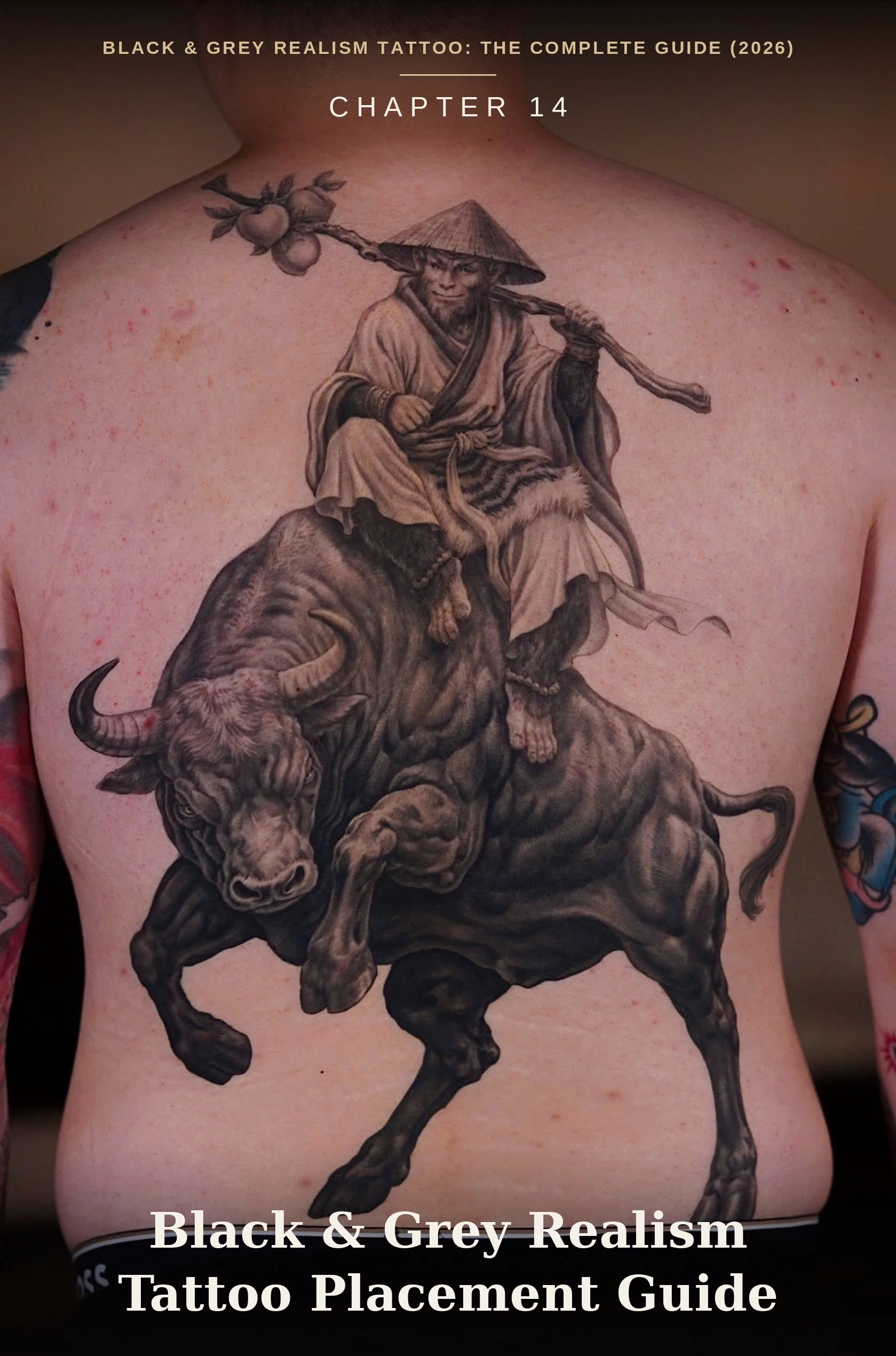
Black & Grey Realism Tattoo: The Complete Guide (2026) - Chapter 14 — Black & Grey Realism Tattoo Placement Guide



Black & Grey Realism Tattoo: The Complete Guide (2026)
Chapter 14 — Black & Grey Realism Tattoo Placement Guide
How to Choose the Right Body Placement for a Realism Tattoo
Choosing the right placement is not simply about finding an empty space on your body.
For a Black & Grey Realism tattoo, placement affects almost everything:
-
how large the design can be;
-
how much detail the artist can use;
-
how the tattoo follows the body's shape;
-
how the image looks when your body moves;
-
how much sunlight and friction it receives;
-
and how the composition will look years from now.
A realistic tattoo is an image built specifically for a three-dimensional surface.
The body is not a flat canvas.
A portrait on the upper arm behaves differently from a portrait on the forearm. A landscape on the back can be designed differently from one on the calf. A small realistic animal may work beautifully in one location but become visually crowded in another.
So before choosing the design, it is worth choosing the canvas.
Quick Answer
There is no single "best" placement for every Black & Grey Realism tattoo.
The right location depends on the subject, size, level of detail, body shape and how visible you want the tattoo to be.
Common placements for Black & Grey Realism include:
-
upper arm;
-
forearm;
-
full sleeve;
-
shoulder;
-
chest;
-
back;
-
thigh;
-
calf;
-
ribs;
-
and lower leg.
For highly detailed realism, larger and relatively stable areas generally give the artist more room to build smooth gradients, realistic textures and clear separation between elements.
The most important thing is to choose the placement together with the design, rather than treating them as two completely separate decisions.
1. Why Placement Matters So Much in Realism
A realistic image needs proportion.
If the image is forced into an unsuitable area, the artist may have to reduce important details, distort the composition or make the tattoo smaller than ideal.
For example, a realistic portrait needs enough vertical space for:
-
the forehead;
-
eyes;
-
nose;
-
mouth;
-
chin;
-
neck;
-
and surrounding shadows.
Trying to compress all of this into a very small area can make the image unnecessarily difficult to read.
The same principle applies to animals, architecture, landscapes and other realistic subjects.
The design should fit the body rather than simply being placed on top of it.
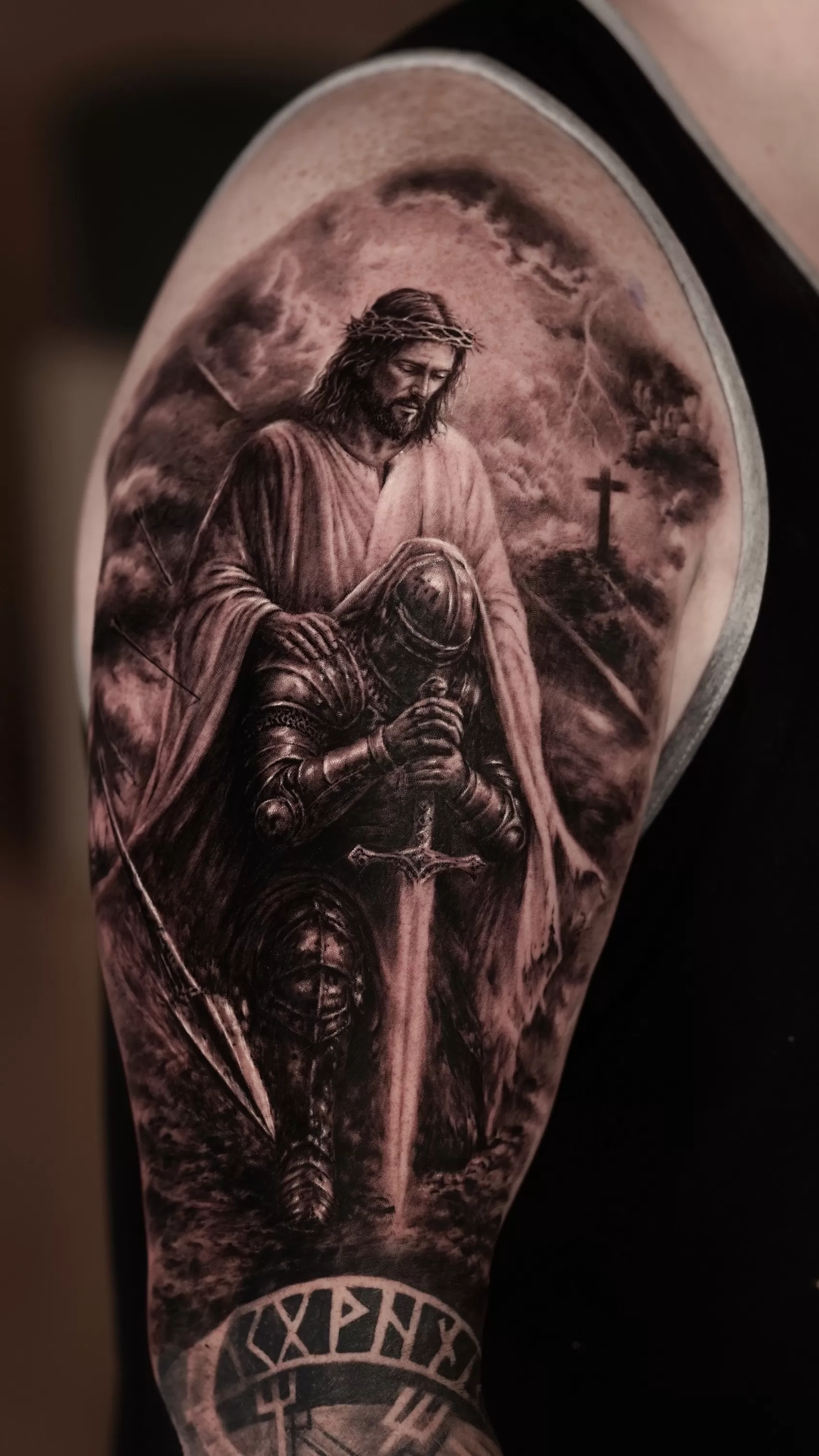
2. Upper Arm
The upper arm is one of the most versatile locations for Black & Grey Realism.
It provides a relatively broad surface and can accommodate both vertical and slightly curved compositions.
It works particularly well for:
-
portraits;
-
animals;
-
statues;
-
religious imagery;
-
flowers;
-
realistic objects;
-
and larger compositions.
The shoulder and upper arm also allow an artist to build the design around the natural shape of the muscle.
A portrait can be positioned so that the face remains visually strong from different angles rather than looking like a flat rectangular image.
Why choose the upper arm?
Good for: medium to large realism pieces, portraits, animals and future sleeve projects.
Visibility: moderate. It can be covered relatively easily.
Design flexibility: high.
3. Forearm
The forearm is one of the most popular placements for people who want their tattoo to be visible.
Its relatively long shape naturally suits vertical compositions.
It can work particularly well for:
-
portraits;
-
animals;
-
figures;
-
flowers;
-
swords or objects;
-
architectural subjects;
-
and elongated compositions.
The forearm is also useful when you want the tattoo to be readable from a distance.
However, the available width matters.
A highly detailed image may need to be enlarged rather than compressed.
4. Full Sleeve
A full Black & Grey Realism sleeve is not simply a collection of individual tattoos.
The strongest sleeves are usually planned as one composition.
This allows the artist to consider:
-
the shoulder;
-
upper arm;
-
elbow;
-
forearm;
-
wrist;
-
negative space;
-
transitions;
-
and the direction in which the whole piece flows.
A sleeve can combine several subjects while maintaining one visual language.
For example:
portrait + architecture + landscape + texture
can be connected through consistent shading, background elements and tonal structure.
The advantage of planning the entire sleeve from the beginning is that each tattoo does not have to compete with the next one.
5. Shoulder
The shoulder has a naturally rounded surface.
This makes it particularly interesting for compositions that can follow the body's curve.
Good subjects can include:
-
animal heads;
-
portraits;
-
flowers;
-
statues;
-
masks;
-
and circular or semi-circular compositions.
The design should account for the shoulder's movement.
A composition that looks perfect when the arm is hanging naturally may look different when the arm is raised.
An experienced artist will consider this before finalising the stencil.
6. Chest
The chest provides a large canvas and allows much more ambitious compositions.
It can work for:
-
large portraits;
-
animals;
-
religious imagery;
-
statues;
-
landscapes;
-
and multi-element realism compositions.
The chest also offers the possibility of designing across the body's central structure.
For example, a large composition can be built around the sternum and pectoral muscles rather than treating the chest as a flat rectangle.
One important consideration
The chest moves when you breathe.
This sounds obvious, but it matters when designing a highly detailed image.
The artist needs to consider the body's natural movement rather than simply reproducing an image at a fixed angle.
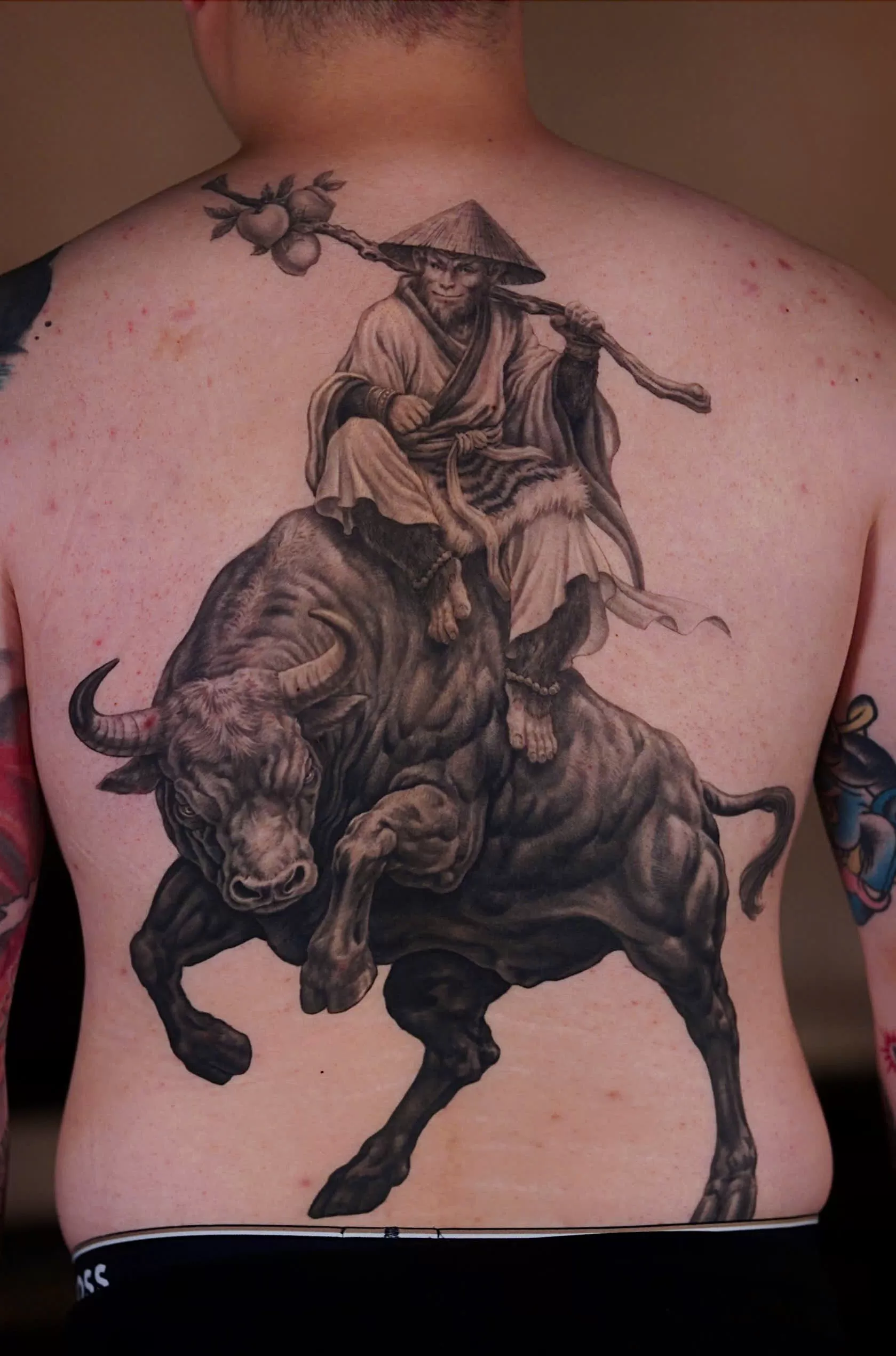
7. Back
The back is one of the largest areas available for tattooing.
For large Black & Grey Realism projects, it offers enormous design potential.
A back piece can contain:
-
large portraits;
-
multiple figures;
-
architecture;
-
landscapes;
-
animals;
-
dramatic scenes;
-
or combinations of several subjects.
The large surface also gives the artist more freedom to create transitions between major elements.
A detailed back piece can be designed as a single artwork rather than several isolated images.
Best for
People who want a large-scale realism composition with significant visual impact.
8. Thigh
The thigh offers a broad area that works particularly well for medium-to-large realism tattoos.
It can accommodate detailed subjects without forcing the design into an unnecessarily small format.
Popular choices include:
-
portraits;
-
animals;
-
statues;
-
flowers;
-
landscapes;
-
and large objects.
Another advantage is that the tattoo can remain relatively private under normal clothing.
This makes the thigh a practical option for people who want a substantial tattoo without having it visible every day.
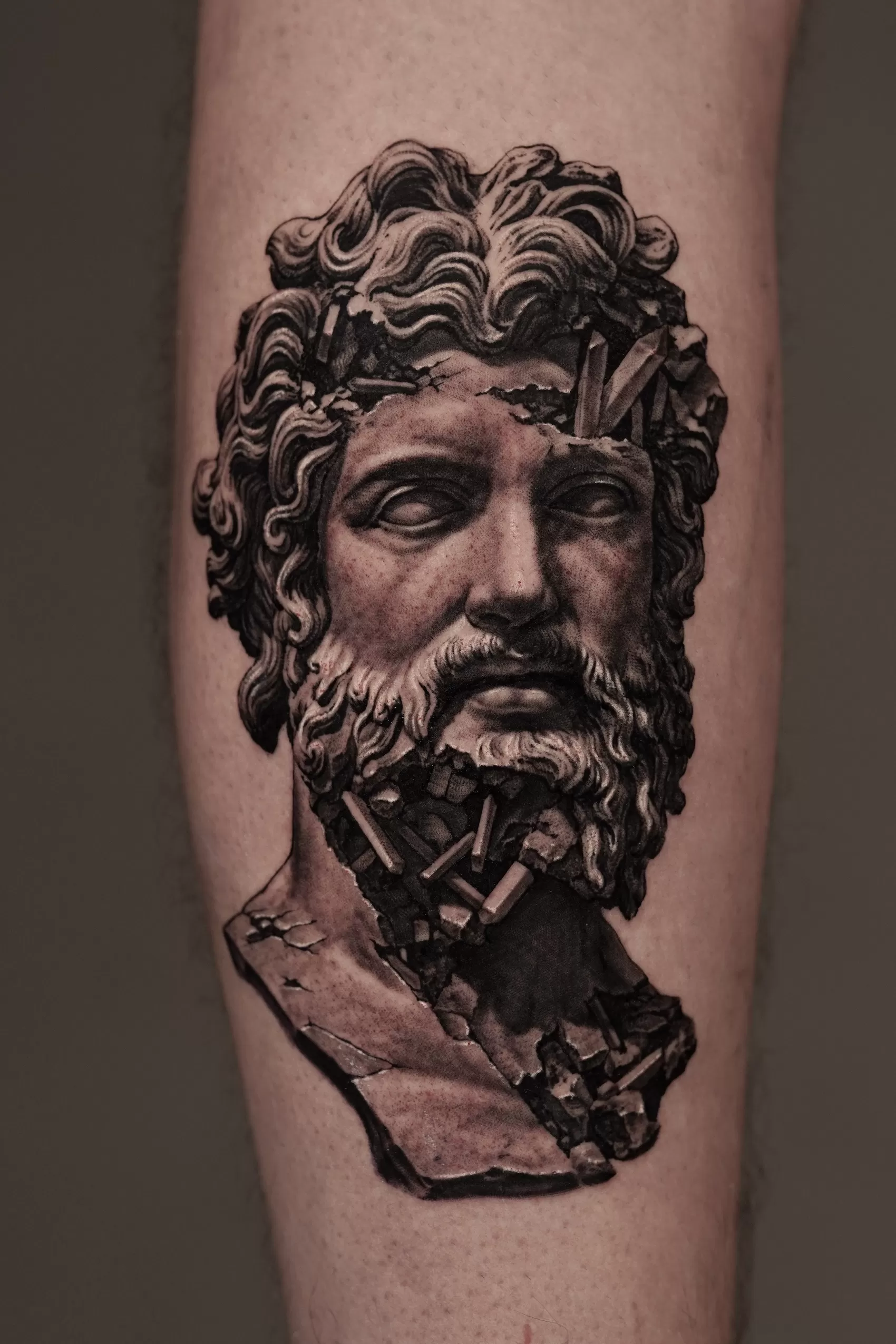
9. Calf
The calf has a naturally elongated shape.
This makes it suitable for vertical compositions.
Examples include:
-
portraits;
-
animals;
-
statues;
-
figures;
-
architectural elements;
-
and landscape scenes.
The curvature of the calf should be considered when positioning the central subject.
A good design can follow the muscle instead of appearing like an image simply pasted onto the leg.
10. Ribs
The ribs provide a long surface that can accommodate interesting compositions.
However, this area is often more sensitive than some other placements.
The design also needs to account for the body's movement and curvature.
Rib tattoos can work particularly well when the composition has a strong vertical or flowing structure.
They can be visually striking while remaining relatively easy to conceal with clothing.
11. Knee and Elbow
Joints require special consideration.
The skin and surface shape change significantly when the joint moves.
For that reason, placing highly detailed focal elements directly over a joint requires careful planning.
Rather than forcing the main subject across the most difficult part of the anatomy, the artist may use the surrounding area for the important details and allow the joint to become part of the overall composition.
This is particularly important when designing a sleeve.
The elbow does not have to be the centre of attention.
It can instead become a transition point between larger sections of the tattoo.
12. Hand and Fingers
Hands and fingers can be attractive placements for small tattoos, but they are not always ideal for highly detailed realism.
These areas experience:
-
frequent washing;
-
friction;
-
movement;
-
sunlight;
-
and constant use.
Because of this, tattoos in these locations can require more maintenance over time.
The limited space also means extremely detailed realism can become difficult to reproduce without reducing the design.
If you want a highly detailed portrait or complex realism composition, a larger area may provide a better canvas.
13. Neck
The neck is a highly visible placement and has a relatively complex surface.
A realism tattoo here needs to work with:
-
the jawline;
-
neck muscles;
-
natural curves;
-
and movement.
Because of the limited space in many areas of the neck, the design should be carefully simplified without losing its main visual characteristics.
It is generally better to create a strong, readable composition than to try to squeeze too many tiny details into the area.
14. Choosing Placement Based on Tattoo Size
Size and placement should be considered together.
A useful way to think about it is:
More detail → more space.
This does not mean every realism tattoo has to be large.
A skilled artist can create beautiful small realism tattoos.
But there are physical limits to how much information can remain visually separated inside a small area.
If your reference image contains hundreds of subtle details, the artist may recommend increasing the size.
That recommendation is not necessarily about charging for a larger tattoo.
It can simply be about giving the design enough room to work.
15. Placement for Portrait Tattoos
Portraits are particularly sensitive to size and placement.
The human face contains many small relationships.
A few millimetres can affect:
-
the eyes;
-
nose;
-
mouth;
-
facial proportions;
-
and expression.
For this reason, the artist needs enough space to reproduce the important characteristics of the reference.
Common placements
-
upper arm;
-
forearm;
-
thigh;
-
chest;
-
calf;
-
back;
-
and full sleeve compositions.
The best location depends on the portrait's orientation and the overall design.
16. Placement for Animal Tattoos
Animal realism gives you more freedom because different subjects have different shapes.
A wolf's head, for example, has a very different composition from a snake or a bird.
The animal's natural proportions should influence the placement.
A long subject may work better along the forearm or calf.
A compact animal head may work well on the shoulder or upper arm.
A full animal scene may need the thigh, back or chest.
The important thing is to avoid designing the animal first and deciding where to put it later.
17. Placement for Landscape and Architecture
Landscape realism benefits from horizontal space.
Architecture can also require enough room for:
-
perspective;
-
windows;
-
columns;
-
roofs;
-
shadows;
-
atmospheric depth;
-
and surrounding elements.
Large surfaces such as the back, thigh, chest or upper arm can provide more flexibility.
For smaller areas, the artist may simplify the scene and focus on the most recognisable elements.
This is where composition becomes more important than simply copying every detail from a reference photograph.
18. Placement and Tattoo Visibility
Placement is also a personal decision about visibility.
Before choosing a location, ask yourself:
Do I want to see the tattoo every day?
Consider the forearm, hand, neck or other visible areas.
Do I want to be able to cover it?
The upper arm, thigh, back and chest offer more flexibility.
Do I work in an environment where tattoos need to be covered?
This should be considered before committing to a highly visible placement.
Do I want the tattoo to be part of a future sleeve?
If yes, plan the surrounding anatomy before starting with an isolated piece.
19. Placement and Sun Exposure
Some body areas receive much more sunlight than others.
Forearms, hands and lower legs may spend significant amounts of time exposed outdoors.
Other areas are normally covered by clothing.
This does not mean you should avoid visible placements.
It simply means that long-term sun protection becomes especially relevant.
If you travel frequently, spend a lot of time outdoors or live in a sunny climate, consider how much UV exposure your tattoo will receive over the years.
20. Placement and Friction
Friction is another practical factor.
Consider areas that regularly come into contact with:
-
clothing;
-
shoes;
-
equipment;
-
bags;
-
watches;
-
or other surfaces.
For a fresh tattoo, this can affect comfort during healing.
For a healed tattoo, repeated irritation and environmental exposure are simply part of the long-term conditions your skin experiences.
Your lifestyle should therefore influence your placement decision.
21. How the Tattoo Looks When Your Body Moves
One of the biggest differences between a tattoo and a printed photograph is movement.
Your body is constantly changing shape.
When you:
-
bend your arm;
-
raise your shoulder;
-
sit down;
-
walk;
-
twist your torso;
the tattoo moves with you.
A good realism composition should account for this.
The focal point should remain visually strong rather than becoming distorted by normal movement.
This is especially important for large pieces and tattoos crossing joints.
22. Don't Choose Placement From a Reference Photo Alone
A common mistake is showing an artist a tattoo from Instagram and saying:
"I want exactly this placement."
The reference may have been designed for a completely different body.
Different people have different:
-
proportions;
-
muscle structure;
-
skin surfaces;
-
arm lengths;
-
leg shapes;
-
and existing tattoos.
The same design may need to be rotated, enlarged, reduced or restructured to work properly on your body.
Use reference tattoos to communicate the idea, not necessarily the exact placement.
23. How a Professional Artist Approaches Placement
A good consultation should consider both the artwork and the body.
The artist may look at:
-
the size you want;
-
the reference image;
-
the anatomy of the area;
-
existing tattoos;
-
your daily activities;
-
visibility;
-
future tattoo plans;
-
and the level of detail required.
Sometimes the best recommendation will be different from the location you initially imagined.
That is not necessarily a problem.
The purpose of a consultation is to find the placement where the artwork and the body work together.
24. Planning Around Existing Tattoos
If you already have tattoos, the new realism piece needs to coexist with them.
The artist may need to consider:
-
existing black areas;
-
old faded tattoos;
-
negative space;
-
colours;
-
composition;
-
and visual weight.
A new tattoo does not always need to cover an old one.
Sometimes the stronger solution is to build a new composition around the existing work.
This is especially important when creating sleeves or larger connected projects.
25. The Best Placement Is the One That Fits the Design
There is no universal answer to:
"Where is the best place for a Black & Grey Realism tattoo?"
A portrait, landscape, animal and architectural composition may each have different requirements.
Instead of choosing a body part first and forcing a design into it, think in this order:
1. What do you want to tattoo?
Portrait, animal, landscape, object, architecture or something else?
2. How detailed is the design?
More detail usually requires more room.
3. How large should it be?
The artist can help determine an appropriate size.
4. How visible do you want it to be?
Consider your work and lifestyle.
5. How should it interact with your body?
Think about curves, muscles and movement.
6. What will happen next?
If you might eventually build a sleeve or larger composition, plan for it now.
Black & Grey Realism Tattoo Placement Guide at a Glance
| Placement | Best Suited For | Visibility | Design Flexibility |
|---|---|---|---|
| Upper Arm | Portraits, animals, medium-large realism | Medium | High |
| Forearm | Portraits, animals, vertical designs | High | High |
| Shoulder | Animal heads, portraits, curved compositions | Medium | High |
| Full Sleeve | Large connected realism compositions | High | Very High |
| Chest | Large portraits, scenes, symbolic realism | Medium | Very High |
| Back | Large-scale realism and multi-element pieces | Low | Very High |
| Thigh | Large portraits, animals, landscapes | Low | Very High |
| Calf | Vertical realism compositions | Medium | High |
| Ribs | Flowing and vertical designs | Low | Medium |
| Hand/Fingers | Small, simpler designs | Very High | Low |
| Neck | Compact, highly visible designs | Very High | Medium |
Frequently Asked Questions
What is the best placement for a Black & Grey Realism tattoo?
There is no single best placement. The right location depends on the design, size, detail level, body shape, visibility and lifestyle.
Is the upper arm good for realism tattoos?
Yes. The upper arm offers a relatively broad and versatile surface for portraits, animals and other medium-to-large realism designs.
Is the forearm good for a realism portrait?
It can be. The forearm's vertical shape can work well for portraits, provided the tattoo has enough width and size for the required detail.
What is the best body part for a large realism tattoo?
Large areas such as the back, thigh and chest provide substantial space for complex compositions. Upper arms and full sleeves can also work well depending on the design.
Are hands good for realism tattoos?
Small realism tattoos can work on the hands, but the area experiences frequent movement, washing, friction and sun exposure. The limited space can also restrict detail.
Does tattoo placement affect how long a realism tattoo lasts?
Placement can influence long-term exposure to sunlight, friction and movement. These factors can affect how a tattoo changes over time.
Should I choose the tattoo design or placement first?
Ideally, they should be planned together. The subject, proportions and level of detail should determine which areas of the body can accommodate the design properly.
Should a realism tattoo be bigger for more detail?
Not always, but highly detailed designs generally benefit from having enough space. Making a tattoo slightly larger can sometimes allow the artist to preserve important details and tonal transitions more effectively.
Can I use another person's tattoo as a placement reference?
Use it as inspiration rather than an exact template. Your body has different proportions and contours, so the design may need to be adapted to fit you.
Final Thoughts
A Black & Grey Realism tattoo is not simply an image transferred onto the body.
It is a composition built around the body.
The curve of the shoulder.
The length of the forearm.
The shape of the thigh.
The movement of the chest.
The structure of the back.
All of these can become part of the artwork.
This is why placement should be discussed before the final design is created.
A good realism tattoo does not fight the anatomy.
It uses it.
And when the subject, size, detail and placement are planned together, the result can look more natural, more balanced and easier to live with for years.
At Silver Ant Tattoo in Hanoi, every realism project starts with more than a reference image. We look at the idea, the body area, the required size and the level of detail needed to make the design work as a tattoo — not simply as a picture.
The body is the canvas.
The placement is part of the design.