The Ultimate Guide to Realism Tattoos (2026) - Chapter 10 — Frequently Asked Questions About Realism Tattoos



The Ultimate Guide to Realism Tattoos (2026)
Chapter 10
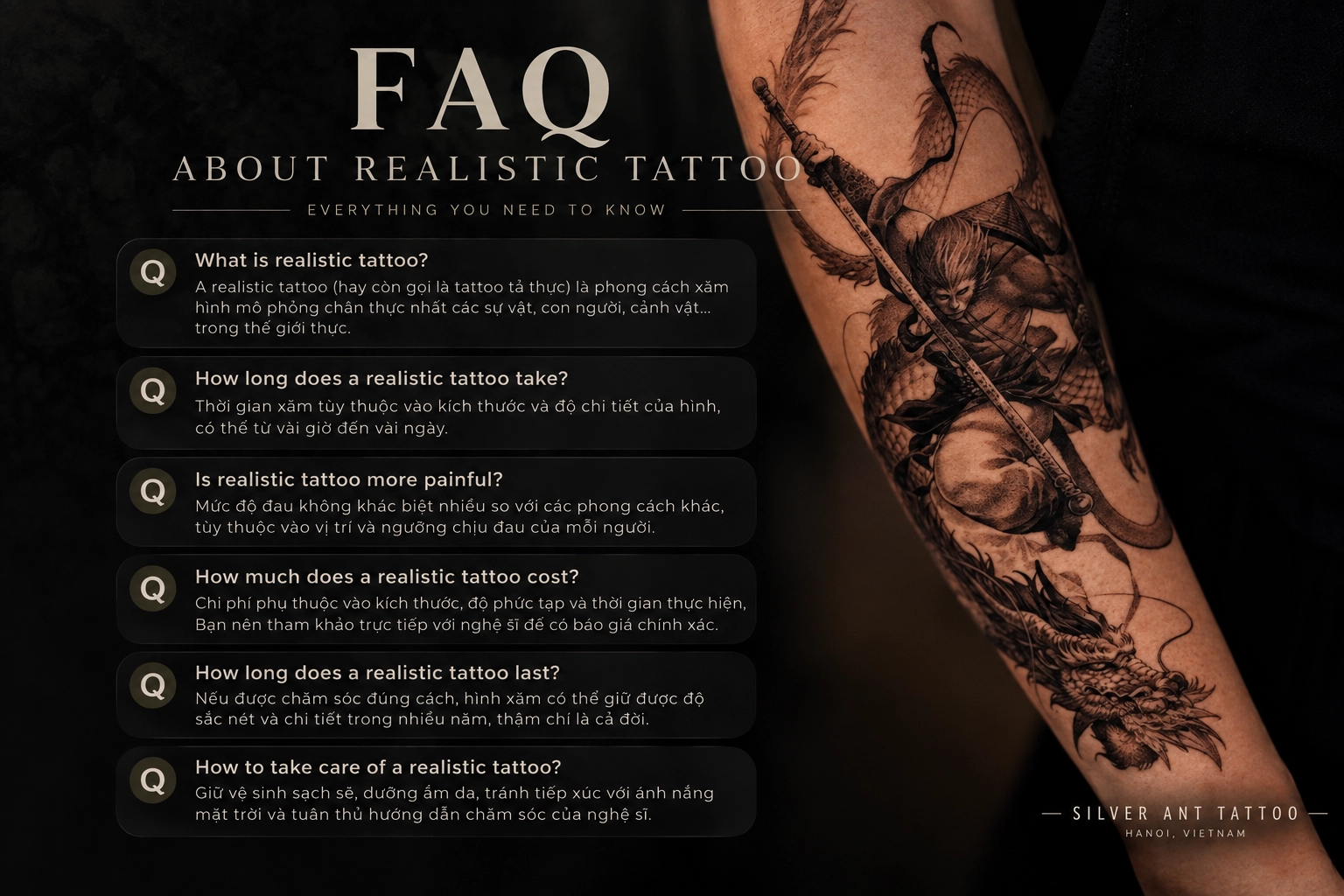
Frequently Asked Questions About Realism Tattoos
1. What is a realism tattoo?
A realism tattoo is a tattoo style that recreates real-life subjects using light, shadow, texture, and tonal transitions to create the illusion of three-dimensional depth. Rather than relying on bold outlines, realism focuses on accurate proportions, smooth shading, and carefully controlled contrast.
Unlike simply copying a photograph, professional realism artists redesign images to suit human skin, ensuring the tattoo remains clear and visually balanced after healing.
2. Do realism tattoos age well?
Yes—when they are properly designed and professionally executed.
A realism tattoo's longevity depends on several factors, including:
-
contrast and value structure;
-
body placement;
-
skin quality;
-
tattoo size;
-
aftercare;
-
sun protection;
-
the artist's understanding of long-term design.
Well-planned realism tattoos can remain visually striking for decades, although all tattoos naturally soften as the skin ages.
For more information, see our Tattoo Healing Guide (/tattoo-guides/tattoo-healing) and Tattoo Aftercare Guide (/tattoo-guides/tattoo-aftercare).
3. Are realism tattoos more expensive?
Generally, yes.
Realism requires extensive planning, advanced technical skill, and significantly more time than many traditional tattoo styles.
Pricing usually depends on:
-
size;
-
placement;
-
level of detail;
-
colour or black & grey;
-
number of sessions;
-
the artist's experience.
Rather than comparing tattoos by price alone, consider the value of custom design, artistic expertise, and long-term quality.
4. Are realism tattoos more painful?
Not necessarily.
Pain depends far more on body placement than tattoo style.
Areas with thinner skin, less muscle, or more nerve endings—such as the ribs, feet, or sternum—typically feel more sensitive than areas like the outer forearm or thigh.
Long realism sessions may also become more uncomfortable simply because they take more time.
For a placement comparison, read our Tattoo Pain Chart (/tattoo-guides/tattoo-pain-chart).
5. How long does a realism tattoo take?
There is no universal answer.
Small realism tattoos may take only a few hours.
Large sleeves, backs, or full-leg projects often require multiple sessions spread over several weeks or months.
During your consultation, your artist should provide an estimated timeline based on the complexity of your design rather than making unrealistic promises.
6. Can realism tattoos be done in one session?
Some can.
Many cannot.
The decision depends on:
-
the size of the tattoo;
-
your ability to sit comfortably;
-
skin condition;
-
the level of detail;
-
the artist's working method.
For large-scale projects, dividing the work into multiple sessions often produces a better healed result.
7. Should I choose black & grey or colour realism?
Neither style is objectively better.
Black & Grey realism is often chosen for portraits, sculptures, wildlife, and dramatic compositions because it emphasises light and shadow.
Colour realism excels when the natural colours of the subject are essential to the story, such as flowers, tropical birds, marine life, or cinematic scenes.
The best choice depends on your goals, anatomy, skin tone, and personal taste—not on current trends.
8. Can realism tattoos be tattooed small?
They can—but only to a point.
Every realism tattoo requires enough space to create believable depth.
When a design becomes too small, important tonal transitions and textures compete for the same limited area, reducing long-term clarity.
Experienced artists often simplify smaller realism tattoos to preserve readability after healing.
If your design is less than palm-sized, our Micro Realism Tattoo Guide (/tattoo-styles/micro-realism-tattoo) explains the possibilities and limitations in greater detail.
9. Will my realism tattoo fade?
All tattoos change over time.
This is a normal part of living skin.
However, fading should not be confused with failure.
Professional artists design realism tattoos expecting natural softening over the years.
Factors that influence long-term appearance include:
-
sun exposure;
-
aftercare;
-
placement;
-
skin quality;
-
and the original design itself.
A tattoo with strong contrast and thoughtful composition generally maintains its readability far longer than one that relies on excessive fine detail alone.
10. How do I choose the right realism tattoo artist?
Choosing the artist is often more important than choosing the design.
Look for:
-
healed portfolio photos;
-
consistent quality across multiple projects;
-
strong understanding of anatomy and lighting;
-
willingness to customise designs;
-
transparent consultation process;
-
realistic expectations about healing and longevity.
Avoid choosing solely based on social media popularity or heavily edited photographs.
11. Can realism tattoos be covered or reworked later?
It depends on the original tattoo.
Because realism often contains subtle tonal transitions, successful cover-ups usually require careful planning and, in some cases, laser tattoo removal before beginning the new design.
If you think you may expand or modify your tattoo in the future, discuss those plans during your initial consultation so the composition can be designed accordingly.
12. Are realism tattoos suitable for first-time clients?
Absolutely.
Many first tattoos are realism tattoos.
The key is choosing an appropriate design, an experienced artist, and a placement that supports the level of detail you want.
A realistic consultation is often more important than previous tattoo experience.
Professional artists will guide you through preparation, healing, and aftercare to ensure you understand the entire process before your appointment.
Final Thoughts
Realism tattooing is often described as one of the most technically demanding styles in modern tattooing.
That description is accurate—but technical skill alone is not what makes realism exceptional.
Outstanding realism is built on observation, artistic judgement, anatomy, composition, contrast, and a deep understanding of how human skin changes over time.
The greatest realism tattoos are not remembered because they copied a photograph perfectly.
They are remembered because they captured something more important:
A story.
An emotion.
A memory.
A moment.
When those elements are combined with thoughtful design and expert craftsmanship, the result is more than a tattoo.
It becomes a lasting piece of art that continues to evolve with the person wearing it.
Continue Your Journey
Whether you're planning your first realism tattoo or your next large-scale project, these guides will help you make informed decisions:
Tattoo Styles
-
Black & Grey Realism Tattoo →
/tattoo-styles/black-grey-realism-tattoo -
Color Realism Tattoo →
/tattoo-styles/color-realism-tattoo -
Portrait Tattoo Guide →
/tattoo-styles/portrait-tattoo -
Micro Realism Tattoo →
/tattoo-styles/micro-realism-tattoo
Tattoo Guides
-
Tattoo Healing Guide →
/tattoo-guides/tattoo-healing -
Tattoo Aftercare Guide →
/tattoo-guides/tattoo-aftercare -
Tattoo Placement Guide →
/tattoo-guides/tattoo-placement-guide -
Tattoo Consultation Guide →
/tattoo-guides/tattoo-consultation -
How to Choose a Tattoo Artist →
/tattoo-guides/how-to-choose-a-tattoo-artist
About This Guide
This guide is part of the Silver Ant Knowledge Project—an educational content series created to help collectors make informed decisions through transparent, experience-based information rather than trends or marketing claims.
Our goal is simple:
To help every client understand not only how a realism tattoo is created, but why the best ones continue looking exceptional long after the appointment ends.