The Ultimate Guide to Realism Tattoos (2026)



The Ultimate Guide to Realism Tattoos (2026)
Chapter 1 — What Is a Realism Tattoo?
What Is a Realism Tattoo?
Quick Answer
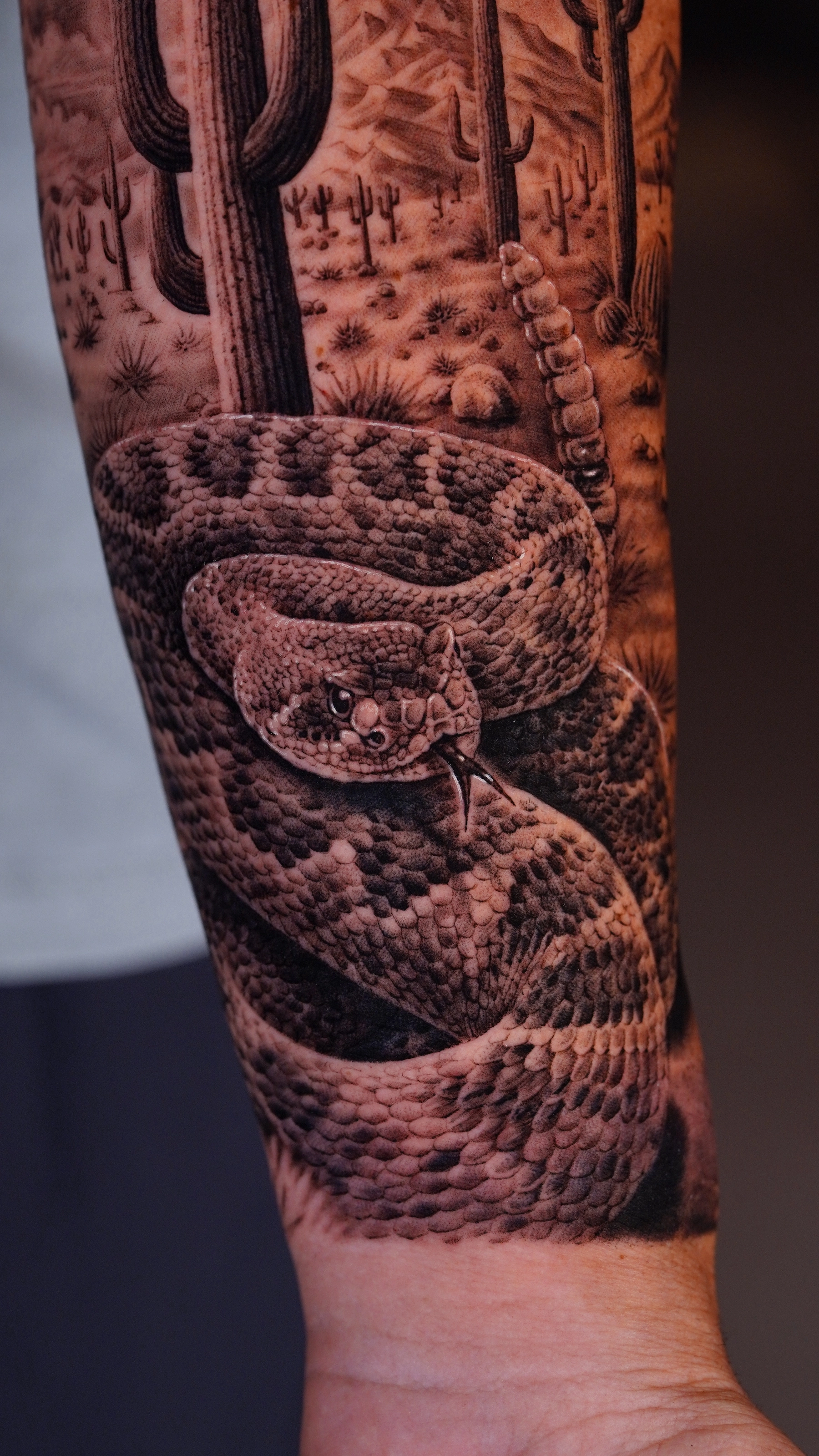
A realism tattoo is a style of tattooing that recreates real-life subjects—people, animals, architecture, sculptures, flowers, and landscapes—using carefully controlled light, shadow, texture, and tonal transitions to create the illusion of three-dimensional depth on skin.
Unlike traditional tattoo styles that rely on bold outlines and simplified shapes, realism depends on subtle value changes and visual perception. A successful realism tattoo should feel natural from every viewing distance, not simply look impressive in a freshly taken photograph.
Most importantly, the best realism tattoos are not exact copies of photographs. They are carefully interpreted artworks designed to age gracefully on living skin.
Key Insight
Professional realism is the art of deciding what to leave out—not how much detail to add.
Why This Guide Is Different
Most articles explain realism tattoos by saying they "look like photographs."
While technically true, that explanation barely scratches the surface.
A photograph exists on paper or on a screen.
A tattoo exists on human skin.
Skin stretches.
Skin heals.
Skin ages.
Skin reflects light differently depending on its texture, tone, hydration, and even the surrounding muscles.
These biological differences fundamentally change how a realism tattoo should be designed.
Throughout this guide, you'll learn how experienced artists think before a single drop of ink touches the skin. Rather than focusing on trends, we'll explore the artistic principles, technical decisions, and long-term considerations that separate an average realism tattoo from an exceptional one.
More Than Copying a Photograph
One of the biggest misconceptions about realism tattooing is that success depends on reproducing every visible detail.
In reality, experienced artists often achieve better results by doing the opposite.
The human brain doesn't recognize reality by analyzing every pore, eyelash, or wrinkle individually. Instead, it recognizes larger visual relationships—light, shadow, proportion, depth, and contrast.
This is why the most accomplished realism artists simplify reference images before they ever begin tattooing.
They remove visual distractions.
They strengthen the focal point.
They increase tonal separation.
They redesign lighting when necessary.
Every decision serves one purpose: making the tattoo look better after it heals, not just when it's freshly completed.
This approach is one reason professionally designed realism tattoos often continue looking strong years later, while tattoos copied directly from photographs may gradually lose clarity as the ink naturally settles within the skin.
If you're exploring different highly detailed tattoo styles, compare this approach with our Micro Realism Tattoo Guide (/tattoo-styles/micro-realism-tattoo) and Hyper Realism Tattoo Guide (/tattoo-styles/hyper-realism-tattoo). Although they share similar artistic foundations, each style presents different technical challenges and ages differently over time.
Artist Insight
"Clients are often surprised when we intentionally remove details from a reference photo. The goal isn't to reproduce every pixel. The goal is to preserve the feeling of realism ten years from now. Sometimes removing information actually makes the tattoo feel more alive."
— Silver Ant Tattoo
Reality vs Human Perception
Artists do not create realism by copying reality.
They create realism by understanding how people see.
Human vision constantly simplifies information. Before recognizing tiny details, the brain first identifies overall shapes, contrast, proportions, and lighting direction.
This explains why portrait tattoos are among the most technically demanding forms of tattooing.
A viewer may never consciously notice a one-millimetre difference in eye placement, but the brain immediately recognises when something feels "off."
For realism artists, anatomy matters because perception matters.
Every highlight, shadow, and transition must support the illusion that the subject has genuine volume rather than existing as ink on a flat surface.
If you're considering a portrait project, our Portrait Tattoo Guide (/tattoo-styles/portrait-tattoo) explains how anatomy, facial structure, and lighting influence successful portrait tattoos far more than simply selecting a high-resolution reference photograph.
Scientific Note
Studies in visual neuroscience show that humans process overall facial structure and contrast before fine detail. This is one reason portrait tattoos demand exceptional precision, even when viewed from a distance.
Further Reading
-
National Eye Institute: https://www.nei.nih.gov
-
National Library of Medicine (PubMed): https://pubmed.ncbi.nlm.nih.gov
Common Misconception
"The best realism tattoo is the one that looks exactly like the photo."
Not necessarily.
Photographs are created for cameras.
Tattoos are created for living skin.
An experienced realism artist redesigns the reference image to account for healing, body movement, skin texture, and long-term readability. What appears to be a small artistic adjustment on day one often becomes the difference between a tattoo that remains clear for years and one that gradually becomes visually flat.
Understanding how tattoos evolve over time is just as important as choosing the right design. Before your appointment, we recommend reading our Tattoo Healing Guide (/tattoo-guides/tattoo-healing) and Tattoo Aftercare Guide (/tattoo-guides/tattoo-aftercare) to understand how healing influences the final result.
End of Part 1 — Continue in Chapter 1, Part 2