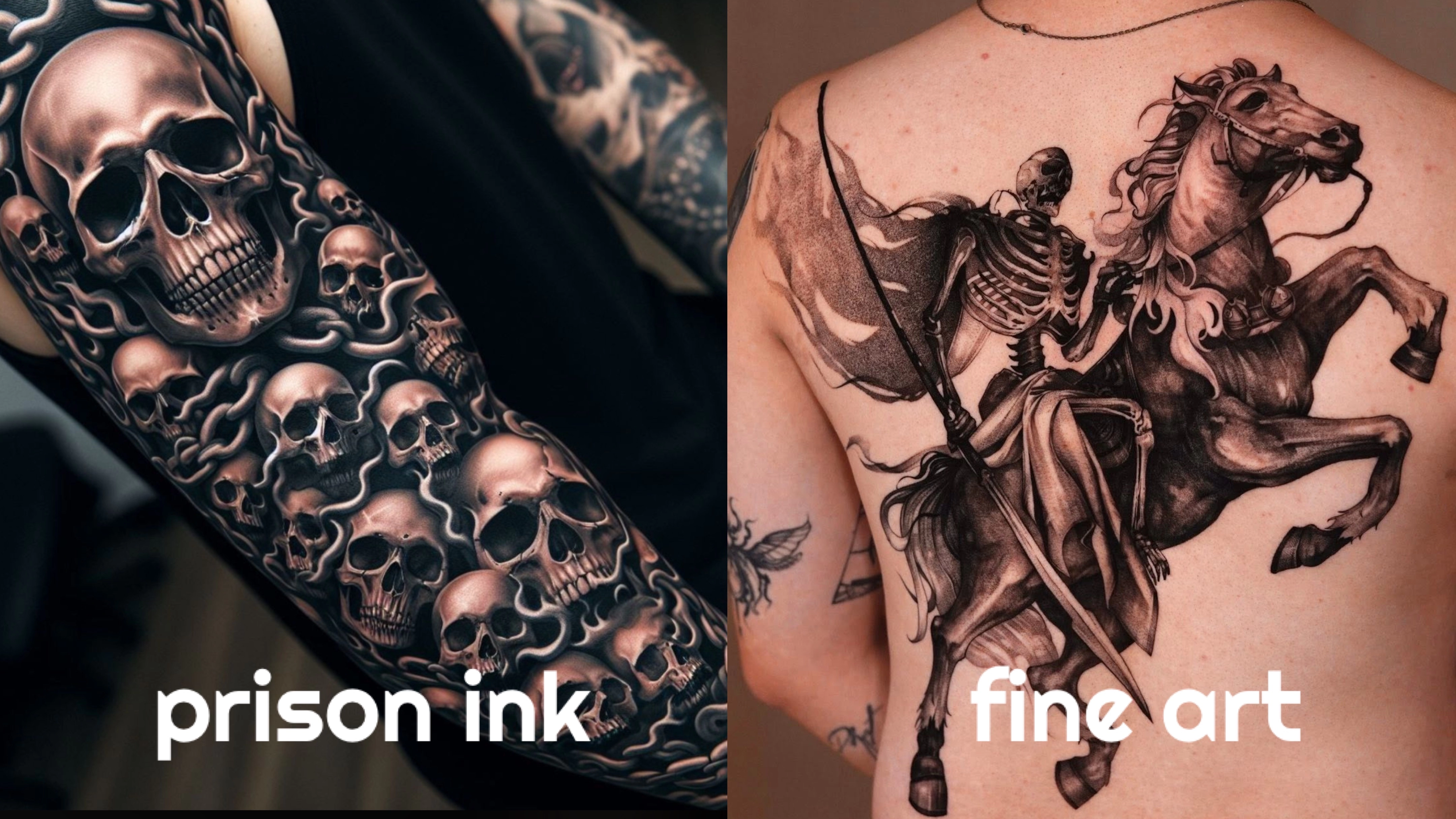
Black & Grey Realism Tattoo: The Complete Guide (2026) - Chapter 2 — The History of Black & Grey Tattooing - From Prison Ink to Fine Art



Black & Grey Realism Tattoos
Chapter 2
The History of Black & Grey Tattooing
From Prison Ink to Fine Art
Quick Answer
Black & Grey tattooing began as a practical solution rather than an artistic movement. Using homemade black ink and limited equipment, early tattooists developed techniques based entirely on value, contrast, and shading. Over time, those techniques evolved into one of the most respected and technically sophisticated styles in modern tattooing.
Today, Black & Grey Realism is recognised as a fine art form that combines classical drawing principles with advanced tattoo craftsmanship.
A Style Born from Limitation
Many great artistic movements began with limitations rather than unlimited creative freedom.
Black & Grey tattooing is one of them.
In environments where coloured pigments were unavailable, tattooists learned to create images using only black ink and varying levels of dilution.
Instead of relying on colour relationships, they depended entirely on:
-
light and shadow;
-
tonal transitions;
-
composition;
-
negative space.
What started as necessity eventually became a distinctive artistic language.
Even after colour inks became widely available, many artists deliberately continued working in black and grey because of the style's dramatic atmosphere and timeless aesthetic.
Artist Insight
"Black & Grey wasn't created because artists rejected colour. It was created because they learned how powerful light and shadow could be on their own."
— Silver Ant Tattoo
The Influence of Chicano Tattoo Culture
One of the most influential chapters in the history of Black & Grey tattooing emerged from Chicano communities in Southern California during the second half of the twentieth century.
Artists developed a highly recognisable visual language characterised by:
-
smooth grey shading;
-
elegant lettering;
-
religious symbolism;
-
portraits;
-
roses;
-
angels;
-
cultural identity.
These tattoos often carried deeply personal meanings, representing family, faith, resilience, and heritage.
While the subject matter has evolved over time, many of the technical foundations developed during this period continue to influence Black & Grey artists around the world.
From Illustration to Realism
As tattoo equipment improved and artists gained access to better needles, machines, and inks, expectations also changed.
Collectors no longer wanted only symbolic imagery.
They wanted tattoos that looked convincingly real.
Portraits became more expressive.
Animals appeared more lifelike.
Stone sculptures seemed carved directly into the skin.
This transition required artists to study disciplines far beyond tattooing.
Many turned to:
-
classical drawing;
-
anatomy;
-
photography;
-
sculpture;
-
Renaissance painting;
-
cinematic lighting.
The modern realism artist became not only a tattooist but also an observer of light, texture, and human perception.
Scientific Note
The illusion of realism relies on visual processing mechanisms within the human brain. Accurate tonal relationships help the visual system interpret flat surfaces as three-dimensional forms, making value structure more important than decorative detail.
Further Reading
-
National Eye Institute
-
National Library of Medicine (PubMed)
The Rise of Large-Scale Black & Grey Projects
For many years, Black & Grey tattoos were commonly small or medium-sized.
As tattooing techniques advanced, artists began designing increasingly ambitious compositions.
Full sleeves.
Back pieces.
Chest panels.
Leg sleeves.
Instead of treating each tattoo as an isolated image, artists started viewing the human body as a continuous canvas.
This shift changed the design process completely.
Composition became just as important as technical execution.
Artists carefully planned:
-
visual flow;
-
focal points;
-
transitions between subjects;
-
body movement;
-
long-term expansion.
Modern Black & Grey realism is as much about storytelling as it is about technical precision.
Why Classical Art Still Matters
Many of today's realism tattoo artists continue studying painters such as Leonardo da Vinci, Caravaggio, and Rembrandt—not to imitate their paintings, but to understand how they manipulated light.
Caravaggio's dramatic chiaroscuro.
Rembrandt's subtle transitions.
Leonardo's observation of anatomy.
These artistic principles remain surprisingly relevant on skin.
Although the tools have changed, the underlying challenge is identical:
How can a flat surface create the convincing illusion of depth?
The answer today is much the same as it was centuries ago:
Through thoughtful control of value, contrast, and composition.
Did You Know?
Some professional tattoo artists spend as much time studying photography, sculpture, and traditional drawing as they do practising tattoo techniques.
Understanding how light behaves in the real world often improves realism more than simply learning new machine techniques.
Black & Grey in Modern Tattooing
Today, Black & Grey Realism is one of the most internationally recognised tattoo styles.
It appears across a wide variety of subjects, including:
-
portraits;
-
wildlife;
-
mythology;
-
architecture;
-
religious imagery;
-
cinematic scenes;
-
surreal compositions.
Despite advances in pigments and equipment, the core philosophy has remained remarkably consistent.
Strong realism begins with strong values.
Technology can improve efficiency.
It cannot replace artistic understanding.
Common Misconception
"Black & Grey is an old-fashioned style."
Quite the opposite.
While its roots stretch back decades, modern Black & Grey Realism continues to evolve through digital design, improved tattoo equipment, advanced shading techniques, and ongoing artistic research.
Its popularity today reflects its versatility—not nostalgia.
Key Takeaways
-
Black & Grey tattooing developed from practical limitations rather than artistic trends.
-
Chicano tattoo culture played a major role in shaping the modern style.
-
Advances in tattoo technology expanded Black & Grey into highly detailed realism.
-
Classical drawing and Renaissance art continue to influence contemporary tattoo artists.
-
Modern Black & Grey Realism combines historical foundations with cutting-edge craftsmanship.
Continue Exploring
To understand how these historical principles influence modern tattoos, continue with:
-
Chapter 3 — The Science of Light and Shadow
-
The Ultimate Guide to Realism Tattoos
-
Tattoo Design Process
-
The Science of Contrast
References & Further Reading
Art History
-
The Metropolitan Museum of Art
-
Getty Museum
Vision & Perception
-
National Eye Institute
-
National Library of Medicine (PubMed)
Next Chapter
Chapter 3 — The Science of Light and Shadow: Why Black & Grey Creates Depth Without Color