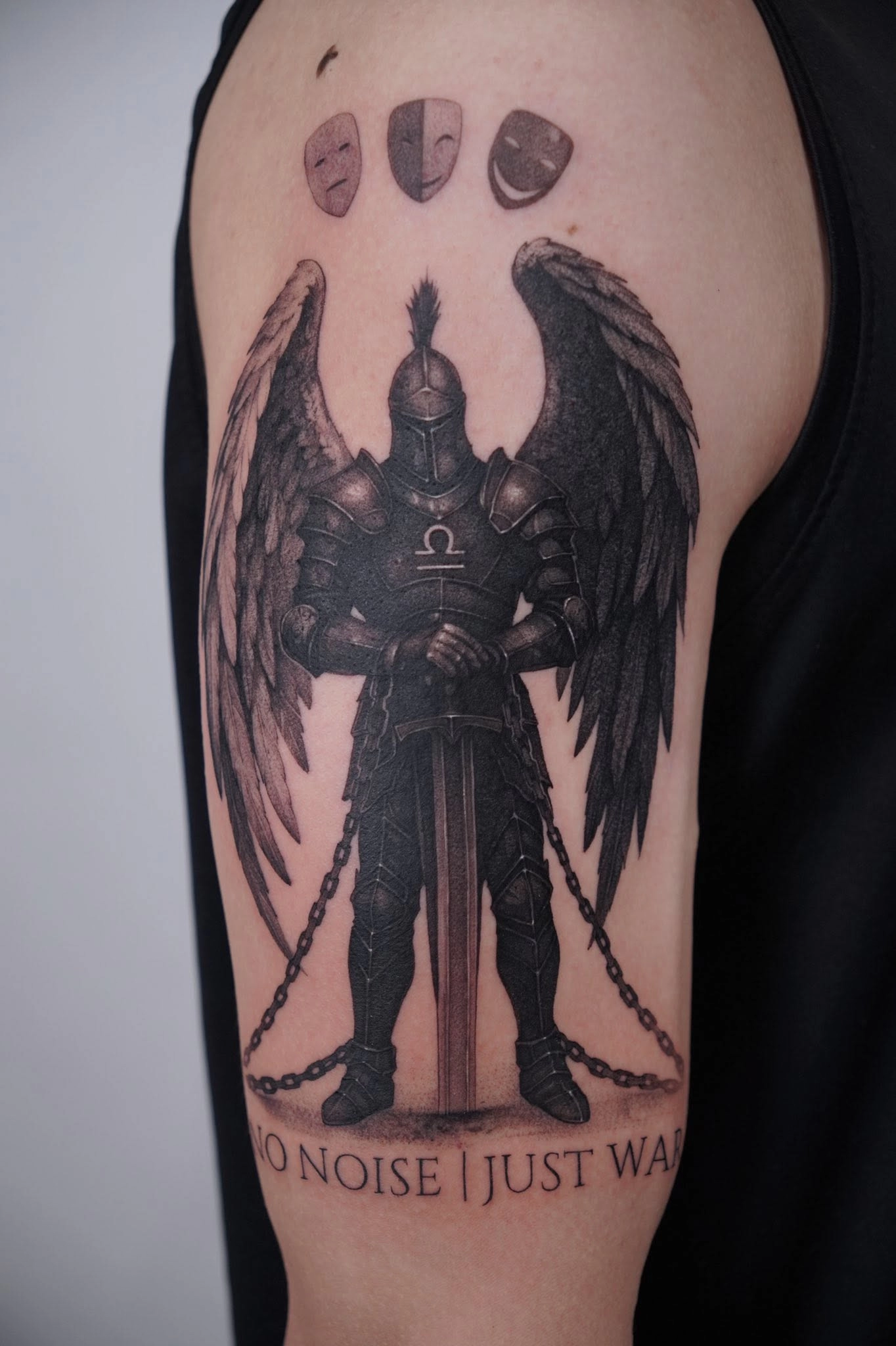
Black & Grey Realism Tattoo: The Complete Guide (2026) - Chapter 1 — What Is a Black & Grey Realism Tattoo?



Black & Grey Realism Tattoo
The Complete Guide (2026)
Estimated Reading Time: 15 minutes
Quick Answer
A Black & Grey Realism tattoo uses only black ink, diluted black ("grey wash"), and the natural tone of your skin to create lifelike images with depth, contrast, and texture. Rather than relying on colour, this style recreates the way light interacts with real-world subjects, making it one of the most timeless and technically demanding forms of tattooing.
When designed well, Black & Grey Realism ages exceptionally gracefully because its visual impact is built on value and contrast instead of colour saturation.
What Is a Black & Grey Realism Tattoo?
Black & Grey Realism is a tattoo style that recreates real-life subjects using only monochromatic tones.
Instead of colourful pigments, artists create an entire visual spectrum—from deep blacks to soft mid-tones and delicate highlights—by carefully controlling ink dilution, needle technique, and negative space.
The result is an image that feels almost photographic while retaining the artistic character of hand-crafted tattooing.
Although many people associate Black & Grey with portraits, the style extends far beyond faces.
Today it is widely used for:
-
portraits;
-
wildlife;
-
sculptures;
-
architecture;
-
religious imagery;
-
mythology;
-
cinematic scenes;
-
historical figures.
The absence of colour does not limit realism.
In many cases, it strengthens it.
Artist Insight
"Without colour to attract attention, every decision about light, shadow, and composition becomes even more important. Black & Grey exposes both the strengths and weaknesses of an artist."
— Silver Ant Tattoo
Why Black & Grey Feels So Real
The human brain recognises shape before colour.
When we look at a person's face, we first notice:
-
light;
-
shadow;
-
proportion;
-
depth.
Colour comes later.
This explains why classic black-and-white photography remains emotionally powerful despite the absence of colour.
Black & Grey Realism applies the same visual principles.
By prioritising value relationships over pigmentation, the tattoo creates convincing three-dimensional form that remains readable from both near and far.
This emphasis on contrast is one reason many collectors describe Black & Grey as "timeless."
Scientific Note
Research in visual perception shows that luminance contrast plays a fundamental role in object recognition. Our visual system processes differences in light intensity before interpreting many colour relationships, making tonal structure essential for perceived depth.
Further Reading
-
National Eye Institute
-
National Library of Medicine (PubMed)
More Than "No Colour"
A common misconception is that Black & Grey simply means removing colour from an image.
In reality, professional artists often redesign the entire composition.
A flower designed for colour realism may require stronger lighting.
A wildlife portrait may need simplified textures.
Background elements may be reduced to preserve separation between the focal subject and surrounding areas.
Because colour can no longer distinguish one object from another, contrast must do all the work.
That demands thoughtful planning from the very beginning.
Why Collectors Choose Black & Grey
Every collector has different reasons, but several themes appear repeatedly.
Many appreciate the understated elegance of monochrome artwork.
Others enjoy the cinematic atmosphere created by dramatic lighting.
Some simply prefer tattoos that integrate naturally with future sleeves and larger compositions.
For memorial portraits, religious imagery, and classical sculptures, Black & Grey often enhances emotional impact by directing attention toward expression, texture, and form rather than colour.
This versatility explains why the style has remained consistently popular across generations rather than following short-lived trends.
Common Misconception
"Black & Grey is easier because there are fewer colours."
In practice, many artists consider the opposite to be true.
Without colour to separate different elements, every illusion of depth must be created through careful control of value, edge quality, and composition.
Mistakes are often more noticeable because there is nothing to hide behind.
Key Takeaways
-
Black & Grey Realism creates lifelike tattoos using tonal values rather than colour.
-
Contrast, lighting, and composition are the foundations of the style.
-
The style works exceptionally well for portraits, wildlife, sculpture, and dramatic imagery.
-
Long-term success depends on thoughtful design—not simply using black ink.
-
A strong Black & Grey tattoo is judged by how it heals, not how it looks on the day it is finished.
Continue Exploring
To better understand the principles behind this style, continue with:
-
The Ultimate Guide to Realism Tattoos
-
The Science of Contrast
-
Designing a Realism Tattoo
-
Tattoo Healing Guide
Next Chapter
Chapter 2 — The History of Black & Grey Tattooing: From Prison Ink to Fine Art